Weather products and blending
Of the weather changes tested, only training on estimates of past weather (ERA5) clearly lowered the error in a test without power lags, for 6 solar farms and 3 wind farms up to 6 days ahead, and no extra weather forecast has yet been shown to help in a way a live service could use.
A weather product is a source of weather data, such as the European Centre for Medium-Range Weather Forecasts (ECMWF) ensemble (ENS), the Met Office's UKV (a 2 km forecast of the UK), the US ensemble GEFS, or ICON-EU (the German weather service's regional forecast). The experiments trained XGBoost models on one product's history, then added a second product as extra input columns or as a blend. They scored 6 solar farms, 3 wind farms, and 16 Primary substations, each over one validation year. For Primary demand, even weather as accurate as ERA5 lowered the score by only 0.10 points.
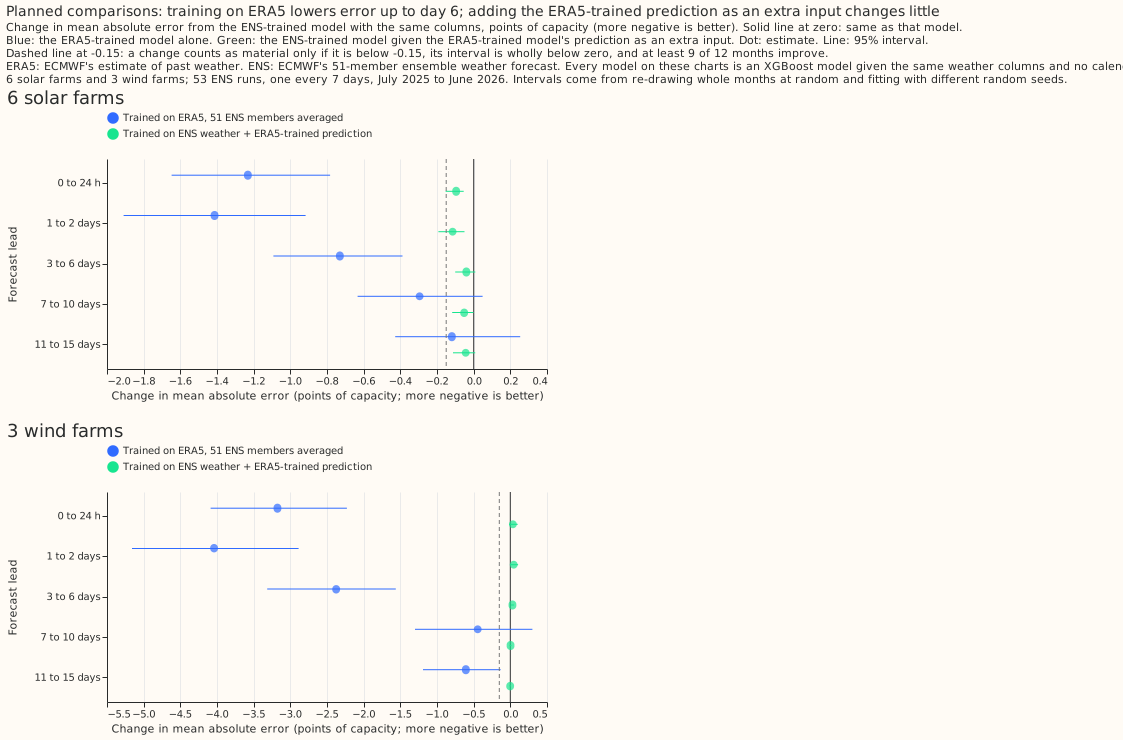
Training on ERA5 lowered the mean absolute error of the ensemble-mean forecast at 6 solar farms and 3 wind farms up to day 6, and not beyond. Source: experiment 1. Lower is better.
Does it work?
Training on ERA5 lowered the solar and wind farm error up to day 6. Over all leads, the ERA5-trained XGBoost model scored 15.39 against 17.09 for wind (-1.70, 95% interval -2.33 to -1.08) and 7.67 against 8.25 for solar (-0.57, -0.83 to -0.32), in points of capacity, with no calendar or lag columns (experiment 1). The contrasts were revised after two reviews, so they are not pre-registered. A later test used the quantile score and power lags at 24 to 54 hours. It found the ENS-trained model 0.218 points lower than the ERA5-trained best guess for wind (-0.472 to +0.069) and 0.107 lower for solar (-0.327 to +0.053). Both differences are unresolved (experiment 54, experiment 57).
For demand series it did not carry over. On 22 series that are not wind or solar farms, 16 of them Primaries, the ERA5-trained model scored 1.37 points worse (+0.68 to +2.17) with weather columns only. Starting the ERA5 history in 2023-09 instead of 2019-09 lowered the error by 1.32 (-1.81 to -0.90), a post hoc read that does not separate drift in the series from bad early data (experiment 3).
Weather as accurate as ERA5 gave a small gain for Primary demand, measured only for a model trained on ENS. Swapping ENS for ERA5 weather in the stack of experiment 19 (a half-life of 0.5 years) lowered the quantile score by 0.10 (99.38% interval -0.16 to -0.04) at 16 Primaries over 73 runs. Shortwave radiation alone gave -0.084, and inside 2 days there was no gain (experiment 22). Training on CAMS sunshine instead of ERA5 shortwave gave -0.035 (97.5% interval -0.070 to +0.001), against a planned 0.2 (experiment 9). Mapping the ENS shortwave onto CAMS first (stage 0) gave a further -0.067 (97.5% interval -0.094 to -0.039). The CAMS-trained arm with stage 0 scored 0.102 below the ERA5-trained arm. The verdict stays inconclusive because the monthly mismatch to CAMS reached 18.6% (experiment 14).
A second global ensemble, GEFS, did not improve the sunshine anomaly. The anomaly is a forecast's sunshine minus its own monthly mean, scored against the CAMS anomaly at 5 Primaries on daylight rows from April to September. Cross-validated squared error was 1.109 times ENS's for GEFS (worse in all 9 held-out months) and 1.002 times for a fitted blend, against the 0.99 needed (refuted, experiment 50).
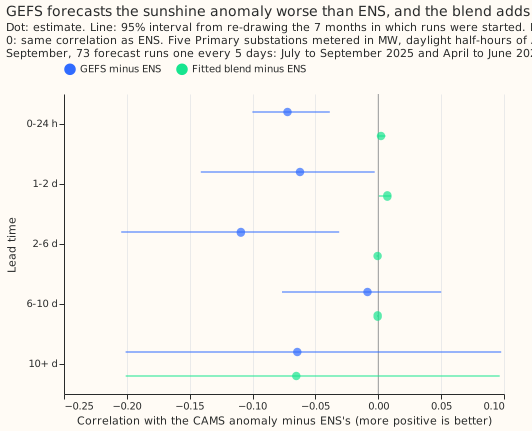
GEFS correlated worse with the CAMS anomaly than ENS did, and the blend matched ENS. Source: experiment 50.
A UKV and ENS blend lowered the squared error of the same anomaly by 7.6% over 0 to 54 hours in cross-validation, and the validation year cannot confirm it. The validation correlation gain was +0.011 (-0.006 to +0.027), and the blend beat ENS in 3 of the 6 months of forecast origin that the intervals resample. The test was post hoc. Six or 7 origin months understate the uncertainty (experiment 53).
UKV wind lowered the wind-farm quantile score by about 0.2 points at 24 to 54 hours, a small gain that is an upper limit. An ENS-trained XGBoost model given UKV wind as extra columns, trained on UKV's own history, scored -0.198 (-0.316 to -0.069) at 3 wind farms. The interval's end nearest zero does not reach the pre-registered 0.15, and a shuffled-UKV placebo scored +0.013 (-0.012 to +0.040). One farm gained clearly (-0.413) and one did not (+0.018), post hoc. The UKV data come from the CEDA archive, which differs statistically from the live feed (experiment 54; UKV-CEDA study).
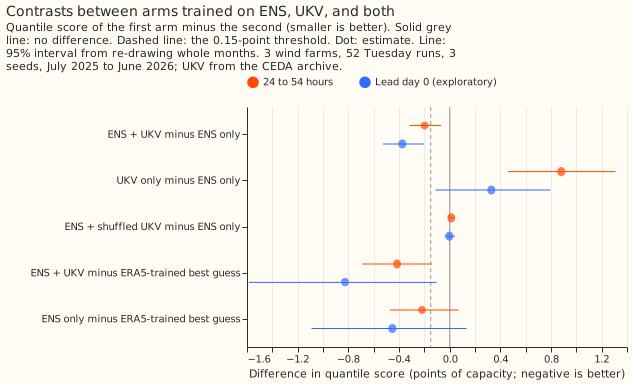
Giving UKV wind to an ENS-trained model lowered the wind-farm score, and the shuffled-UKV placebo did not. Source: experiment 54.
The same test with UKV shortwave, cloud, and temperature at 6 solar farms was inconclusive. The score changed by -0.035 (-0.119 to +0.037), so a gain of 0.10 can be neither shown nor ruled out (experiment 57). Averaging the wind best guess with ICON-EU and the ECMWF high-resolution forecast (IFS) gave -0.055 (-0.200 to +0.072) at days 1 and 2, also inconclusive, and the products' runs were half a day older than ENS (experiment 52).
Best design so far
The best recipe tested here depends on the target, and none beat the reference by a resolved margin. For farms the reference is the best guess, as the generator-forecasting Summary explains.
- Solar and wind farms, up to day 6: train the weather-to-power model on ERA5 and apply it to each of the 51 ENS members (experiment 1). This was measured without power lags, and experiments 54 and 57 found the ENS-trained model within an unresolved margin at 24 to 54 hours. For solar, CAMS sunshine as the training input scored -0.140 (99.5% interval -0.277 to -0.044), short of the planned -0.15 and inconclusive (experiment 12).
- Wind farms, 24 to 54 hours: add UKV wind as columns to an ENS-trained model, trained on UKV's history (experiment 54). This is an upper limit, measured on the CEDA research archive.
- Primary substations: keep the model trained on ENS. If training on estimates of past weather, start in 2023-09 (experiment 3) and map the ENS shortwave onto CAMS (experiment 14).
Candidates for production
Two experiments are marked candidate, and neither is ready to port as it stands.
- ERA5-trained weather-to-power model for solar and wind farms (experiment 1). Production would train on ERA5 and CAMS history and serve ENS members, which needs the staged design. The caveat under "Best design so far" about power lags applies.
- Stage 0 mapping of ENS shortwave onto CAMS for Primaries (experiment 14). Production would fit the mapping on 14 or more months of ENS and CAMS pairs. The mapping left monthly mismatches, widened the member spread by 27%, and needs a CAMS-trained model.
No second weather product (GEFS, UKV, ICON-EU, IFS) is ready. Experiments 50, 52, 53, 54, and
57 are not-for-production.
Gotchas and implementation details
- Train each product on its own history. The arms are ENS-trained, ENS plus the other product as columns, and the other product alone; an ERA5-trained model is only a reference. A model trained on ENS and fed ERA5 weather understates what ERA5 training would give (experiment 22). The ERA5-trained wind model fed uncorrected ICON-EU winds alone scored 2.5 points worse than the best guess, and IFS winds 1.3 points worse, at days 1 and 2 (experiment 52). Re-check when the model, the product, or the bias correction changes.
- "Better weather adds little" was measured only for a model trained on ENS. Experiment 22 trained on the ENS control member, and ERA5 differs from ENS in bias (mean shortwave 132.6 against 139.1 W/m2). Experiment 9's CAMS-trained arm gained 0.88 daylight points at observed weather and 0.04 over all leads with ENS input (experiment 9). Look for a Primary demand model trained on ERA5 and scored on experiment 22's stack.
- Pass a shuffled-product placebo through every step. In experiment 54 the placebo showed that extra columns alone do nothing. In experiment 52 it scored +0.343 because July's equal weights and the spread factor, not the shuffled forecasts, drove the score, so fit the spread factor on blends made under the same weights (experiment 54, experiment 52). Re-check if the blend weights or the spread factor are fitted a different way.
- Use the live feed, and check its variables on a recent run. The CEDA UKV archive has no 100 m wind and lacks four hourly steps, UKV was upgraded on 2026-01-21, and Open-Meteo's UKV history stops at lead day 0 (experiment 54, experiment 57). Feeds gain fields over time, so an old date gives a wrong answer. Re-check when a live UKV history exists.
- Feed the run the service would have. Experiment 52 fed runs half a day older than ENS, and experiment 53 assumed a 3-hour UKV delivery time without measuring it (experiment 53). Look for a measured delivery time before reading a blend's gain. Re-check once the live delivery time is known.
- Give a guard arm the variant it guards. A guard arm is a control built to catch one artefact; in experiment 3 it was the ENS-trained arm with one row per valid time. The ENS training frame repeats each valid time about 15 times, so calendar columns let an ENS-trained model memorise the calendar position, and a one-row-per-valid-time guard arm with lags failed by construction (experiment 1, experiment 3). Re-check when the input columns or the training rows change.
- Calibrate each source's anomaly, and cross-validate by whole months. GEFS's raw anomaly was about 15% too large, and the interval width follows the number of origin months (experiment 50, experiment 53). Re-check with a longer validation period, which gives more origin months.
- Check the hour-of-day peak of every source. CAMS and ENS are means labelled at the period end and UKV is instantaneous, so a mislabelled UKV control peaked at 10 UTC instead of 12 UTC (experiment 53). Re-check for any new product whose shortwave is instantaneous.
- Take the planned threshold from a contrast between like arms. Experiment 9 planned 0.2 and resolved 0.035 (experiment 9). Report a pooled share with and without the largest series: a fixed CAMS correction removed 46.6% of the daylight squared residual, one substation set the pooled figure, and a fixed bias alone removed 39.1% (experiment 7, inconclusive). Re-check whenever a pooled share is quoted.
What we have not settled
Whether a live UKV history gives the wind-farm gain, whether ICON-EU and IFS help when read at the service's own time, and whether a source of a different kind helps solar farms. Experiment 50 tested GEFS against the CAMS solar anomaly at 5 Primaries only. The open proposals are in the research plan.