Experiment 54: does UKV, learned from its own history, help the wind-farm forecast?
Giving the Met Office's UKV wind forecast to a wind-farm forecast that already uses the European
Centre's ensemble (ENS) lowered the error by about 0.2 points of the farms' capacity at 1 to 2
days ahead, a small but real gain, so the verdict is small gain. The error is the quantile
score, a measure of how well a forecast's range of likely power fits what happened, and 1 point is
1% of a farm's capacity. The 95% interval is 0.07 to 0.32 points, so the 0.15-point gain we
decided in advance would justify a new weather feed lies inside it. UKV, the Met Office's 2 km
weather forecast, adds information and does not replace ENS: UKV alone scores 0.88 points worse
than ENS alone. The UKV data come from a research archive (CEDA), not the live feed, so even this
is an upper limit on what a service could get. We tested it by training XGBoost models, each on
its own forecast history, for three metered wind farms, with the same training window and
settings, at 24 to 54 hours after the ENS run's 00 UTC start (UKV's forecasts stop at 54 hours).
The next step is to find or build a live UKV history for the farms, or to test UKV at lead day 0,
the first 24 hours, where a live history exists.
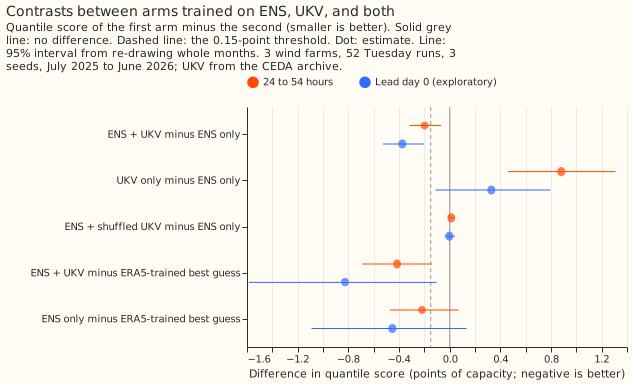
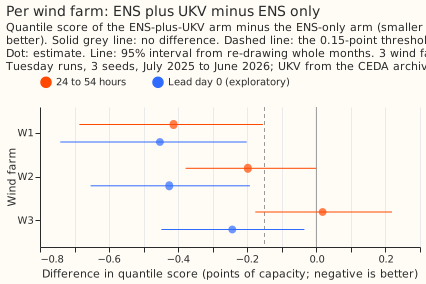
UKV helps as an addition to ENS, and the gain is not an artefact of extra columns. The placebo (the UKV values shuffled among similar rows) differs from ENS alone by no more than 0.04 points (+0.013, -0.012 to +0.040). At W1 the gain is clear (-0.413), at W2 it probably exists (-0.198, with the end of its interval nearest zero at -0.000), and at W3 there is none (+0.018). The 95% interval excludes a gain larger than 0.32 points at these three farms. The ENS-only model scored 0.218 points better than experiment 33's ERA5-trained best guess at these leads, but the interval (-0.472 to +0.069) includes zero, so that comparison is unresolved.
Results
The primary contrast C1 is the ENS-plus-UKV arm minus the ENS-only arm, for cases 24 to 54 hours after the 00 UTC start of the ENS run's date. UKV's leads stop at 54 hours, so these cases are lead day 1 and the first 6 hours of lead day 2. C1 is -0.198 (95% interval -0.316 to -0.069; 28,230 cases, three farms, three seeds, whole months re-drawn), and the pre-registered threshold was -0.15 for the end of the interval nearest zero (-0.069 here). The CEDA archive is not the live product: its licence is non-commercial (from the archive's catalogue) and the UKV-CEDA blends study found it statistically different from the live feed. The page therefore reports the result as a ceiling: a gain a matched UKV might add, not one a service could now deliver. The prediction was -0.2 to -0.5, and -0.198 is at the weak end of that range.
Absolute scores
Arm B scores best at 24 to 54 hours (5.921), and arm C, UKV alone, scores worst (7.000). The quantile score is twice the mean pinball loss over nine quantile levels, in points of capacity (smaller is better). Coverage is the share of cases inside the 5% to 95% band (nominally 0.90), and the 0.95 column is the share above the 0.95 quantile. Arm A is the ENS-only XGBoost model, B adds UKV, C is UKV alone, and the placebo is B with the UKV values shuffled. The reference rows are experiment 33's ERA5-trained best guess and its ENS-trained model on the same cases, which are the 52 Tuesday runs that have a complete UKV run.
| Arm | Lead day 0 (0 to 24 h) | 24 to 54 h | All cases | Coverage, 24 to 54 h | Above 0.95, 24 to 54 h |
|---|---|---|---|---|---|
| A, ENS only | 6.337 | 6.119 | 6.189 | 0.924 | 0.031 |
| B, ENS plus UKV | 5.963 | 5.921 | 5.935 | 0.900 | 0.042 |
| C, UKV only | 6.666 | 7.000 | 6.892 | 0.858 | 0.062 |
| Placebo | 6.334 | 6.133 | 6.198 | 0.925 | 0.030 |
| Reference, ERA5-trained best guess | 6.789 | 6.337 | 6.483 | 0.915 | 0.050 |
| Reference, ENS-trained (experiment 33) | 6.312 | 6.137 | 6.193 | 0.947 | 0.019 |
At 24 to 54 hours, arm B's band is slightly narrower than arm A's (coverage 0.900 against 0.924, and 0.042 above the 0.95 quantile against 0.031). The experiment did not test why. Per farm at 24 to 54 hours, the scores are A 5.871, 6.382, 6.109 and B 5.458, 6.184, 6.127 at W1, W2, and W3.
What else the numbers show
All reads in this section are exploratory.
- W1 gains clearly, W2 probably gains, and W3 shows no gain. B minus A at 24 to 54 hours is -0.413 (-0.686 to -0.155) at W1, -0.198 (-0.378 to -0.000, the upper end rounds to zero) at W2, and +0.018 (-0.177 to +0.219) at W3.
- The gain holds across the UKV upgrade and without July. B minus A is -0.189 (-0.342 to -0.025) before UKV's upgrade of 2026-01-21, -0.210 (-0.387 to -0.006) after it, and -0.180 (-0.309 to -0.045) without July 2025.
- The point estimate is larger at lead day 0. B minus A at 0 to 24 hours is -0.374 (-0.526 to -0.203), and over all cases it is -0.255 (-0.348 to -0.145). The experiment did not test whether lead day 0 differs from 24 to 54 hours, and lead day 0 lies outside the contrast.
- The placebo differs from arm A by no more than 0.04 points. The placebo minus A is +0.013 (-0.012 to +0.040) at 24 to 54 hours, and B minus the placebo is -0.211 (-0.334 to -0.076).
- At 24 to 54 hours, UKV alone is far worse than ENS alone. C minus A is +0.881 (+0.460 to +1.308) at 24 to 54 hours and +0.329 (-0.113 to +0.795) at lead day 0.
- ENS plus UKV beats the ERA5-trained best guess. B minus the best guess is -0.416 (-0.693 to -0.136) at 24 to 54 hours and -0.826 (-1.586 to -0.103) at lead day 0.
- The ENS-only model scores 0.218 better than the best guess, an unresolved difference. The difference is -0.218 (-0.472 to +0.069) at 24 to 54 hours, and the experiment 33 ENS-trained model minus A is +0.018 (-0.026 to +0.064). Experiment 1 had the ERA5-trained model ahead by 1.70 points; this contrast covers only the first 54 hours.
- UKV's wind speed is lower than ENS's. Over the scored cases, UKV's mean 10 m wind speed is 4.46 m/s against 5.00 m/s for the ENS control member.
How the experiment was run
- Arms: every arm is an XGBoost model with nine quantile levels, trained per farm and per seed
(0, 1, and 2) with experiment 33's recipe for its ENS-trained model: the ENS control member of the
daily 00 UTC runs from 2024-04-01 to 2025-06-30, recency weights with a half-life of 2 years,
lead_hours, and three lags of power from the 09:00 UTC origin. The three farms have 40,864, 40,876, and 40,846 training rows (W1, W2, W3), identical for every arm. Arm B runs once per ENS member with the UKV columns fixed, and the 51 member quantile sets are pooled. - UKV: the CEDA archive's 00 UTC run of the ENS run's date, at each farm's nearest 2 km cell (0.9 to 1.1 km away). The four columns are 10 m speed, the sine and cosine of the 10 m direction, and the speed at 925 hPa, because the archive holds no 100 m wind. The store lacks hourly steps 49, 50, 52, and 53, which are interpolated linearly, and a valid time at :30 averages the east-west and north-south components of the hours either side. All 455 of the 456 training runs and 52 of the 53 validation Tuesday runs have a complete UKV wind set at each farm; the run of 2026-06-30 is missing and its cases are dropped from every arm.
- Latency: the experiment assumes the 00 UTC UKV run is available within 8 hours of its start, from the Met Office's published schedule, and did not measure it. The service reads ENS at 09:00 UTC.
- No matched live history: Open-Meteo's UKV history at the farms holds only
previous_day1(lead day 0), starting on 2024-08-06 and covering 71% of the training window at one farm. - Departures from the plan: none.
- Code:
ml-experiments/00054-product-trained-xgboost-wind-farms/. One Sonnet plan review and one Sonnet code review found no leakage; the code review noted that the UKV run coverage is counted per run in the fit script, so a separate check script counts it per farm (455 and 52 at every farm) and finds no placebo group of one row.
What the next experiment should answer
Whether a live UKV feed gives the same gain. The Met Office's live UKV forecast is the product a service would receive, and the CEDA archive differs from it statistically. The next experiment could build a matched history of the live UKV for the three farms, which needs a source that holds live UKV at lead days 1 and 2 (Open-Meteo's history stops at lead day 0), and rerun arms A and B on it. A second option is a lead day 0 test on Open-Meteo's live UKV, where the CEDA arm already gains -0.374.