Does an ERA5-trained weather-to-power model beat the same model trained on ENS?
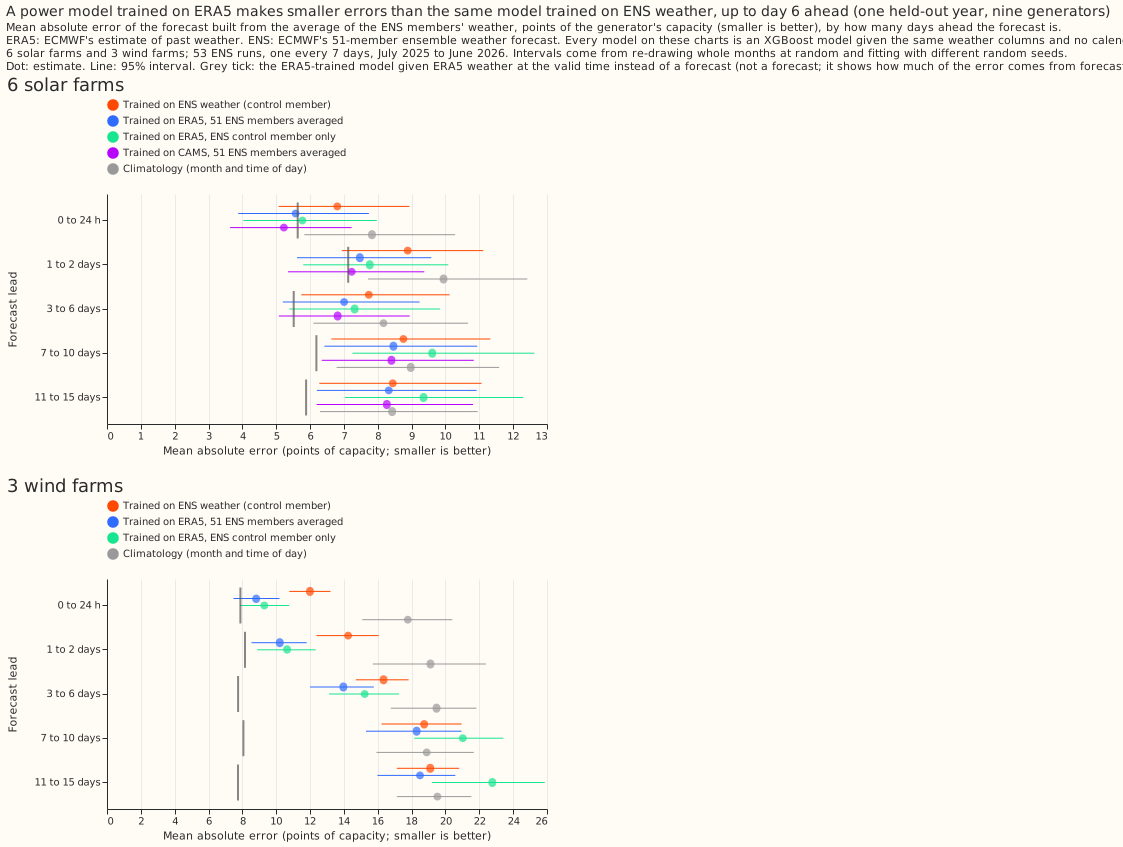
We asked whether a model that turns weather into solar or wind farm output works better when it is trained on estimates of past weather than when it is trained on archived weather forecasts. We trained one model each way for 6 solar farms and 3 wind farms, gave both the same 51 weather forecasts for the days ahead, and compared their errors over 53 weekly forecast runs in one held-out year. Training on estimates of past weather gave the smaller error for forecasts up to 6 days ahead, and the benefit was not shown beyond that.
Verdict: supported up to day 6, not supported beyond. Stage 1a (one XGBoost model per series,
trained on ERA5 (a reanalysis, an estimate of past weather) and CAMS (the Copernicus Atmosphere
Monitoring Service's satellite estimate of sunlight), no calendar and no power-history columns)
applied to the 51 members of ENS (the European Centre for Medium-Range Weather Forecasts' ensemble
forecast) and averaged has a smaller error than the same columns trained on ENS weather, for lead
bands up to 6 days, for 6 solar farms and 3 wind farms, in one held-out year (fold A, 53 weekly
runs). The planned contrasts were revised after two scientific reviews, so they are not
pre-registered. The full write-up is the study README in studies/stage1_pilot/README.md.
Input columns
Every arm except c0 gets the same columns, and none is a calendar column or a power lag. Solar
zenith and azimuth carry the time of day and the time of year.
- Solar farms (9 columns):
shortwave,longwave,temperature_2m,dew_point_temperature_2m,pressure_surface,precipitation,wind_speed_10m,solar_zenith,solar_azimuth. - Wind farms (6 columns):
wind_speed_10m,wind_speed_100m,wind_dir_sin_10m,wind_dir_cos_10m,wind_dir_sin_100m,wind_dir_cos_100m. The wind farms' ERA5 cells have no temperature or pressure on disk. ens_trained_plus_s1adds one column,stage1a_prediction.- The
*_calendararms (the first run) addhour_sin,hour_cos,doy_sin, anddoy_cos(solar 13 columns, wind 10). c0, the production control, has 24 columns:categorical_precipitation_type_surface,dew_point_temperature_2m,downward_short_wave_radiation_flux_surface,geopotential_height_500hpa,local_day_of_week,local_day_of_week_cos,local_day_of_week_sin,local_time_of_day_cos,local_time_of_day_sin,local_time_of_year_cos,local_time_of_year_sin,local_utc_offset_minutes,power_lag_24h,power_lag_48h,power_lag_168h,power_lag_336h,pressure_reduced_to_mean_sea_level,pressure_surface,temperature_2m,windchill,wind_direction_10m,wind_direction_100m,wind_speed_10m,wind_speed_100m.
Absolute scores, all leads
Mean absolute error, points of capacity, with 95% intervals that resample whole validation months.
| arm | solar | wind |
|---|---|---|
ens_trained (reference) |
8.25 (6.18 to 10.72) | 17.09 (15.32 to 18.67) |
s1_memberavg (ERA5-trained, 51 members averaged) |
7.67 (5.74 to 10.04) | 15.39 (13.26 to 17.21) |
climatology |
8.62 (6.49 to 11.14) | 19.16 (16.49 to 21.50) |
c0 (production control, 24 production columns) |
8.74 (6.51 to 11.37) | 19.08 (17.25 to 20.71) |
era5_ceiling (given ERA5 weather, not a forecast) |
5.98 (4.32 to 8.05) | 7.90 (7.14 to 8.70) |
Planned contrasts (revised)
- P1 (
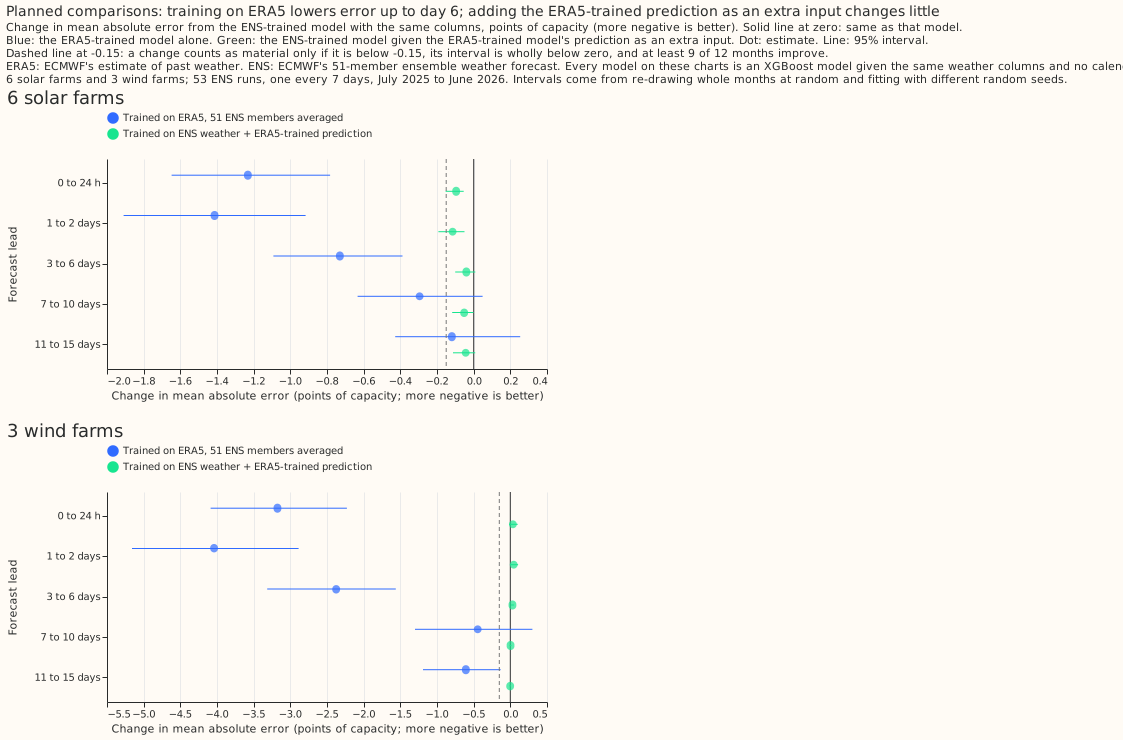
s1_memberavgminusens_trained) is material up to day 6 for both technologies. Wind -3.18, -4.04, and -2.37 points at 0 to 24 h, 1 to 2 days, and 3 to 6 days; solar -1.23, -1.41, and -0.73. At 7 to 10 and 11 to 15 days neither passes. - P2 (adding stage 1a's prediction as a column to
ens_trained) is not material anywhere. Solar -0.06 (-0.12 to -0.01), wind +0.02 (+0.01 to +0.03) over all leads. - Beyond day 6 stage 1a is within about 1 point of climatology.
What else the study found
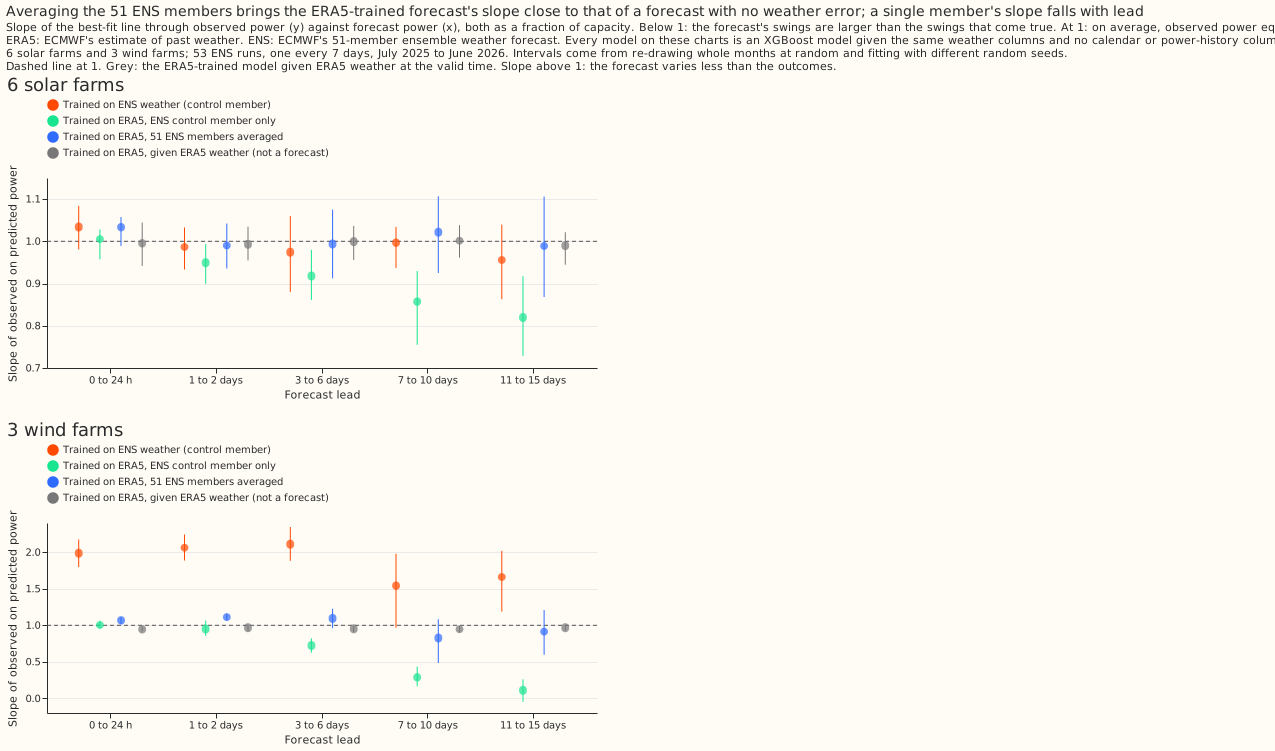
- Averaging the 51 members is associated with a much larger drop in error for the ERA5-trained model (-0.70 solar, -2.23 wind) than for the ENS-trained model (-0.15, -0.22). With the control member alone, ERA5 training is associated with lower error at 0 to 2 days and higher error at 7 to 15 days.
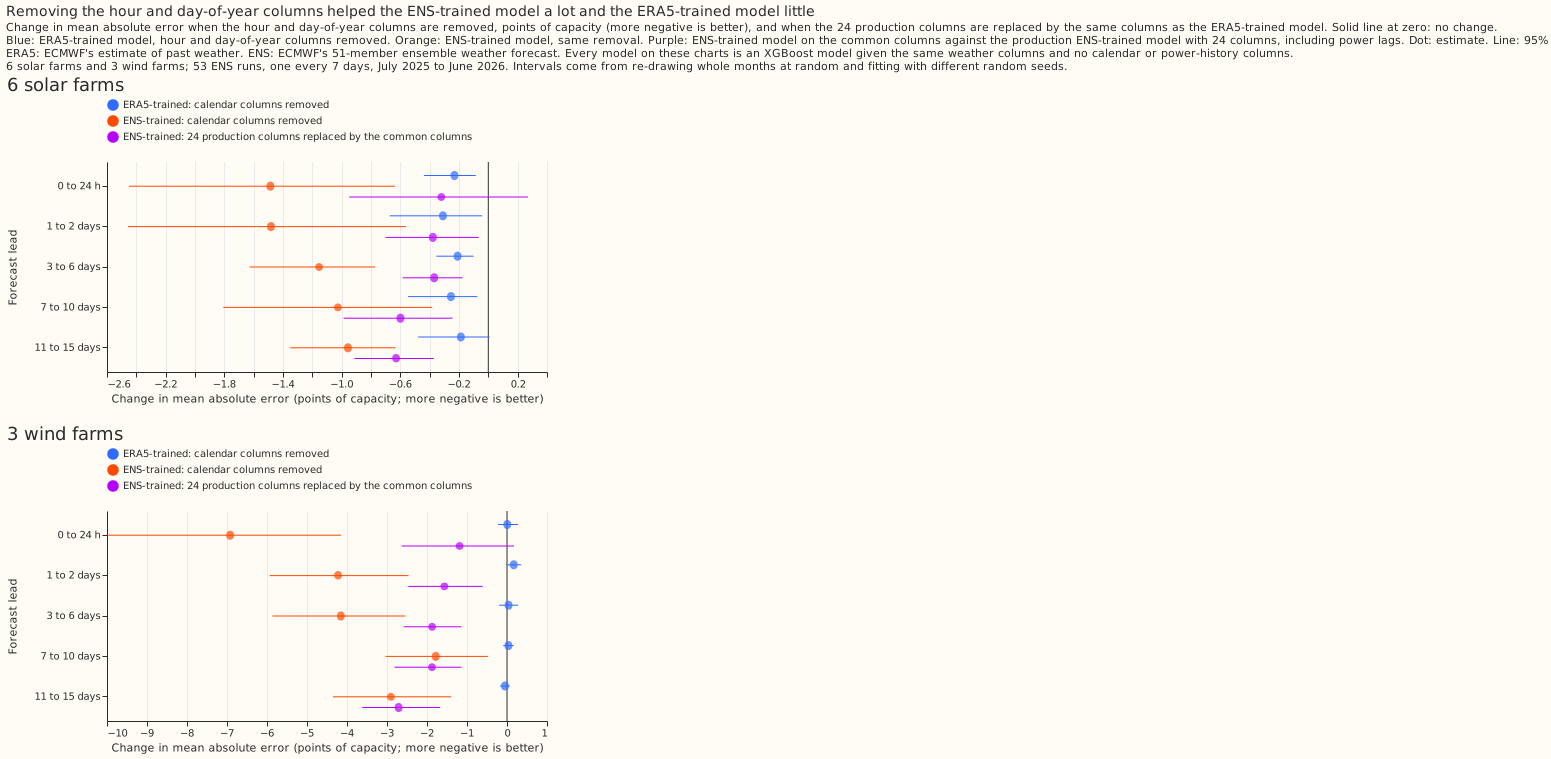
- Removing hour and day-of-year columns lowered the ENS-trained error by 1.13 (solar) and 3.40 (wind) points and the ERA5-trained error by 0.23 (solar) and 0 (wind). The first run's control, with 24 production columns, looked like it memorised calendar position.
Effect of the feature lists (post hoc)
Removing the hour and day-of-year columns helped the ENS-trained model a lot and the ERA5-trained
model little. The first run gave every arm those four calendar columns, and the production
control also had 24 production columns including power lags. The table gives each change in mean
absolute error over all leads, in points of capacity, with 95% month-resampled intervals. Every
row is post hoc. The first run's arms are the *_calendar arms, scored on the same cases.
| change | solar | wind |
|---|---|---|
| ERA5-trained, calendar columns removed (F1) | -0.23 (-0.47 to -0.08) | +0.03 (-0.08 to +0.15) |
| ENS-trained, calendar columns removed (F2) | -1.13 (-1.71 to -0.65) | -3.40 (-4.81 to -1.97) |
| ENS-trained, 24 production columns replaced by the common columns (E13) | -0.49 (-0.70 to -0.29) | -1.99 (-2.73 to -1.31) |
- The ENS-trained model with calendar columns is the one that does worse. The ENS training frame repeats each valid time about 15 times, once per lead, so a model given the calendar position can learn the weather of that day rather than a weather-to-power relation.
- The first run's headline against the production control was largely this effect. The common feature list, with no calendar column, is used in every arm of the revised contrasts.
Gains in the tails (exploratory)
For wind, the gain from ERA5 training is much larger on the largest outputs; for solar it is
larger in points at short leads but uncertain. The tail is the cases where observed power exceeds
the series' 90th percentile of cleaned power in stage 1a's training window (20,020 solar and 9,747
wind cases per seed). The table gives s1_memberavg minus ens_trained in points of capacity, with
95% month-resampled intervals, against the same contrast on all cases.
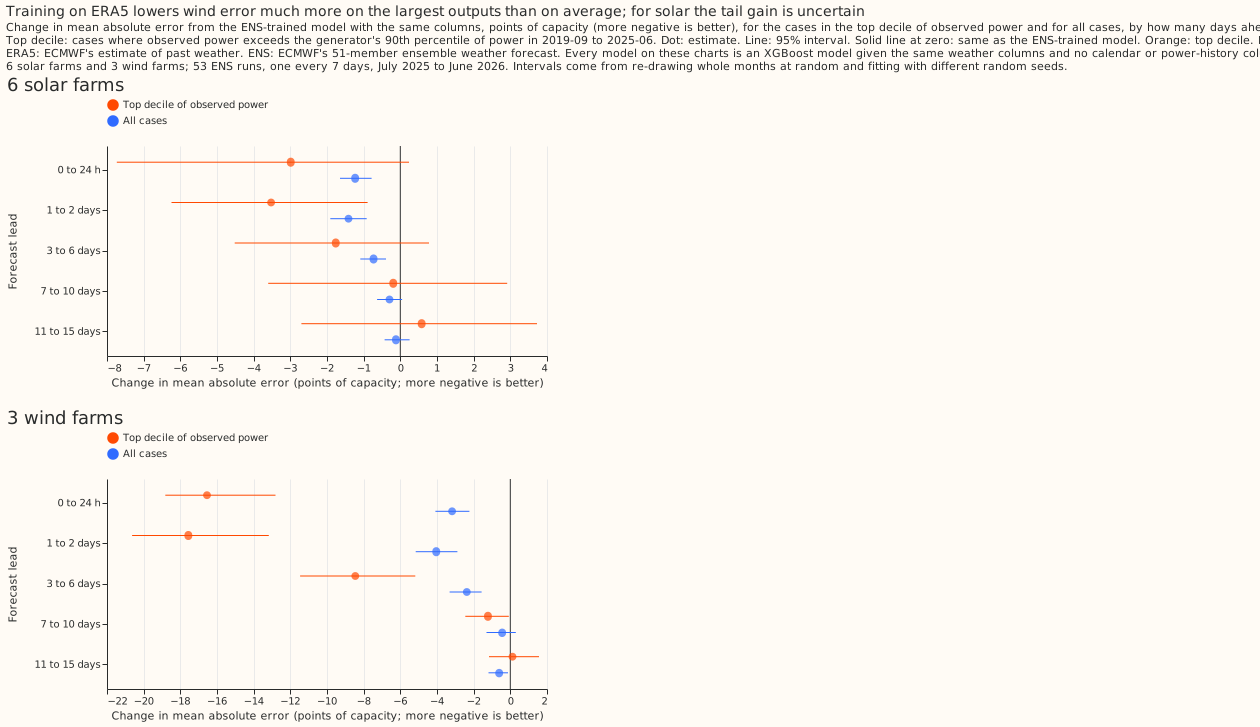
| lead band | wind, top decile | wind, all cases | solar, top decile | solar, all cases |
|---|---|---|---|---|
| 0 to 24 h | -16.54 (-18.82 to -12.81) | -3.18 | -2.99 (-7.73 to +0.23) | -1.23 |
| 1 to 2 days | -17.56 (-20.63 to -13.17) | -4.04 | -3.52 (-6.24 to -0.89) | -1.41 |
| 3 to 6 days | -8.46 (-11.47 to -5.18) | -2.37 | -1.76 (-4.52 to +0.78) | -0.73 |
| 7 to 10 days | -1.22 (-2.46 to -0.08) | -0.45 | -0.19 (-3.60 to +2.91) | -0.30 |
| 11 to 15 days | +0.12 (-1.17 to +1.56) | -0.61 | +0.58 (-2.70 to +3.73) | -0.12 |
| all leads | -6.14 (-7.66 to -4.33) | -1.70 | -1.05 (-3.93 to +1.25) | -0.57 |
- Relative to each arm's own error, the wind gain is about 12% in the tail and 10% overall. The
top-decile error of
ens_trainedis 53.22 points and ofs1_memberavg47.08, against 17.09 and 15.39 over all cases. At 0 to 24 h the tail gain is 42% of the error against 27% overall. - For solar the relative gain is smaller in the tail (4% against 7% over all leads), and every solar tail interval over all leads and at 0 to 24 h and 3 to 6 days spans zero.
- Tail errors are large for every forecast, and the weather input is associated with most of
them.
era5_ceilinghas a top-decile error of 13.16 (wind) and 18.43 (solar) points. Without a second model, both ERA5-trained and ENS-trained forecasts miss most of the largest wind outputs. - The control member alone gives the same tail result for wind (-6.95, -8.39 to -5.23), so averaging the members is not needed for the tail gain, unlike the all-cases gain.
- Selecting on the observed value truncates the outcome, so slopes on this subset are not comparable across studies; only paired differences are reported. Tail pinball loss, exceedance Brier scores, and reliability for the probabilistic forecasts are in the stage 2 experiment.
Failures and limits
- The first run compared against a control that memorised calendar position, and the headline was revised after two Opus reviews. The revised contrasts were chosen after seeing the first run.
- One held-out year, nine generators in two weather regions, fold A only, 24 decisions without a multiple-comparison correction.
- ENS is biased against ERA5 (10 m wind 13% to 15% slower, shortwave 7% brighter). Mapping ENS onto ERA5 before stage 1a is untested.
Lessons for later experiments
- Give every arm the same feature columns, and add a control without calendar columns whenever the training rows repeat a valid time.
- Report the benchmark's absolute score and a climatology row beside every contrast.
- Predictions: the per-member predictions of every arm are under
data/studies/per_study/stage1_pilot/(stage1a/,ens_trained/,scores/). They have not been written intodata/ml-experiments/00001-era5-trained-stage1a-vs-ens-trained/predictions/with a manifest, because theexperiment_storemodule of PR #1187 does not exist yet.