MVA fold: solar capacity and the eight MVA-only Primaries
If a Primary substation's meter reports only apparent power, a fit that allows for reverse flow finds reverse flow at one of the eight such substations, Stickney (D12), and at none of the other seven. Reverse flow means power flowing from the substation back into the grid, which solar panels cause at midday. A Primary is a substation that steps 33 kV down to 11 kV. Eight Primaries (the "MVA-only" ones) report apparent power in MVA, which has no sign, and six report signed power in MW. We asked two questions. First, does the rule of experiment 366 keep the fitted solar capacity close to that of a fit to the signed series (S)? The rule chooses, for each Primary, between the naive fit (N), which reads the meter reading as signed power, and the fit through the meter (L0), which can represent reverse flow. Second, at which MVA-only Primaries does L0 find reverse flow? For the six signed-MW Primaries, the chosen fit's capacity is within 3.1% of S's, with and without synthetic solar output added to the readings. L0 finds reverse flow at D12 and at no other MVA-only Primary, including Marsh Lane (D8), which NGED's monitor file marks "Yes" for reverse flow. Verdict: partly supported. The capacity result and the D12 result hold. The second half of the hypothesis, that L0 finds reverse flow at the substations NGED marks "Yes" or "Maybe", was refuted. Prediction P3, that L0 would invent reverse flow at the other MVA-only Primaries, failed. The page's predictions P1 to P4 are in the front matter.
Every result holds for reactive power zero only. Experiment
366
found that the rule fails at power factor 0.97, and real MVA-only meters have unknown reactive
power. The rule is used as registered and was not tuned. The fits are frozen at the cut on past
weather (the scored cut is 2025-07-01 and the replicate cut is 2024-07-01), as in experiment
358,
which also holds the injection levels. "Points of capacity" are percentage points of a substation's
solar capacity. The fitted capacity is the last season-year's at the cut;
the 2025-07-01 cut uses no later rows. D9 is new; D5, D10, D11, D14, and D16 reuse experiment 358's
cells, and the pin is the pinned solar capacity of experiment 45's frozen vintage as read by
pinned_capacity.
Results (reactive power zero, scored cut unless stated)
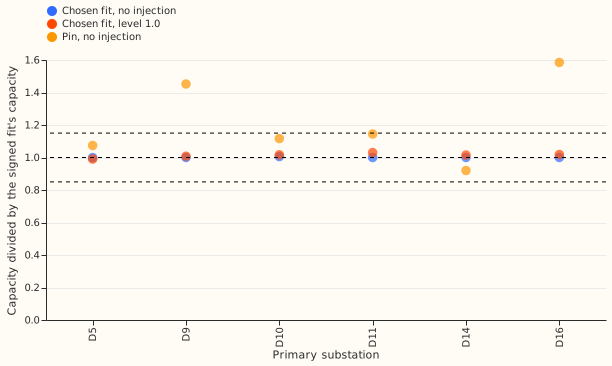
- P1 holds, and level 1.0 is the real test. With no injection the result is mostly a check that the rule does not pick L0 at D5, because N equals S where there is no reverse flow. The chosen fit's capacity is within 15% of S's at 6 of 6 Primaries at level 0.0 (ratios 0.999 to 1.006) and at level 1.0 (0.991 to 1.030). The rule chooses N at D5, D11, D14, D16, and D9 and L0 at D10 with no injection, and L0 everywhere at level 1.0. L0's own ratio at D5 with no injection is 1.30, the placebo failure of experiment 358.
- P2 holds, narrowly. The pin is within 25% of S's capacity at 4 of 6 at level 0.0: D5 1.07, D10 1.12, D11 1.14, D14 0.92. It is 1.45 at D9 and 1.58 at D16.
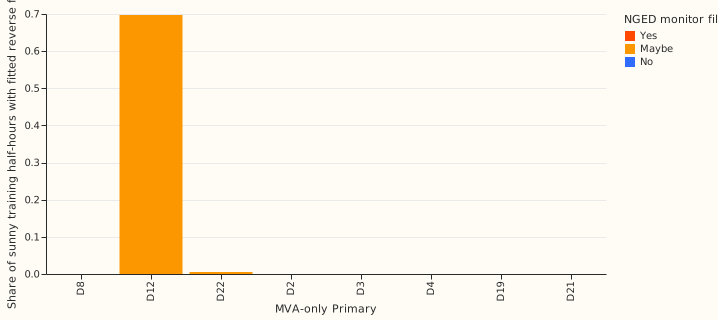
- P3 fails. L0's fitted reverse-flow share of sunny training half-hours exceeds 50% at 1 of the 8 MVA-only Primaries at both cuts. At D12 it is 0.70 (scored) and 0.62 (replicate). At D8 and at the other six it is at most 0.006. At D22 (NGED "Maybe") L0 and N have nearly the same capacity (51.4 and 51.2), and at D8 they are identical, so L0 finds nothing there that N lacks.
- P4 holds, against a weak comparator. N's fitted capacity at D12 is 0.0 at both cuts, so the gap is "some solar against none". At D12 the rule chooses L0 at both cuts, and L0's reading error on sunny half-hours is 9.3 points of capacity below N's at the scored cut (16.2 against 25.5) and 10.7 below at the replicate cut. At the seven others the chosen arm is N, so its error equals N's by construction.
- Rule statistics at the eight MVA-only Primaries. D12 has correlation +0.55 and a 1st percentile of 26.7. The seven other MVA-only Primaries have correlations of -0.54 to -0.04 and 1st percentiles of 5.9 to 40.2, which repeats experiment 366.
- Starting points disagree. The six starting points of L0's fit disagree on capacity by 125 points at D12 and 176 at D4 (11 to 20 at D2, D8, D19, D21; under 0.2 at D3 and D22; scored cut), so a single fit's capacity at D4 or D12 is uncertain.
Checks
- Trigger 2 fired on P3. P3 failed, and experiment 365 found that L0 fits reverse flow on 96% to 97% of summer midday half-hours at D5. The explanation offered is weak and untested. Experiment 365 reported that figure at the signed-MW sites it checked, including D5, where the readings dip towards zero. The eight MVA-only Primaries have 1st percentiles of the sunny-midday readings of 5.9 or more, against 3.8 at D5. The D5 comparison on sunny half-hours was not computed.
- Trigger 7 fired. A planned all-16-Primaries experiment depends on this result, which has not been replicated.
- Audit. A fresh Sonnet auditor (the series brief allows Sonnet only) re-derived the headline numbers from the stored files and found no error. P1 at level 0.0 is largely true by construction. N's capacity at D12 is zero. D8's statistics move between the cuts. The pin's source at D9 and D16 was not checked.
- Median against mean forecast. This check does not apply, because the fits are frozen point fits with no quantile forecasts.
Caveats and what to try next
- No signed truth exists at the eight MVA-only Primaries. The claim that D12 has reverse flow and the others have little rests on the NGED monitor file and experiment 110. It is unconfirmed whether the fit cannot see reverse flow at D8 or D22 or whether there is none.
- D8's L0 capacity moves from 32.6 (replicate cut) to 44.4 (scored cut) and its 1st percentile from
24.7 to 5.9, so D8's rule statistics are unstable between the two cuts. The
sourceof the pin at D9 and D16 (vintage or growth prior) was not checked, so the reason for the pin being 45% and 58% high is unknown. - The fits are frozen and use past weather, so there is no ensemble forecast, no quantiles, and no Kalman filter.
- The all-16-Primaries step should run the full forecast stack and must include the power factor 0.97 case, where the rule and the fit are known to fail.