MVA fold: known-answer test at folded signed Primaries
The model fitted through the meter recovers the flow direction and the solar capacity about as well as a model that sees the signed power, while reactive power is zero. The model also invented reverse flow at the one Primary substation with none (D5), and it failed when the data carried reactive power at power factor 0.97. Verdict: partly supported. The sequence stops here, because the pre-registered pass rule fails as written.
We asked whether the direction of the power flow at a Primary substation can be recovered from a meter that reports only apparent power (the size of the flow in MVA, with no direction). We took five Primaries whose signed power is known and subtracted the output of a real solar farm at two sizes: 1.0 times and 2.0 times the site's median absolute midday power. Those are injection levels 1.0 and 2.0, and "natural" means no injection. We then replaced each reading with its magnitude, which is what folding means here.
We fitted three models. L0 is the convex demand-plus-solar model fitted through the meter, as in experiment 110. S is the same model fitted to the signed series, which is the ceiling. N is the same model fitted to the magnitude as if it were signed power. Fits were frozen at 2025-07-01 (the scored cut) and scored on the following year with past weather; the replicate cut is 2024-07-01. "Sunny half-hours" are April to September, starting 10:00 to 13:30 UTC, with irradiance of at least 500 W/m².
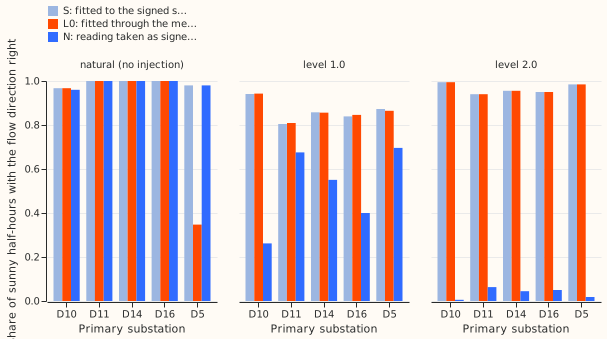
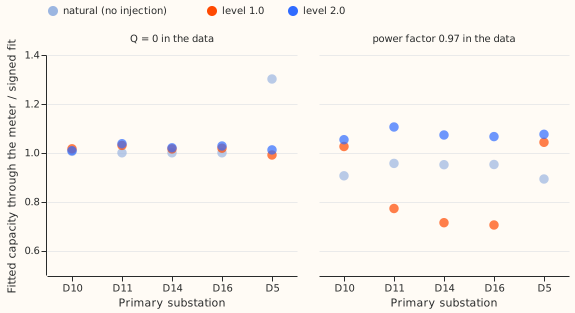
Results (scored cut, zero reactive power in the data, point forecasts)
- Direction, sunny half-hours. L0's accuracy is within 0.01 of S's at every site and level except D5 at the natural level. At level 1.0 it is 0.82 to 0.94 against N's 0.26 to 0.70. At level 2.0 it is 0.94 to 0.99 against N's 0.01 to 0.06. The replicate cut agrees (L0 within 0.01 of S).
- Pre-registered rule. At level 1.0, 4 of 5 sites reach balanced accuracy 0.80 on sunny half-hours (D5 is 0.69, and S is 0.66 there too). At level 2.0, balanced accuracy is 0.5 at every site, because 92% to 99% of the sunny half-hours are reverse flow. The rule fails as written, and the metric cannot tell the arms apart there. Plain accuracy, post hoc, passes at 5 of 5 sites.
- Capacity. L0's fitted capacity is within 15% of S's at 5 of 5 sites at both levels. The rise from the natural fit is about 75% to 80% of the injected capacity for both L0 and S (D10: 0.80), so the capacity shortfall appears in the signed fit too and the folding does not cause it.
- Reading error. L0's mean absolute error on the magnitude is below N's at every level-1.0 and level-2.0 cell, by 1 to 15 points on sunny half-hours (for example D10 at level 2.0: 10.4 against 25.3).
- Placebo fails at D5. With no injection, L0 gets the direction right on 35% of sunny half-hours at D5 (S and N: 98%). Its fitted capacity is 1.30 times S's. The six starting points of the fit disagree by 45 percentage points of capacity. The lowest-loss start has a solar term that is large and negative at midday, a mirror image that a loss on the magnitude cannot tell from the right answer.
- Reactive power breaks it. With power factor 0.97 in the data and
Q = 0in the fit, L0 collapses to N at D11, D14, and D16 at level 1.0 (accuracy 0.31 to 0.63, capacity 0.70 to 0.77 of S). The design brief's measurement puts the reactive floor at Stickney (D12) below 1% of capacity, so the zero-reactive case is the relevant one there.
Checks
- Triggers. Audit trigger 1 (a failed control) fired: the D5 placebo. A fresh Sonnet auditor
found no leakage, confirmed
the D5 result is a mirror-basin weakness and not a bug, traced the Q1 collapse to the
Q = 0assumption, and confirmed the sunny mask. It also flagged that the claim "L0 matches S" excludes D5 at the natural level, which this page states. - Median against mean forecast. Not applicable: these are point forecasts from frozen fits.
- Departures from the plan. Plain accuracy is added post hoc beside balanced accuracy. The audit used Sonnet because the series brief requires it, not Opus.
Caveats and what to try next
- Frozen fits on past weather, no ensemble, no Kalman filter, no quantiles: sign recovery only.
- One farm (A) supplies the injected output, so the result is for one farm shape.
- At the natural level, D11, D14, and D16 have no reverse flow, so balanced accuracy cannot be computed.
- Step 2 should read L0's reverse flow only after a check that rejects the D5-type mirror basin (for example, require the lowest-loss start to agree with the start nearest zero reverse flow).