MVA fold: gated fit through the meter, known-answer test
A gate that checks fitted reverse flow against an independent solar forecast does not stop the fit through the meter from inventing reverse flow. At the registered setting the gate rejected no fit in any of 60 cases. At a stricter post hoc setting it fixed D5, the one of the five substations with no reverse flow, at the 2025 cut only, and it rejected the correct fits at four of five substations when reverse flow was heavy. Verdict: refuted. The sequence stops here.
Experiment 358 found that the model fitted through an apparent-power meter invents reverse flow at D5 when no solar output is injected. This experiment tested a gate. The fit tries six starting points. The gate rejects a start when more than 0.5% of its training half-hours have negative fitted power while the independent solar output is under a set multiple (the ratio) of the fitted demand. The independent solar output is the pinned capacity times the solar shape plus, in this lab test, the injected farm's true output. We tested the registered ratio of 0.75 and, post hoc, the ratios 1.0 and 1.25. Everything else follows experiment 358. The ungated fit (L0) reproduces experiment 358's numbers.
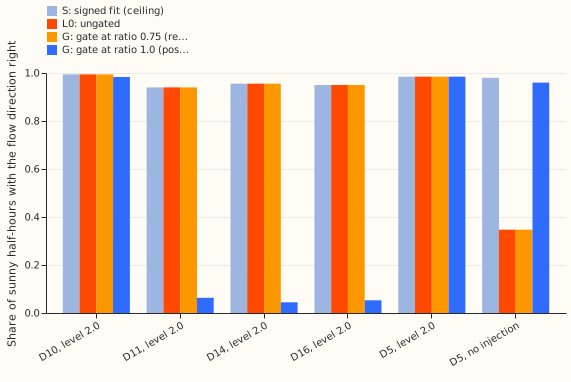
Results (reactive power zero; scored cut unless stated)
- Registered gate (ratio 0.75) rejects nothing. It rejects 0 of 6 starts in all 60 cases, so it gives the ungated fit's answer everywhere. D5 with no injection stays at 0.35 against the signed fit's 0.98. The decision rule fails on one criterion: the gate matches the signed fit within 0.02 at 5 of 5 substations at both injection levels, but misses D5 at the natural level by 0.63.
- Why it rejects nothing. On training half-hours the mirror fit's negative power falls where the independent solar output is at least 0.75 times the fitted demand, because true flow at midday is near zero and the independent forecast cannot tell a small positive flow from a small negative one. The invented reverse flow at D5 appears mostly on the following year's half-hours.
- Post hoc ratio 1.0. At the scored cut it fixes D5 with no injection (accuracy 0.96, capacity 1.02 times the signed fit's) and matches the signed fit at level 1.0. It breaks level 2.0 at D11, D14, and D16 (accuracy 0.05 to 0.06 against 0.94 to 0.96, capacity 0.18 to 0.26 times the signed fit's), because the correct starts are rejected. At the 2024 cut it does not fix D5 (0.49, with every start rejected) and also breaks level 2.0 at D10, D14, and D16.
- Ratio 1.25. It breaks level 1.0 at D11, D14, and D5 and level 2.0 at all but D11 at the scored cut.
Checks
- Triggers. Audit trigger 1 (a control fails: the D5 placebo) and trigger 2 (the result contradicts its prediction) fired. The explanation tested is that the invented reverse flow appears on half-hours after the fit was made, not on its training half-hours. A fresh Sonnet auditor found the gate code a faithful copy of the ungated fit apart from the rejection step, found the units right, and reproduced experiment 358's D5 numbers. It found no bug behind the null at 0.75: a start is rejected only when its fitted solar exceeds about 1.33 times the independent solar, and the wrong D5 starts overshoot by only about 1.2 times. It also noted that clipping the forecast power at zero cannot change a sign accuracy, so the clip is inert here.
- Median against mean forecast. Not applicable: the forecasts are single values from frozen fits.
- Departures. Ratios 1.0 and 1.25 are post hoc. The audit used Sonnet because the series brief requires Sonnet only.
Caveats and what to try next
- The gate reads the injected farm's true output, an advantage a real substation lacks, and it still failed.
- One farm shape (A) supplies the injected output.
- Try a rule on the meter readings alone: accept reverse flow only if the training readings come within a few percent of capacity of zero at midday. The brief's measurement says only Stickney (D12), Langrick (D22), and Marsh Lane (D8) do.