Differentiable physics: a same-weekday error profile on top of GAM-K
Take-home: using the same weekday's recent errors, instead of the last 14 days' errors alike,
lowers the day-ahead quantile score by only about 0.011 points (0.5% of 2.44), so it is not worth
adding to recipe R. Recipe R is the baseline correction: it subtracts 0.75 times the mean of the
last 14 days' errors by half-hour from GAM-K's forecast. One point is 1% of a substation's
capacity, and lower scores are better. The gain is below the 0.02-point threshold set in the plan
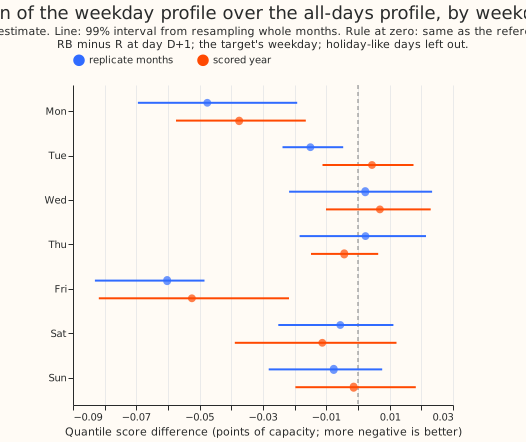
before any fit, and the scored-year interval includes zero. The gain sits on Mondays and Fridays
and is absent from Tuesday to Thursday. A variant that groups days into five day types did better
(0.022 points against recipe R, exploratory) and is the version worth testing next, limited to day
D+1. The verdict is not supported.
What was asked, and the answer in plain terms
The question was whether the correction to the day-ahead forecast should look at the same weekday as the day being forecast. The forecast is the electricity demand of five Primary substations (the stations that step power down from 33 kV to 11 kV) for the day after the 09:00 UTC forecast origin, from the physics-based demand model with a Kalman filter on ECMWF ensemble weather (GAM-K, arm K0; experiment 111). Experiment 115 found that subtracting 0.75 times the mean of the last 14 days' errors by half-hour (recipe R) lowers the day-ahead score by 0.09 points. We kept R and added a shrunk same-weekday profile to it.
Answer. The shrunk weekday profile (arm RB) scored 2.424 points against 2.436 for R in the scored year. Scores are in points of effective capacity (1 point is 1% of a substation's capacity), lower is better, and rows inside the hand-filtered switching events are left out. The settings were chosen on the odd months of July 2024 to June 2025 (tuning months); the even months are the replicate months, and the scored year is 2 July 2025 to 29 June 2026 (292 runs).
Figures
Results
- Arms. K0 (GAM-K); R (recipe R; its scores match experiment 115's); Rh (R with the holiday rule, kappa 0.75); L1 (last week's same-weekday error, kappa 0.5); RW (mean same-weekday error of the last 3 weeks, kappa 0.5); RB (kappa, the correction weight, 0.75; lambda, the weekday share, 0.25; n, the number of weeks, 3); RB-day-types (kappa 0.75, lambda 0.5, n 4 weeks). Settings are fleet-wide and were chosen by the tuning rows' D+1 mean absolute error of the median. No demand model was refitted (experiment 111's monthly refits are reused).
- Rows and compute. 66,844 D+1 rows in the scored year and 41,126 in the replicate months at the five decision substations (D5, D10, D11, D14, D16), with D9 beside them. Fits take seconds; the tuning, gate, and frame builds took a few minutes on 3 cores.
- Absolute scores, scored year, D+1 (all leads). K0 2.524 (2.812), R 2.436 (2.744), Rh 2.440 (2.745), L1 2.535 (2.879), RW 2.452 (2.803), RB 2.424 (2.750), RB-day-types 2.414 (2.756). D9 beside them: K0 2.194, R 2.123, RB 2.127.
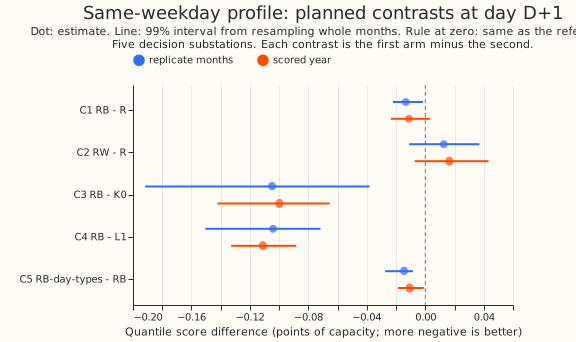
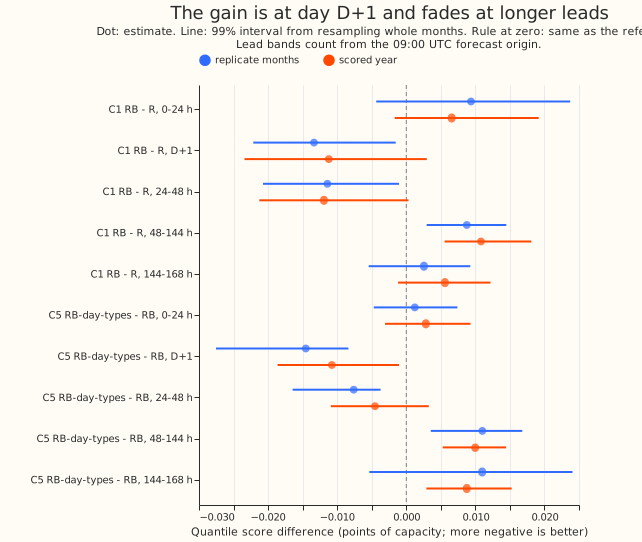
- C1 RB minus R (decides the verdict, 99%). Scored year -0.0112 (-0.0234 to +0.0030), 3 of 5 substations; replicate months -0.0134 (-0.0221 to -0.0015), 3 of 5. Excluding holiday-like days the scored year is -0.0135 (-0.0243 to -0.0034). Over all leads the C1 estimate is +0.0062 (+0.0016 to +0.0138), 0 of 5 substations: the score is worse beyond day D+1 (48 to 144 hours: +0.0108).
- C2 RW minus R. +0.0165 (-0.0073 to +0.0432) scored; +0.0126 (-0.0110 to +0.0371) replicate: a pure same-weekday profile is noisier than the all-days one, as predicted.
- C3 RB minus K0. -0.0998 (-0.1423 to -0.0654), 5 of 5; replicate -0.1049. C4 RB minus L1. -0.1111 (-0.1328 to -0.0883), 5 of 5; one week of same-weekday errors alone is no better than K0 (L1 minus K0 +0.011).
- C5 RB-day-types minus RB. -0.0108 (-0.0186 to -0.0010), 4 of 5; replicate -0.0145 (-0.0275 to -0.0084), 5 of 5. Against R (exploratory, 95%): -0.0220 (-0.0364 to -0.0065) scored and -0.0279 (-0.0414 to -0.0161) replicate.
- C6 RB minus Rh (diagnostic, 95%). -0.0153 (-0.0225 to -0.0086), 5 of 5 substations: with the holiday rule held fixed, RB scores 0.015 points better than Rh. Rh minus R is +0.0041 (-0.0001 to +0.0116): the holiday rule alone raises the score by 0.004 points, with an interval that includes zero. C1 in the Christmas window is +0.0726 (+0.0285 to +0.0842, 0 of 4 substations), and C1 on Easter is -0.0835 (one set of 720 rows); C1 mixes the weekday term and the holiday rule, and the holiday rule's own effect in those windows was not printed.
- Weekdays (scored year, C1). Monday -0.0375 (-0.0575 to -0.0165), 4 of 5; Friday -0.0525 (-0.0819 to -0.0218), 5 of 5; Tuesday +0.0044, Wednesday +0.0069, Thursday -0.0043, Saturday -0.0113, Sunday -0.0014, all with intervals that include zero. The replicate months show the same pattern, with Tuesday also negative (-0.0150).
- Winter (scored year, C1). November to March -0.0115 (-0.0364 to +0.0271), 3 of 5; winter evening 16:00 to 20:00 -0.0488 (-0.0654 to -0.0333), 5 of 5; non-winter -0.0110 (-0.0185 to -0.0013). Cold-snap days (daily mean under 3 degrees C): +0.0036 (-0.1191 to +0.1565) with 2400 rows, too few to read. Easter has one set of 720 rows.
- COPY7. On the 7-days-ago subset, scored year, COPY7 scored 7.067 at D+1 against 2.521 for K0 and 2.421 for RB; copying last week is much worse, as predicted.
- Tails (scored year, D+1; coverage gap in points, pinball). RB: q01 +1.41 (0.1883), q05 +1.81 (0.6087), q95 -1.02 (0.6554), q99 -1.12 (0.2115); R: +1.39, +1.76, -1.01, -1.16 with pinball 0.1875, 0.6138, 0.6573, 0.2124. The tails barely move.
- Predictions. Held: C1 within -0.01 to -0.04 (at its upper edge); RW minus R within 0.00 to +0.05; COPY7 worse than K0; best lambda 0.25 (inside 0.25 to 0.75). Failed: RB-day-types was expected within 0.01 of RB and was 0.011 better.
Gate
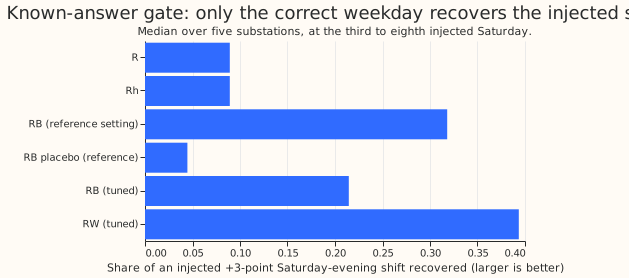
The known-answer gate passed, and it was run on the tuning months before any replicate or scored forecast was read. A +3-point shift on Saturdays 17:00 to 21:00 for 8 weeks (2 November to 21 December 2024) was recovered at the third to eighth Saturday as follows (median of five substations, share of the shift): R 0.089, Rh 0.089, RB at the reference setting 0.318 (at least 0.15 and more than twice R), RB tuned 0.215, RW 0.394, and the placebo (weekday labels shifted by 3 days) 0.045 at the reference and 0.067 tuned. The placebo condition on recovery (at most R plus 0.05) is nearly arithmetic, because a profile from the wrong weekday carries only the shrunk share of any shift, so the second check is the informative one. The share cannot reach 1: removing each day's mean, as the profile does, lowers the largest recoverable share to about 0.83. On the tuning rows, the placebo's mean absolute error at D+1 (4.217) is above Rh's (4.130) and RB's at the reference (4.098), so the placebo's error does not improve: the benefit needs the correct weekday.
Checks
- Median forecast minus mean forecast per site (scored year, D+1, points). K0: D10 +0.003, D11 -0.022, D14 +0.014, D16 -0.014, D5 -0.097. R: +0.009, -0.019, +0.002, -0.015, -0.037. RB: -0.003, -0.010, -0.012, -0.002, -0.039. No shift over 0.04 except D5 for K0.
- Mean absolute error of the median and of the mean forecast beside each contrast (scored year, D+1). C1: median -0.0183, mean -0.0183; C2 +0.0436 and +0.0439; C3 -0.1955 and -0.1977; C4 -0.2133 and -0.2112; C5 -0.0172 and -0.0183. The quantile score and both errors point the same way.
- Triggers. None fired. The gate passed; the results agree with the predictions except C5's size; the quantile score and the errors agree; leaving out one substation never flips C1's sign (-0.0053 to -0.0161 scored; the scored-year interval includes zero in four of five leave-one-outs, as in the full set, and D11's upper end is +0.0000); no nested arm beats the arm containing it (RB contains Rh and RW as special cases and beats both, which is the expected order); the closest sister interval, experiment 115's KW minus R, is a different contrast; no later experiment depends on this result. No audit was run.
Caveats
- Five substations and one independent winter. Settings were chosen on the tuning months with the mean absolute error of the median, not the quantile score, and R's kappa was not re-tuned.
- The shift applies at every lead as recipe R does, so the weekday of the target is only right at day D+1 (leads 15.5 to 39 hours); this is the likeliest reason for the loss beyond 48 hours.
- Weekday labels use UTC days of the valid time while the profile uses local half-hours. The gate's Saturday is the UTC day. The 3.5-hour telemetry delay is assumed, as in experiment 115.
- RB-day-types was not pre-registered as the best arm; its advantage over R is exploratory.
What to try next
- Test day-type profiles at day D+1 only, with lead-aware weights, tuned on the quantile score, and replicated on the even months.
- Test a Monday and Friday weekend-edge term on its own, since all of the gain sits there.
Every number above is printed by ml-experiments/00134-*/e00134_report.py; its output is
report.txt.
Plan, committed before any fit
This experiment asks whether the forecast's recent-error correction should look at the same weekday as the day being forecast, rather than at the last 14 days alike. It reuses experiment 111's stored GAM-K forecasts and experiment 115's K0 and recipe R, and refits no demand model. It follows experiment 115, whose recipe R is a plain average of the last 14 days' errors by half-hour. None of experiments 111 to 115 tested a weekday-specific version. Shrinking a weekday profile towards an all-days profile is a partial-pooling step of the kind described by Gelman and Hill (2006). The naive baseline of repeating the value from seven days ago is a seasonal-naive forecast, as defined by Hyndman and Athanasopoulos (2021).
Arms
- K0. GAM-K as stored (control).
- R. Recipe R reproduced exactly as experiment 115 stored it: K0 minus kappa times the mean of the last 14 UTC days' D+1 errors by local half-hour, each day's mean removed, kappa 0.75, no holiday rule.
- Rh. R with the holiday rule below, kappa re-chosen on the tuning months. It separates the effect of the holiday rule from the effect of the weekday.
- COPY7. The actual power at the same half-hour 7 days earlier as a point forecast (all 11 quantiles equal), reported beside the arms and never corrected, on its own subset: the rows where that reading exists, with K0 and RB rescored on the same subset.
- L1. K0 minus kappa times last week's same-weekday D+1 error profile (one sample).
- RW. K0 minus kappa times the mean same-weekday error over the last n weeks; n from 2, 3, 4.
- RB (lead arm). Profile = A + lambda (W - A), where A is Rh's 14-day all-days profile, W is the n-week same-weekday profile, and lambda lies in 0 to 1. Where W has no usable day, W is A.
- RB-day-types. As RB, with W built from days of the same day type: Monday, Tuesday to Thursday, Friday, Saturday, Sunday.
No lookahead. At the 09:00 UTC origin on day D the target is D+1. Each source day is a UTC day fully observed by D 00:00 UTC, so the same weekday of the target last counts on day D-6. A day enters a profile when at least 40 of its 48 half-hours have a reading, as in experiment 115.
Holiday rule (Rh, RW, L1, RB, RB-day-types). A holiday-like day is an English bank holiday, Easter Saturday or Sunday, or 24 or 27 to 31 December. Holiday-like days are left out of every profile as source days, and a holiday-like target gets no correction. Holiday-like targets are scored separately.
Settings and how they are chosen
- Grids. kappa from 0.5, 0.75, 1.0; lambda from 0, 0.25, 0.5, 0.75, 1; n from 2, 3, 4.
- Rule. Fleet-wide settings (one set for all five decision substations), because each substation
has about 3,000 tuning-month D+1 rows and the weekday profiles use 2 to 4 samples; a
per-substation choice would mostly fit noise. The setting with the lowest mean absolute error of
the corrected median at D+1 on the tuning rows, in points of effective capacity, pooled with equal
weight per row over the five decision substations, wins. Holiday-like targets stay in the tuning
rows (they carry zero correction in every arm). Weeks
nis chosen separately for RW and RB, and the tuning-row scores of the kappa 0.75 slice of the RB grid are printed. Lambda takes 0.25, 0.5, and 0.75 in RB, because lambda 0 is Rh and lambda 1 is RW, which are tuned separately. Each arm's spread is then refitted on the tuning rows and its factors chosen per lead band, as for every arm of experiment 115. - Sensible limits. If lambda = 0 wins, RB equals Rh and the verdict says so.
Known-answer gate (reported before any score)
On real tuning-month residuals, add +3 points to the readings of Saturdays 17:00 to 21:00 local for 8 consecutive Saturdays (2 November to 21 December 2024), run every arm's full profile code on the changed readings, and measure the share of the shift each correction recovers at the third to eighth Saturday. The Saturday is the UTC day of the valid time, and the half-hours are local. The injection goes through the same 40-of-48 reading filter, holiday rule, and fallback as the real scoring, so the gate can fail for a real reason. The share is linear in the weights: with kappa 0.75, R recovers about 0.75 x 2/14 = 0.11, and RB at lambda 0.5 and n 4 recovers about 0.19.
- Settings. The gate runs at the tuned settings and at a fixed reference (kappa 0.75, lambda 0.5, n 4), so the result does not depend on where tuning lands.
- Pass conditions, at the reference. RB recovers at least 0.15 of the shift and at least twice what R recovers; the placebo (the profile reads the weekday that falls 3 days after the target's; same settings, not re-tuned, because the placebo only has to show the gain needs the right weekday) recovers at most what R recovers plus 0.05; and on the tuning months the placebo's mean absolute error at D+1 lies less than halfway from Rh's to RB's.
- Tuned settings. Reported beside the reference. If lambda 0 scores best in tuning, RB equals Rh and the verdict says so.
- A failed condition caps the verdict at
inconclusive. The gate runs before any replicate or scored forecast is read.
Predictions
- C1 (RB minus R) is -0.01 to -0.04 points at D+1; C2 (RW minus R) is 0.00 to +0.05, because 2 to 4 samples per weekday are noisy; COPY7 is worse than K0 overall; the best lambda lies between 0.25 and 0.75; RB-day-types is within 0.01 of RB (C5).
Contrasts and decision rule
- C1 RB minus R (decides the verdict), C2 RW minus R, C3 RB minus K0, C4 RB minus L1, C5 RB-day-types minus RB. C6 (diagnostic) RB minus Rh.
- Supported if C1's scored-year interval has its upper end at most -0.02 points; the replicate
year has the same sign and an estimate at least half the scored estimate; at least 3 of 5
substations improve in both periods; the winter C1 estimate is at most 0 with its upper end under
+0.02; and the gate passes. Small gain if the scored interval lies wholly below zero but its
upper end is above -0.02. Not supported if the interval includes zero. Refuted if the
interval lies wholly above zero. A gate failure caps every verdict at
inconclusive. - C1 and the holiday rule. C1 is RB minus R as the brief states, so it includes the holiday rule. The write-up reports C1 on non-holiday rows and C6 (RB minus Rh) beside it, and says so when the weekday effect and the holiday rule point in different directions.
- Threshold, with the reason. 0.02 points (about 1% of the score), because the change adds one profile of the same size as recipe R to the serving path.
- Intervals. 99% intervals, month blocks resampled, paired across arms
(
studies.bootstrap.bootstrap_difference_at_level).
Breakdowns and checks
The winter evening peak is 16:00 to 20:00 local from November to March. "Last n weeks" counts the
last n same-weekday dates, and a date left out by the holiday rule or by the reading filter is not
replaced. Charts and tables use D-labels only. result.md opens with the take-home message, then one
headline chart with intervals, then the weekday-by-weekday chart.
Each weekday separately; winter (November to March) and the winter evening peak; cold nights (daily
mean under about 3 C, as in experiment 122) with q95 coverage; holidays, Christmas windows, and
Easter; non-winter; per substation (5 of 5 counts); tails (coverage and pinball loss at q01, q05,
q95, q99); and the "Checks" list the ml-experiment skill requires.
Compute and schedule
CPU only, at most 4 cores and 8 GB under systemd-run --user --scope -p MemoryMax=8G -p
OOMPolicy=continue. Each arm is a correction on stored member forecasts, so a fit takes seconds.
No retraining happens: experiment 111's monthly refits are reused.