One GAM stack at all 16 Primaries, with the MVA treatment as an explicit arm
One stack, run unchanged, scores level with BG2 on average at the six Primaries that report signed megawatts. One year of data cannot rule out a gap of 0.13 points. The stack is worse than BG2 on sunny half-hours. A Primary is a 33 kV to 11 kV substation. The stack is a two-stage additive forecast (a generalised additive model with a correction stage) fitted separately at each Primary. BG2 is the production-style forecast that the stack is compared with. A score is the quantile score (twice the mean pinball loss over 11 quantiles), and a negative difference means the stack is better. Stack minus BG2 over all half-hours, pooled over the six, is -0.02 points of effective capacity (percent of a Primary's capacity; 95% interval -0.17 to +0.13). The pre-registered bar was an interval whose upper end is below +0.10, so the verdict for that group is inconclusive (neither supported nor not supported). The sunny-daylight gap is +0.46 (+0.20 to +0.70). Winter half-hours and cold nights go the other way (-0.29 and -0.44). Every result holds for reactive power zero.
We asked whether the best-guess stack of experiment
252, with stage 2, scores as well as BG2 at
every Primary, and how much of the gap at the eight Primaries that report only apparent power
(megavolt-amperes, MVA) comes from the MVA treatment. The six signed-MW Primaries are D5, D9, D10,
D11, D14, and D16. We ran the unchanged chain of experiment 252 there (its control source), took
the eight MVA-only Primaries from experiment
374, and scored all three groups with the
rows, metric, and bootstrap of experiment 374.
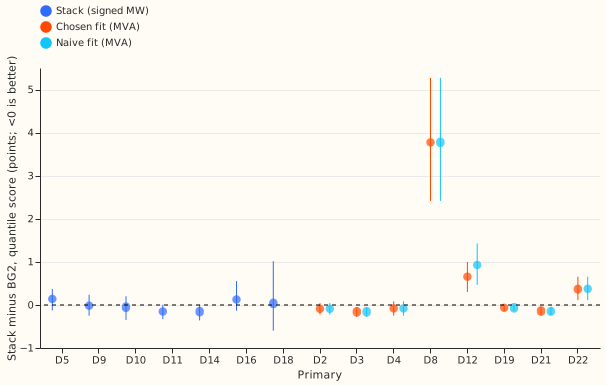
At the eight MVA-only Primaries the gap to BG2 is a Marsh Lane (D8) gap, and the rule adds 0.03 points. The rule-chosen fit (the fit through the meter at Stickney, D12, and the naive fit elsewhere) minus BG2 is +0.53 (+0.35 to +0.73), and +0.07 (-0.03 to +0.17) without D8. The naive fit at all eight minus BG2 is +0.57 (+0.40 to +0.75). The rule-chosen fit minus the naive fit is -0.03 (-0.08 to +0.01), and it is exactly zero at seven Primaries. At D12 it is -0.27 (-0.61 to +0.04). The rule changes the forecast at D12 only.
Results (quantile score in points of effective capacity; lower is better)
- Signed-MW group (D5, D9, D10, D11, D14, D16): inconclusive. Stack minus BG2 is -0.02 (-0.17 to +0.13). Per Primary: D5 +0.14, D9 -0.02, D10 -0.05, D11 -0.15, D14 -0.15, D16 +0.13; every interval includes zero. Stack minus the manual heuristic is -0.70 (-0.96 to -0.44), and minus climatology -0.97 (-1.31 to -0.65).
- Slices, stack minus BG2, signed-MW group. Sunny daylight +0.46 (+0.20 to +0.70); winter nights -0.17 (-0.30 to +0.03); cold nights -0.44 (-0.95 to -0.00); Economy 7 step -0.06 (-0.16 to +0.04). Registered prediction P1 (between -0.20 and +0.20) holds.
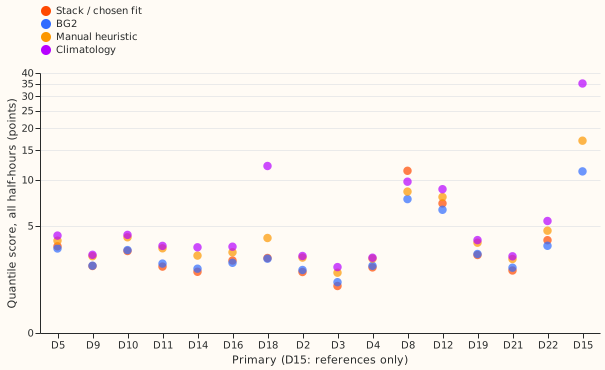
- Absolute scores, all half-hours (stack, BG2, manual heuristic, climatology). D5 3.52, 3.38, 3.90, 4.26; D9 2.38, 2.40, 2.91, 3.00; D10 3.22, 3.28, 4.13, 4.31; D11 2.35, 2.51, 3.39, 3.55; D14 2.09, 2.25, 2.95, 3.45; D16 2.67, 2.55, 3.15, 3.49.
- MVA-only group (D2, D3, D4, D8, D12, D19, D21, D22): descriptive. Chosen fit with stage 2 minus BG2 +0.53 (+0.35 to +0.73); naive fit with stage 2 minus BG2 +0.57 (+0.40 to +0.75); A1 minus BG2 +0.56 (+0.39 to +0.75). By Primary, chosen minus BG2: D8 +3.77 (+2.42 to +5.27), D12 +0.65, D22 +0.37, and -0.07 to -0.16 at D2, D3, D4, D19, and D21. Without D8: chosen +0.07 (-0.03 to +0.17), naive +0.11 (-0.00 to +0.22). P2 and P3 hold.
- D8 on its own. Chosen and naive fits score 11.37, BG2 7.59, climatology 9.76, manual heuristic 8.47. D8 is the only Primary where the stack trails climatology.
- Slices, chosen minus BG2, MVA-only group. Sunny daylight +0.65 (+0.41 to +0.90); winter nights +0.28 (+0.16 to +0.39); cold nights -0.12 (-0.26 to +0.13); Economy 7 step +0.60 (+0.33 to +0.90).
- D18 (third group). The stack fits with 12 monthly fits and borrows its spread from the six signed-MW Primaries. Stack 2.81, BG2 2.78, manual heuristic 4.09, climatology 12.13; stack minus BG2 +0.04 (-0.60 to +1.01) on 61,519 rows, one Primary and few months, so the interval is wide.
- D15 (third group). No ensemble store exists and fetching one was out of scope, so only references are scored: BG2 11.27, manual heuristic 17.02, climatology 35.14 (experiment 372).
- Pooled training. Not run: it needs machinery that does not exist .
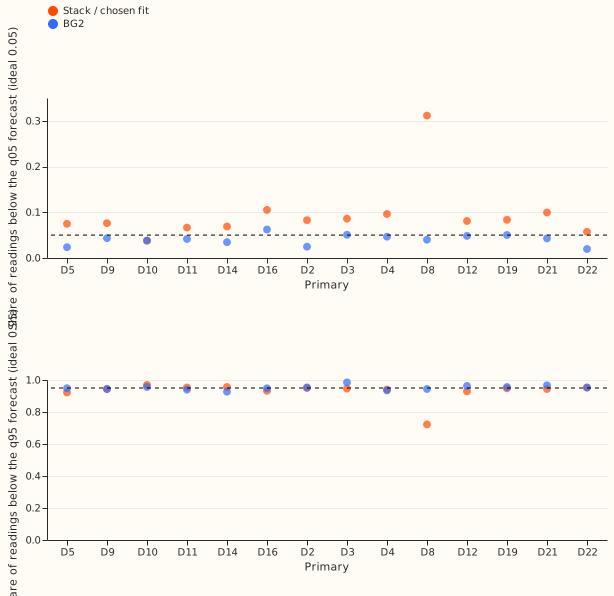
- Tail calibration (share of readings at or below each quantile, mean over the Primaries of the group; ideal 0.01, 0.05, 0.95, 0.99; pinball loss not computed). Signed-MW stack: 0.024, 0.072, 0.946, 0.982; BG2: 0.010, 0.041, 0.944, 0.983. MVA-only chosen fit: 0.054, 0.112, 0.916, 0.964; BG2: 0.005, 0.040, 0.957, 0.995. P4 (signed-MW q05 coverage above 0.08) fails: the mean is 0.072, and D16 alone is above 0.08 (0.105). The stack's lower tail is still wider than BG2's at five of six Primaries (D10 equal), and sunny-half-hour q05 coverage is 0.157 against 0.104.
Checks
- Control gate. This experiment's stage-2 arm d equals experiment 155's stored arm d to a maximum difference of 0.0 in q50 at all six signed-MW Primaries. The MVA-only numbers reproduce experiment 374's (+0.53, -0.03, +0.07 without D8).
- Median against mean forecast. 0.00 at every Primary for every arm.
- Mean-forecast error beside the contrasts. Error of the mean forecast against BG2's median, in megawatts: D5 6.01 against 5.88; D9 4.21 against 4.33; D10 5.31 against 5.62; D11 4.21 against 4.48; D14 3.69 against 3.96; D16 4.48 against 4.45. The direction agrees with the quantile score at all six Primaries (at D16 the gap is 0.03 MW).
- Leave one Primary out (signed-MW). The stack-minus-BG2 interval has an upper end of +0.09 without D5 and +0.11 to +0.17 without any other Primary. The point estimate flips sign without D11 or D14 (+0.01), so trigger 4 fired for the sign. The verdict is inconclusive in all six leave-one-out runs, except that leaving out D5 would meet the +0.10 bar.
- Triggers. Trigger 4 (a leave-one-out run flips the sign of a contrast) fired as described. Triggers 1 (the gate passed), 3, 5 (no nested arm in the signed-MW group; D8's stage-2 worsening is experiment 374's finding), 6, and 7 did not fire. Trigger 2: P4 contradicts its prediction, and the explanation is untested. No Opus audit ran, because the brief allows Sonnet only and the verdict does not depend on trigger 4: the registered rule uses the upper end of the pooled interval, which is above +0.10 with every Primary except D5.
Caveats and what to try next
- Reactive power zero only; experiment 366's rule fails at power factor 0.97. For D8, it is unproven whether the generator explains the steps and the gap.
- One scored year and twelve month-blocks give wide intervals. Monthly refits on 24 months were used, not weekly production refits.
- The signed-MW stack pins the solar capacity to the stored capacity vintages, and the MVA-only stack has no capacity vintage (experiment 252), so the two groups do not share every design choice.
- The Economy 7 slice is the four half-hours ending at 00:30, 01:00, 07:30, and 08:00 UK local time, defined here.
- Next: the stack's sunny-half-hour gap to BG2 (+0.46 at the six signed-MW Primaries) is the largest cross-group weakness. A narrower lower tail (q05 coverage 0.07 to 0.11) is the second.