Can a penalised level term for each stretch between detected steps let the GAM stack explain D8's steps instead of masking them?
Giving the forecast for D8 a separate level for each stretch between detected steps made the quantile score worse, from 8.382 to 8.674 points at the middle penalty strength.
D8 is a primary substation (Primary) whose power seems to include a dispatchable generator that
switches on and off. A step is a rise or fall of at least 1.5 MW in D8's power found by experiment
361's detector, and a stretch is the run of half-hours between two such steps. We gave each stretch
its own level, shrunk towards zero by a ridge penalty, and tried three penalty strengths. The
weakest penalty scored worst (8.800) and the strongest scored nearest to the control (8.545), where
the control is experiment 354's forecast without the stretch levels. Of the three strengths tried,
none beat the control. The verdict is not supported. The criterion was a fall of at least 0.2
points with a 99% interval wholly below zero, and a stop rule ended the experiment if the middle
penalty did not beat masking the steps.
Experiment 361 removed or masked the steps in the training target, and the score did not move. We asked a different question: if every training row is kept and each stretch gets its own level, can the weather and calendar terms be estimated inside stretches? We refitted experiment 354's best generalised additive model (GAM) stack monthly with the new columns and scored one year of forecasts. The quantile score is twice the mean pinball loss over 11 quantiles, in points of D8's capacity (1 point is about 0.1 MW), and lower is better. The penalised level for each group of rows is a random-effect design, and the step detector is experiment 361's.
Figure 1: every segment-term arm scores worse than the control, and the masking arm scores the same.
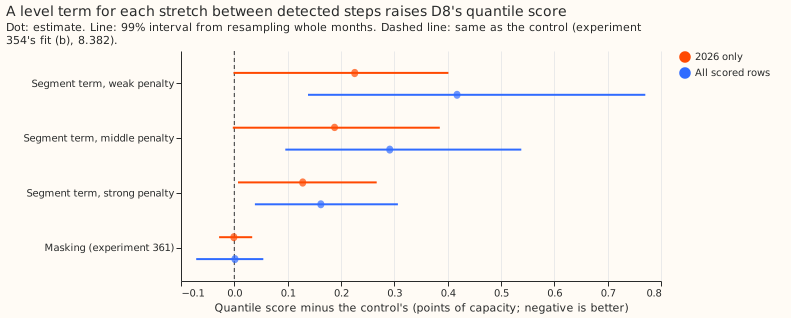
Figure 2: the segment term is worse in every lead band and on days with and without detected steps.
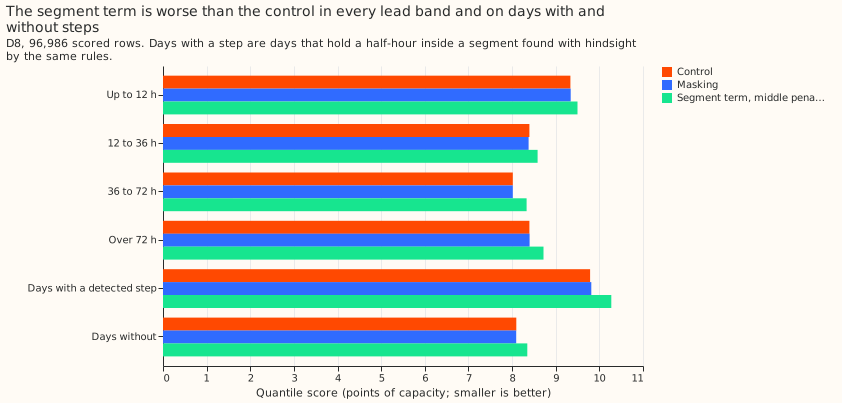
Figure 3: the segment term raises the score at both Primaries that have no engine.
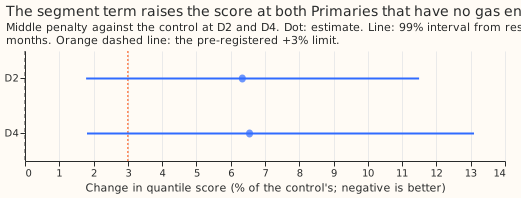
Figure 4: the segment term changes the fitted solar-capacity and seasonal terms most at D8.
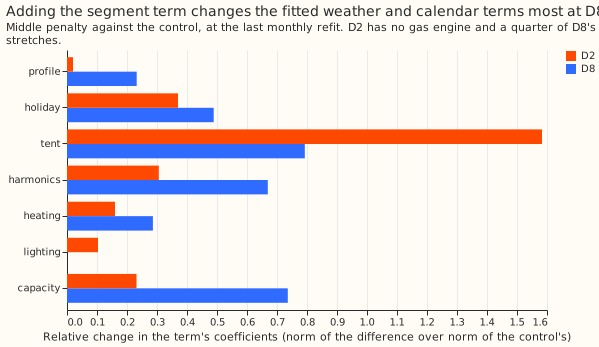
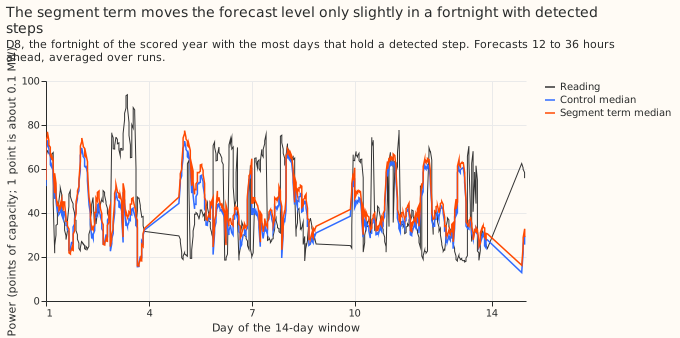
Figure 5: in the fortnight with the most detected steps, the median forecasts of the control and of the middle-penalty segment term follow the same shape.
Headline caveat for every number: interim, one substation plus two placebo Primaries, one scored year; the detector recovers 55% of 2 MW and 91% of 4 MW injections and flags ordinary demand swings; the generator behind D8 is unproven. Lead range: 0 to 168 hours, not the full 1 to 10 days NGED care about.
- Arms. C: experiment 354's fit (b) (monthly refit at 12 stored cuts, history from 2023-09, one
level step per hour band at 2025-04-01), refitted here. M: experiment 361's masking arm, read from
its stored forecasts. S: C plus one ridge-penalised level for each stretch between the starts and
ends of segments found by experiment 361's step and multi-day-drop rules on power up to the cut,
with the ridge at 0.1, 1, and 10 times the interaction penalty's scale (weak, middle, strong). At
forecast time every row after a cut takes the latest stretch's level, so no future data enter; the
level can be one refit period old. All frames are stage
dwith experiment 354's arm-3 band. - Row set. 96,986 rows (
fold_a_daily_gap_v1, the rows of experiment 354). Gate passed: C scores 8.382. Stage 2 and the filter are experiment 252's, unchanged. - Scores (all rows). C 8.382, M 8.384, S weak 8.800, S middle 8.674, S strong 8.545; BG2 7.593,
manual_heuristic8.469, climatology 9.757. - C1 (S middle minus C). +0.291 points (99% interval +0.096 to +0.538); the pre-registered threshold was at most -0.2. 2026 only: +0.188 (-0.003 to +0.385).
- C2 (S middle minus M). +0.290 points (99% interval +0.118 to +0.510). S does not beat M, so the stop rule fired.
- By lead band (S middle minus C). Up to 12 h +0.162 (-0.010 to +0.333); 12 to 36 h +0.187 (+0.012 to +0.373); 36 to 72 h +0.318 (+0.109 to +0.572); over 72 h +0.324 (+0.113 to +0.605).
- By day type (S middle minus C). Days with a detected step (hindsight detection, 16,350 rows) +0.486 (-0.125 to +1.157); days without (80,636 rows) +0.252 (+0.012 to +0.474).
- MAE, correlation, bias (mean forecast). MAE 1.505 MW (C), 1.502 (M), 1.551 (S middle); correlation with readings 0.459, 0.460, 0.436; bias +0.035, +0.041, +0.048 MW.
- Placebos (S middle minus C). D2 2.114 to 2.248, +0.134 points (+6.3%; 99% interval +0.038 to +0.243); D4 2.457 to 2.618, +0.161 points (+6.6%; +0.044 to +0.322). Both exceed the +3% limit.
- Tail calibration (D8, all rows). Readings below q01: C 3.9%, S middle 4.4%; above q99: C 2.9%, S middle 3.4%; inside q05 to q95: C 84.6%, S middle 83.7%.
- S+ (arm S widened in the upper quantiles by the chance that the generator switches back) was not tested. The stop rule applies. In addition, S+ could never have applied: the detector cannot see a fall still in progress at the cut, so the latest stretch before each of the 12 cuts always counted as a normal stretch and the widening reached 0 rows. The share of training rows inside detected falls was 9.2% to 9.8% (median depth 28.5 points, about 2.9 MW).
- Clean-Primary check. At D2 (345 stretches, level standard deviation 1.7 points) the middle penalty changes the fitted heating coefficients by 16%, the solar-capacity coefficients by 23%, and the seasonal harmonics by 31% (relative norm of the difference); at D8 (380 stretches, standard deviation 12.7 points) by 29%, 74%, and 67%. So the segment term takes over work from the weather terms, including at a Primary with no engine.
- Checks. Median minus mean forecast: C -1.44 points, S middle -1.20. Mean-forecast MAE agrees in direction with the quantile score (S worse). Two of the seven audit triggers fired: the result contradicts its prediction with the explanation below untested, and the weakest-penalty arm, which contains the control, scores worse than the control (an infinitely strong penalty would reproduce the control).
- Audit. A Sonnet audit re-derived the headline contrast and checked for leakage; the PR records its findings and their triage.
- Untested explanation. The most likely cause is that the latest stretch's level, fitted from at most one month of rows and carried forward for up to a month, is a noisy guess. Setting the forecast level from a short moving window instead was not tried.
- What to try next. A state estimate at forecast time (the filter in experiment 252 already assimilates recent power) or a live signal for the generator, rather than a fitted past level. No further level-term variants.
- Code.
ml-experiments/00363-d8-segment-level-term-in-the-gam-stack/; imports experiments 252, 264, 354, and 361. Schedule: monthly refits (the same cuts as the control), so the contrast does not depend on a cheaper schedule.