Which of BG2's five members explains its lower score than the GAM stack at substation D8?
Take-home message: BG2's lower score at substation D8 is not a gain from blending. BG2 is the second "best guess" forecast for Primary substations (the substations that step 33 kV or 66 kV down to 11 kV): a blend of five forecasts. D8 is the Primary substation at Marsh Lane. The GAM stack is the generalised additive model forecast of Primary demand research default 1, refitted weekly (experiment 355). Scores are the quantile score, twice the mean pinball loss over 11 quantile levels, in points (percent of effective capacity; lower is better). Four of BG2's five members score 7.47 to 7.69 alone, against 8.338 for the GAM stack. Dropping any one member moves the blend's 7.593 by at most 0.09 points. The XGBoost stack member alone scores 8.562, so the lower score comes from the other four members' own forecasts. The prediction written before any score was read held: no drop moved D8's score by 0.2 points or more.
What we did. We rebuilt BG2's blend from experiment 87's stored member forecasts, with no new fits. The five members are weekly-refitted XGBoost, monthly-refitted XGBoost, an analogue model, a model pooled by substation type, and the XGBoost stack (the N1 model with a 14-day error correction). We re-blended the members with one dropped, re-choosing the blend's monthly weights from earlier months each time, and scored each member alone. Experiment 87 reports drop-one ablations for the Primary substations as a group and none for D8 on its own. The rows are the 96,986 half-hourly forecast rows of experiments 353 to 355 at D8. D8's effective capacity is 10.4 MW, so one point is 0.104 MW. The re-blended five-member arm reproduces BG2's stored 7.593.
Caveat. The result is interim: one substation and one scored year. The experiment cannot show why one member scores best.
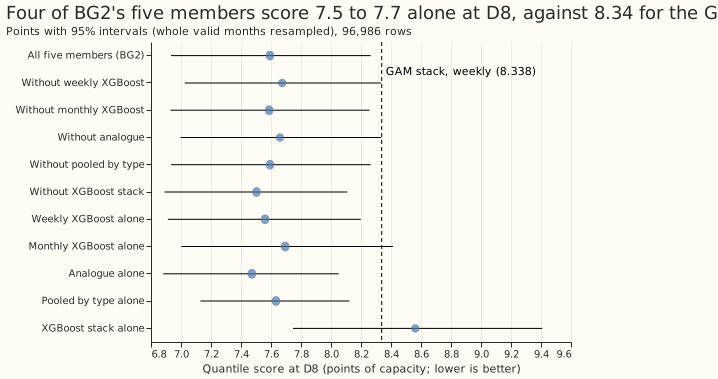
Score at D8 for each blend and each member alone
| Forecast | Score | 95% interval | Minus five-member blend | Mean absolute error of the median (MW) | q05 to q95 coverage |
|---|---|---|---|---|---|
| All five members (BG2) | 7.593 | 6.934 to 8.264 | 0 | 1.440 | 0.904 |
| Without weekly XGBoost | 7.675 | 7.025 to 8.333 | +0.082 (+0.006 to +0.180) | 1.456 | 0.895 |
| Without monthly XGBoost | 7.588 | 6.930 to 8.257 | -0.005 (-0.016 to 0.000) | 1.439 | 0.904 |
| Without analogue | 7.660 | 6.997 to 8.334 | +0.067 (+0.048 to +0.085) | 1.458 | 0.906 |
| Without pooled by type | 7.594 | 6.934 to 8.265 | +0.001 (-0.001 to +0.003) | 1.440 | 0.904 |
| Without XGBoost stack | 7.503 | 6.890 to 8.108 | -0.090 (-0.224 to +0.008) | 1.419 | 0.929 |
| Weekly XGBoost alone | 7.560 | 6.913 to 8.198 | -0.033 (-0.167 to +0.080) | 1.432 | 0.927 |
| Monthly XGBoost alone | 7.694 | 7.003 to 8.413 | +0.101 (-0.088 to +0.312) | 1.455 | 0.928 |
| Analogue alone | 7.472 | 6.882 to 8.052 | -0.121 (-0.255 to -0.013) | 1.408 | 0.925 |
| Pooled by type alone | 7.633 | 7.130 to 8.123 | +0.040 (-0.220 to +0.244) | 1.460 | 0.957 |
| XGBoost stack alone | 8.562 | 7.746 to 9.408 | +0.969 (+0.679 to +1.287) | 1.624 | 0.825 |
Intervals are 95%, from 20,000 resamples of whole valid months (seed 0). Differences are in points. The nominal q05 to q95 coverage is 0.90.
Control check at three other Primary substations (D2, D3, D4)
Each substation has 121,492 half-hourly rows: all stored rows with a lead of up to 168 hours and an observed power value.
- D2: five-member blend 2.181; drops move it by -0.003 to +0.053 points (largest: without the XGBoost stack, interval +0.026 to +0.081); the best single member (weekly XGBoost) scores 2.221.
- D3: blend 1.661; drops move it by -0.002 to +0.020; the best single member scores 1.673.
- D4: blend 2.403; drops move it by -0.020 to +0.021, all intervals include zero; the best single member (weekly XGBoost) scores 2.374, 0.029 better than the blend.
- The blend is within 0.03 points of the best single member at D3 and D4, and 0.04 points better at D2. The pooled-by-type member alone is the worst of the five at each of the three.
Checks
- Mean forecast. The stored member forecasts hold quantiles only, so there is no mean forecast to compare with the median. The mean absolute error of the median in the table ranks the arms in the same order as the quantile score for the arms with the lowest scores (analogue alone, 1.408 MW; the blend without the XGBoost stack, 1.419 MW).
- A member beats the blend that contains it (audit trigger 5). The analogue member alone scores 0.121 points better than the five-member blend (interval -0.255 to -0.013). A Sonnet agent (not Opus, because this result does not decide a model release) audited the method by re-deriving the scores from the stored D8 frame with its own code, and found no error. There were no duplicate row keys, no missing values, and no crossing quantiles in any arm. The analogue member's advantage comes from a lower median error and better coverage at the same interval width. The analogue member beats the blend in 8 of 12 months, and about half of the total gain comes from January 2026, October 2025, and December 2025 together. In November to January the blend puts weight 0.5 on the XGBoost stack member, the worst member alone, because the weights are chosen on earlier months across all 16 Primary substations. The audit calls the analogue member modestly better, on one substation over 12 months. The control check at D2, D3, and D4 shows no member beating the blend by more than 0.03 points.
Caveats and what to try next
- Blend weights. Each arm's weights are re-chosen over all 16 Primary substations, so the D8 numbers also reflect the other 15 substations.
- Actual values. D8 uses experiment 355's observed power, which models the meter's fold at the MVA level. The control check uses the raw observed series.
- Scorer. The 11 quantile levels are averaged without weights, as in experiments 252 to 355. Experiment 87's mass-weighted scorer gives 9.6 for the same BG2 rows, so the two scores are not comparable.
- One way to look further. Compare the inputs of the four non-stack members with the GAM stack's at D8.
- Code.
ml-experiments/00360-bg2-member-drop-one-at-d8/imports experiment 87's folder (e00087_assemble.py,e00087_common.py).