Can an outside prior and a causal "engine visible" switch bring D8's widened forecast bands close to nominal coverage in every quarter, and do they help or harm the other Primaries?
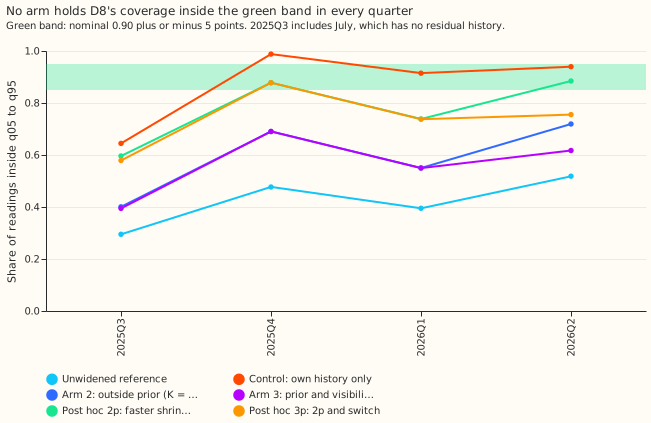
An outside prior and an "engine visible" switch did not bring D8's forecast bands close to nominal coverage in every quarter, and no other Primary needs them. D8 is one of six primary substations with stored forecasts. Its readings appear to include a 6 MW gas engine of National Grid Electricity Distribution (NGED) that appears in no measurement we hold and shows only as unexplained drops in D8's readings. A forecast band here is the range from the forecast's 5% quantile (q05) to its 95% quantile (q95), meant to hold 90% of readings. Experiment 264 widened D8's bands using residuals already seen (a residual is the reading minus the forecast median). That widening needs about a month of past residuals, so the first quarter of the scored year (July to September 2025) was poorly covered. We tested two additions. The first is a starting estimate of the widening taken from the other five Primaries' residuals, which D8's own residuals replace as they accrue. The second is a switch that returns the widening to the starting estimate once the share of half-hours more than 2.5 MW below the forecast median falls. Neither addition fixed the coverage. In the first quarter, the share of D8 readings inside q05 to q95 was 0.40 with the starting estimate, against 0.65 for widening from D8's own history only (the control). The switch turned off on 2026-04-23 as intended, but D8's lower tail stayed heavy (many readings far below the forecast), so coverage in 2026Q2 (April to June) fell from 0.94 for the control to 0.62 for the arm with the switch.
The verdict is not supported. Both pre-registered arms miss the rule at D8 (coverage within 5
points of 0.90 in every quarter, and a quantile score no more than 0.5% above the control's). The
quantile score is twice the mean pinball loss over 11 forecast quantiles, in points of effective
capacity (a unit of 0.1 MW, which is 1% of D8's 10 MW effective capacity; 9.14 is in those units and
lower is better). The control is 264's two-sided widening, rebuilt here, and it reproduces 264's D8
score of 9.14. A post hoc variant with faster shrinkage and a pool without D8 ties the control on
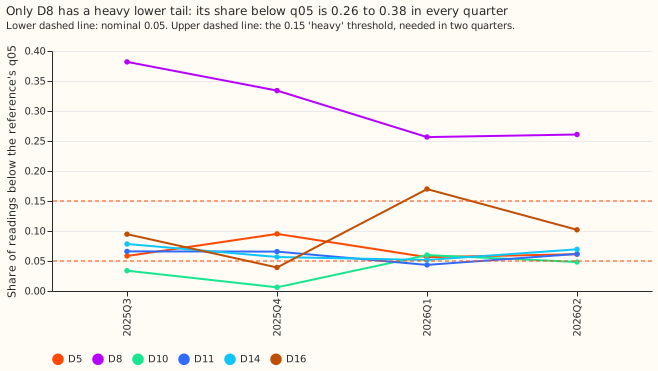
score but covers less. Only D8 has a heavy lower tail, so there is no second Primary with a heavy
lower tail on which to test whether the prior and switch generalise, and the outside prior raises
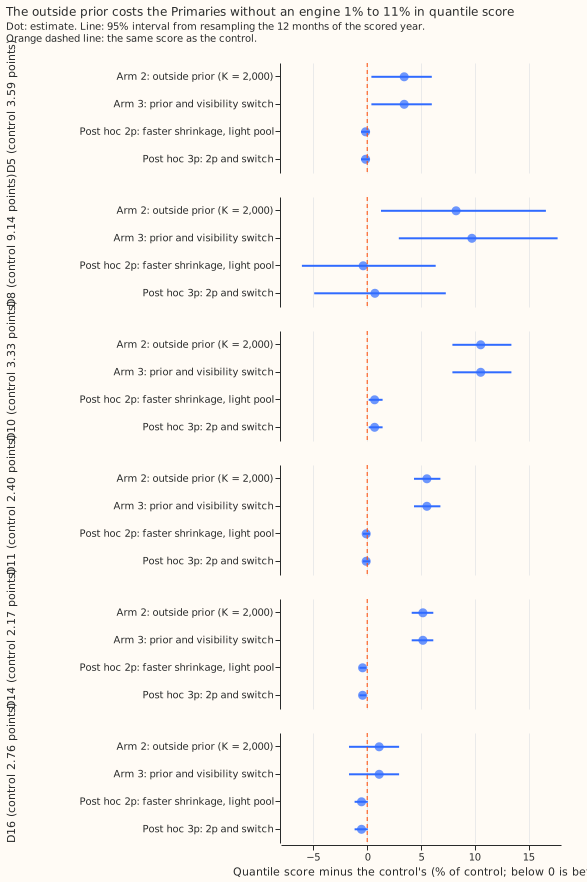
the other Primaries' quantile score by up to 11%.
Arms and rows
- Rows. Experiment 191's stored
reference forecast,
fold_a_daily_gap_v1, seed 0, 2025-07-02 to 2026-06-30, leads 0.5 to 168 hours, outside the hand-filtered events: 97,012 rows at D8 and 84,137 to 97,046 at the others. - Schedule. Every arm refits every 7 daily origins on the trailing 365 days of residuals known 6 hours before the fit. The reference's own refits are monthly, as in experiment 191.
- Arms. Control, arm 2 (prior, K = 2,000 rows), arm 2c (prior from an as-of pool), arm 3 (arm 2 plus the switch at on 7%, off 4%), arm 3 at on 5% and off 3%, and the post hoc arms 2p and 3p (K = 300 rows, pool without the heavy-tailed D8). The arm definitions are in Plan, below.
- No neural network. The brief made it conditional on beating arm 2, and arm 2 does not pass.
Results
- First quarter at D8 (July to September 2025, July included). Coverage is 0.30 for the unwidened reference, 0.65 for the control, 0.40 for arm 2, 0.40 for arm 2c, 0.39 for arm 3, 0.60 for arm 2p, and 0.58 for arm 3p. The prior is no help because the other five Primaries' lower-tail shares are 0.03 to 0.09 in that quarter against D8's 0.38.
-
Coverage of q05 to q95 at D8 by quarter (the target band is 0.85 to 0.95):
Arm 2025Q3 2025Q4 2026Q1 2026Q2 Quantile score Unwidened reference 0.30 0.48 0.40 0.52 10.95 Control 0.65 0.99 0.92 0.94 9.14 Arm 2 0.40 0.69 0.55 0.72 9.89 Arm 3 0.39 0.69 0.55 0.62 10.03 Arm 2p (post hoc) 0.60 0.88 0.74 0.89 9.10 Arm 3p (post hoc) 0.58 0.88 0.74 0.76 9.20 -
Quantile score against the control at D8. Arm 2 +8.3% (95% interval +1.3% to +16.6%), arm 3 +9.7% (+2.9% to +17.7%), arm 2p -0.4% (-6.1% to +6.4%), arm 3p +0.7% (-4.9% to +7.3%). Arm 3 against arm 2: +1.4% (+0.2% to +3.2%), so the switch makes the score worse.
- Tail calibration at D8 (share of readings below q01 and q05, above q95 and q99; nominal 0.01, 0.05, 0.95, 0.99). Control 0.036, 0.065, 0.939, 0.966. Arm 2 0.130, 0.216, 0.808, 0.888. Arm 2p 0.056, 0.116, 0.892, 0.941. Pinball loss at q05: control 2.46, arm 2 3.16, arm 2p 2.45.
- Census (share below the reference's q05, by quarter). D8 0.38, 0.33, 0.26, 0.26. Every other Primary has at most one quarter at or above 0.15 (D16 in 2026Q1, 0.17), so D8 alone has a heavy lower tail by the rule (0.15 or more in two quarters). The residual share below -2.5 MW is 0.04 to 0.12 at D8 and 0.00 to 0.02 elsewhere.
- Visibility switch. At on 7% and off 4% the switch turns on at D8 on 2025-07-04 and off on 2026-04-23, and never changes state at the other five Primaries. At on 5% and off 3% it turns on and never off. The 7% and 4% settings come from 264's sweep, so this is a fit-to-the-year check.
- Placebo Primaries, quantile score against the control (upper end of the 95% interval in brackets). Arm 2: D5 +3.4% (+6.0%), D10 +10.5% (+13.4%), D11 +5.5% (+6.8%), D14 +5.2% (+6.1%), D16 +1.1% (+3.0%). Arm 2p: D5 -0.1% (+0.2%), D10 +0.7% (+1.4%), D11 -0.1% (+0.3%), D14 -0.4% (-0.1%), D16 -0.5% (+0.1%). The rule needs +0.1% or less and an upper end of +0.5% or less, so arm 2 fails at all five and arm 2p fails at D10. Arms 3 and 2 equal each other at every Primary except D8, because the switch never changes state there.
- Hindsight in the prior. Arm 2c (prior from an as-of pool) against arm 2: +0.1% at D8 (-0.4% to +0.6%), +1.1% at D10, and +0.9% to +1.3% at D5, D11, D14, and D16. The hindsight in the whole-year prior is not what limits arm 2.
- Curtailment stand-in at D8. D8 never exports, so no export breach can occur and
studies.node_curtailmentcannot score it as an export node. The stand-in treats D8's demand as the flow under a limit offtimes the July to September 2025 maximum (8.2, 6.8, and 4.6 MW forfof 0.9, 0.75, and 0.5), scores October 2025 to June 2026, and uses the q95 quantile in node-only mode. The energy proxy (pounds, at the module's headline price; the perfect forecast scores 9.0e4, 7.6e5, and 7.6e6) is:f0.9: reference 1.8e6, control 5.3e6, arm 2p 2.3e6, arm 3p 2.2e6.f0.75: 1.4e7, 1.6e7, 1.2e7, 1.1e7.f0.5: 7.1e7, 4.1e7, 4.2e7, 4.3e7. No arm is best at every limit, and the stand-in scores the upper band, which the engine does not threaten, so it does not test the claim of this experiment. - Predictions. P1 failed (first-quarter coverage 0.40 for arm 2, below the control's 0.65). P2 failed (+8.3%). P3 held (the switch turns off once, on 2026-04-23, and never changes state elsewhere). P4 failed (2026Q2 coverage 0.62, and arm 3 scores 1.4% worse than arm 2). P5 failed (only D8 is heavy). P6 failed (arm 2 raises the score at all five placebos).
Checks
- Median minus mean forecast. Zero at every Primary for the control and arm 2p (the arms keep the reference's median and mean).
- Mean-forecast error. Every arm keeps the reference's mean forecast, so the mean absolute error is identical across arms (D8 15.18, D10 5.54 points) and no contrast can disagree with a mean-forecast contrast.
- Triggers. The placebo trigger fired (the placebo rule failed for arm 2 at five Primaries and for arm 2p at D10), the contradicted-prediction trigger fired (five of six predictions failed). The leave-one-site-out style trigger fired too: leaving out one month flips the sign of the arm 2p and arm 3p contrasts with the control at D8, whose intervals span zero, so the verdict does not rest on arms 2p or 3p.
- Audit. A fresh Sonnet agent (the maintainer's brief bars Opus) re-derived the D8 and D10 scores and coverage from the stored predictions, and they agree. It shifted D8's actuals by -40 points after 2026-01-10 and found every row at earlier origins identical for the control, arms 2, 3, and 2c, so the own-history fits are causal, and the 6-hour latency holds. It found no bug. Triaged findings, all accepted and recorded as caveats: the whole-year prior leaks the other Primaries' future (small: +0.1% at D8, +1.1% at D10 for the as-of pool); the control applies no widening before 2025-08-06 while arms 2 and 3 apply the prior from day 1; the shrinkage weight never exceeds about 0.35 at K = 2,000, so the prior dominates, which drives arm 2's D8 failure; and arms 2p and 3p were chosen after seeing arm 2's score, so they are exploratory.
Caveats and what to try next
- Fit to the year. The 7% and 4% switch settings and the census rule use the scored year, and there is no second year of D8 forecasts.
- The prior uses future residuals. It takes the whole scored year of the other Primaries, which a live service would not have, and the control skips widening for its first 28 days, so July is not like for like.
- Arms 2p and 3p are post hoc. K = 300 and the pool without D8 were chosen after arm 2 failed.
- Next. Store D8 reference forecasts for an earlier period so the first quarter starts with residuals, or ask NGED for the engine's own output. The small neural network for the widening factor was not run, because the condition for it (arm 2 passing) was not met.
Plan (as pre-registered)
The question: can plain as-of widening be made close to nominal in every quarter, including the first quarter with no history, and does it generalise to other Primaries with price-driven generation? Pass rules, judged for a candidate arm at D8: (a) coverage in [0.85, 0.95] in every quarter; (b) quantile score at most 0.5% above the control's; (c) at each non-heavy Primary, the score against the control rises by at most +0.1% (point) and +0.5% (95% upper end).
Arms
All arms use the same rows as 264 and the same as-of rule: a residual enters a fit only if its valid time is at least 6 hours before the fit, fits repeat every 7 daily origins, and the window is the trailing 365 days.
-
Control. 264's arm 2b: widen both tails by cell quantiles (six-hour block by season) of the ratio of the residual to the band's half-width, from the site's own window, applied from 28 days of history. Reproduced here, and checked against 264's printed D8 quantile score of 9.14.
-
Arm 2, prior. The same cells, but each cell's quantile is the weighted mean
w * own + (1 - w) * priorwithw = n / (n + K), wherenis the cell's count of own resolved rows andK = 2,000rows (about 6 weeks). With no own rows the table is the prior, so the widening works from the first origin. The prior is the pooled cell quantiles of the ratios of the five Primaries other than the one being widened (D8's pool is D5, D10, D11, D14, and D16, and each other Primary's pool includes D8), over the whole scored year. This uses residuals from after the fit date, which a live service would not have. Arm 2c is the same with the pool restricted as-of to the fit window (falling back to the whole-year prior until 28 days exist), which shows how much the hindsight in the prior matters. -
Arm 3, visibility switch. Arm 2, but the own rows in the fit window are only those taken while the switch had the same state as at the origin. The switch is on when 7% or more of the last 30 days' resolved half-hours had a residual below -25 points (-2.5 MW), and off when the share falls below 4% (hysteresis). When the switch is off and the site has few off-state rows, the widening is the prior, which is the "normal" widening. The 7% and 4% settings come from 264's sweep, which found that 5% and 3% never turn off, so the 7% and 4% settings are post hoc. The 5% and 3% settings are run as a sensitivity check. Flip dates are reported at both.
-
Census, then application. For all six Primaries with stored forecasts the census prints, by quarter, the share of readings below the reference's q05, the share above q95, and the share of residuals below -25 points. A site has a heavy lower tail when the share below q05 is 0.15 or more in at least two of the four quarters (nominal 0.05). Arms 2 and 3 are run at every site, and a site that is not heavy is a placebo, which must not worsen under rule (c). The other heavy sites, if any, are scored by rules (a) and (b).
-
Curtailment cost at D8. D8 never exports (its readings run from 0 to 99 points, never negative), so the export breach that
studies.node_curtailmentscores cannot occur at D8. The stand-in treats D8's demand as the flow that must stay under a limit. The limit isftimes the maximum reading in the first quarter (July to September 2025), forfof 0.9, 0.75, and 0.5. The score runs on October 2025 to June 2026 in node-only mode, with 10 MW effective capacity (0.1 MW per point) and the breach ratio 20, and the manual-heuristic arm is not computed. The stand-in exercises the upper band, not the lower band that the engine threatens, so it cannot show the engine's effect on a generator export. -
Neural network for the widening factor. Not run. The brief makes it conditional on beating arm 2 by a pre-registered margin.
Resources and reviews
CPU only, 4 cores, thread caps of 1, memory capped at 16 GB. One Sonnet reviewer reads the code for
leakage and one checks the write-up against the printed report, then a prose review. An audit by a
fresh Sonnet agent runs if a trigger in the ml-experiment skill fires.