Does a small monotone neural network between the solar forecast and the demand model beat the hard clip?
On top of the hard clip, the network lowers sunny-daylight error a little, but not by the 50% of the remaining gap that the plan required. The network reads the solar term after the 60% clip, the clear-sky index, the hour, and the cap. At D5 the network lowers the sunny-daylight error by 0.028 MW against the clip alone (figure 1).
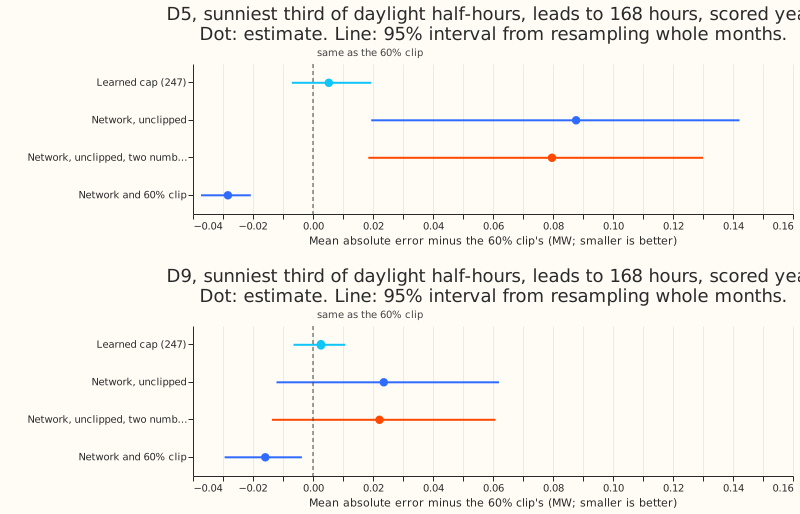
Figure 1. Each arm against the 60% clip at D5 and D9. Smaller is better.
At D5, the network without the clip is worse than the clip. The network on the unclipped solar term raises D5's sunny-daylight error by 0.088 MW (0.019 to 0.142) against the clip, and adding the mean and standard deviation of the 51 members' solar responses lowers that excess by 0.008 MW.
| Arm | D5 gap to BG2 (MW) | D5 closure beyond the clip | D9 closure beyond the clip |
|---|---|---|---|
| 60% clip | 0.069 | 0% | 0% |
| Network and 60% clip | 0.041 (0.008 to 0.062) | 41% (28% to 81%) | 38% (-59% to 221%) |
| Network, unclipped | 0.157 | -127% | -56% |
| Network, unclipped, two numbers | 0.149 | -115% | -53% |
The gap is the mean absolute error of the median minus BG2's, on the sunniest third of daylight half-hours. The closure at D9 is unstable because the clip's own gap there is 0.042 MW with an interval that includes zero.
The placebos change by less than 0.01 MW. The network and clip arm changes the all-half-hour error at D10 and D16 by -0.002 and -0.003 MW against the clip (figure 2), inside the 0.01 MW limit.
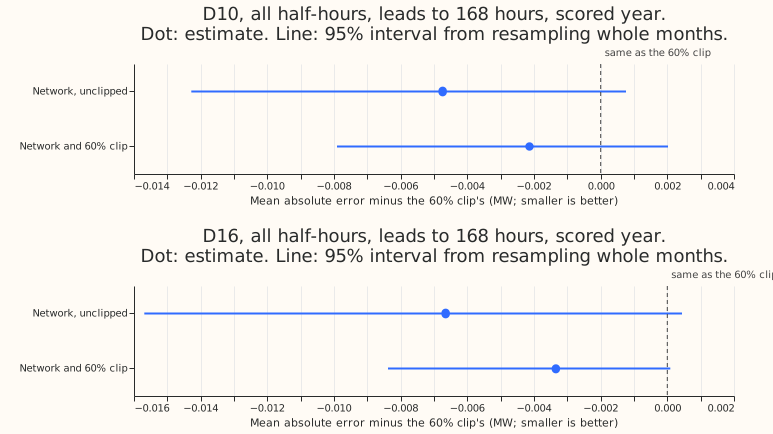
Figure 2. The network arms against the 60% clip at D10 and D16, all half-hours.
The tail check fails for the clip and the network alike. At D5 the 95% quantile covers 99.5% of sunny-daylight half-hours (the clip alone: 99.6%) and 92.3% of all half-hours (the clip alone: 92.3%). Both coverages are more than 2 points from 95%.
Checks
- The learned-cap arm of experiment 247 scores 0.005 MW worse than the clip on D5's sunny-daylight rows (-0.007 to 0.019), so it does not close the gap either.
- The band-width factors are fitted on the same rows as the network, of which 85% are in the network's training split. That may narrow the bands and contribute to the 92.3% coverage.
- Each network fit uses only forecasts whose valid time falls in the 12 months before the monthly cut. The early-stopping rows are the latest 15% of those rows.
- The network's output at a zero solar term is subtracted, so the network removes nothing at night.
- The network replaces the solar term in the stored forecast of the unclipped arm (experiment 180) or the 60% arm (experiment 214). The Kalman filter in each stored forecast adapted to its own solar term, not to the network's output.
- Each network is the mean of 3 seeds.
Which clip form the final assembly should use
Use the hand-set 60% clip alone. The network removes 0.028 MW at D5 and 0.016 MW at D9 of sunny- daylight error, for a trained component on the serving path.
What the next experiment should answer
A network trained end to end inside the demand model's loss, so the filter adapts to its output, would test whether the stored-forecast replacement in this experiment held the gain down.