Photovoltaic (PV) capacity: does fitting only on clear, high-sun half-hours help?
Take-home message: fitting the solar capacity only on clear, high-sun half-hours does not find more of an injected solar farm, and the interval gets wider. Consistent with experiment 231, the irradiance input does not appear to be the limit, and restricting the rows seems to move the loss into the demand terms.
What was done. We added the recorded output of a real solar farm to a Primary substation's power, at 50% of the Primary's pinned capacity (the unmetered solar capacity that experiment 45's real-time estimate gives the Primary). Then we asked the capacity fit of experiment 129 how much of the farm it finds again, using only the half-hours where the Primary's satellite irradiance is at least 0.9 of its clear-sky value, the clear-sky irradiance is at least 200 watts per square metre, and the sun is at least 20 degrees above the horizon. The share found is the recovery: the capacity found with the farm added, minus the capacity found without it, divided by the injected capacity. The five farms A, B, C, D, and F are metered generators and are never named. D5, D10, D11, D14, and D16 are the five decision Primaries of experiment 103's data set, and D9 is shown beside them. The recovery is read at season-year 2024 (July 2024 to June 2025), and the capacity unit is the 99th percentile of alternating-current output over daylight half-hours, in MW.
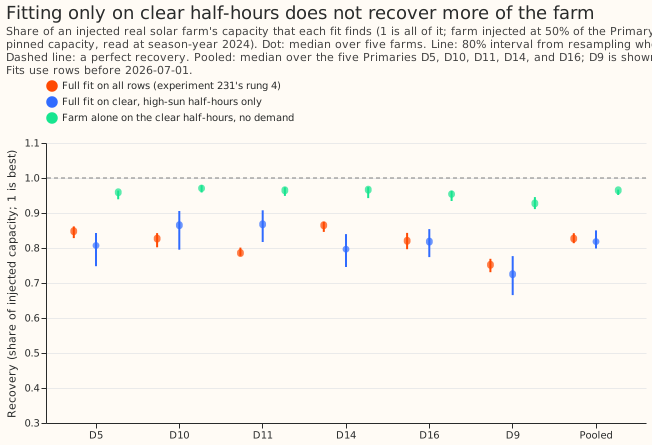
Figure 1. Clear half-hours leave the recovery at about 0.82 and widen the interval.
Findings
- The pre-registered prediction failed. The recovery was to rise by at least 0.05 at 4 of the 5 decision Primaries and the interval was to widen by no more than 50%. The rise was at least 0.05 at 1 of 5 Primaries (D11, +0.082), and the interval was no wider than 1.5 times at 0 of 5.
- Pooled recovery (median over five farms, then over the five Primaries; 80% interval from resampling whole months): 0.827 (0.814 to 0.842) on all rows and 0.818 (0.799 to 0.851) on clear rows. The change is -0.002 (-0.040 to 0.023). The pooled interval is 1.8 times wider on clear rows.
- The farm alone fits better on the clear half-hours (0.965; 0.951 to 0.967), but the full fit does not. Demand absorption, the farm-alone scale minus the full-fit recovery, is 0.147 on clear rows and 0.104 on all rows (experiment 231's rung 1, the farm alone on all daylight half-hours, minus its rung 4, the full fit on all rows: 0.931 and 0.827). A possible cause is that the clear-day solar curve is smooth. A smooth curve is closer to the seasonal demand terms, so the demand terms may take more of it. The smooth-curve explanation was not tested directly here.
- The clear rows are a small share of the training rows. At the five decision Primaries, 5,600 to 5,900 of 78,000 to 89,000 training half-hours remain (3,300 of 45,000 at D9), and 1,300 to 1,600 remain in the read-out season-year.
- The all-rows fit reproduces experiment 231's full fit (the maximum absolute difference over every Primary and farm prints as 0.000 at three decimals).
Checks
- Data cut: the fits stop at 2026-07-01, so the maintainer's labelled exception (data to 2026-07-31) is not used. No forecast is scored.
- Median forecast minus mean forecast, and the mean-forecast error: not applicable, because the experiment scores no forecast.
- Audit triggers (the seven triggers in the
ml-experimentskill's "Audit before merge"): none fired. The result contradicts the pre-registered prediction, but experiment 231 had already lowered that prior and the result agrees with its finding that the irradiance input is not the limit. The coverage test of experiment 129 (23 of 30 cells) was not re-run; the interval-width condition stood in for it. The intervals are month-block bootstrap intervals only; the plan's range over the five farms is not reported. - No Opus audit was run. The ML manager decided that quota did not allow an Opus review of any of this series' experiments, so the judgement that no trigger fired has no Opus audit, and a Sonnet reviewer read the code and the page instead.
What the next experiment should answer
- Reduce demand absorption. Matched sunny-minus-cloudy day pairs (experiment 235) target demand absorption directly.
- Neural components: a learned smooth response of the demand's dependence on irradiance could separate the demand's cloud response from the solar term. The prediction that could fail is a full-fit recovery of 0.90 or more on all rows.
Plan: design
- Rows. The row rule is applied through month weights and a row mask on the per-month Gram matrices (the sums of products of the design columns), as in experiment 231, so that the base and injected fits share one row set.
- Demand terms. The demand columns of the fit are unchanged. On clear days the solar shape is closer to a smooth seasonal curve than on all days, so the demand harmonics may absorb more of it; the experiment reports demand absorption as the contrast between the farm-only scale on clear rows and the full fit on clear rows.
- Reported rows. The recovery on clear rows, the recovery on all rows (rung 4 of experiment 231), the number of training rows kept, and the share of each season-year kept.
- Intervals. A month-block bootstrap, 200 resamples, stratified as in experiment 231, and the range over the five farms.
Plan: checks
- Reproduction: with the row rule switched off the script must reproduce experiment 231's rung 4 at every Primary and farm to within 1e-6.