Does a wind-turbine physics model with an explicit idle layer forecast the three metered wind farms as well as the XGBoost best guess, and is the weather input the limit?
Take-home: the physics model is slightly worse than XGBoost, and the wind forecast is the limit. A physics model of a wind farm scored 0.13 points of capacity worse than the XGBoost best guess on the three metered wind farms, so we should not port it. The score is far better when ERA5 supplies the wind, which shows that the error in the ensemble wind forecast, which ERA5 does not have, causes most of the error.
Results
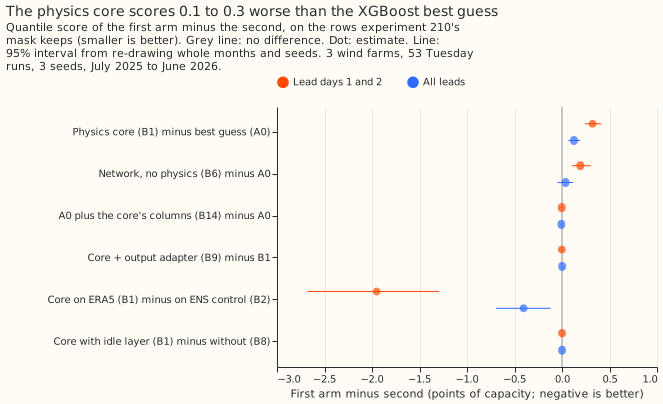
Scores are the quantile score (an estimate of the continuous ranked probability score) in points of capacity (smaller is better), on the rows that experiment 210's mask keeps, over all lead times, for W1, W2, and W3 across 53 Tuesday runs from July 2025 to June 2026. The intervals resample whole months and the three seeds, and do not resample farms, so they describe these three farms only.
- C1, the decisive contrast: the core minus the best guess is +0.126 (95% interval 0.068 to 0.190). At lead days 1 and 2 the contrast is +0.322 (0.241 to 0.413). The core is worse, so the porting threshold (an interval wholly below zero) is not met.
- C4: the idle layer does not change the score (B1 minus B8 is 0.000, interval -0.002 to 0.002). The residual-quantile layer already carries the reactive-power floor.
- C2: the neural output adapter (B9) adds nothing (+0.002, -0.004 to 0.007).
- C3: training the core on ERA5 beats training it on the ENS control member by 0.40 (interval 0.12 to 0.69). At lead days 1 and 2 the gap is 1.95 points. Most of the gap comes from W1 and W3; W2 contributes least.
- XGBoost on the core's output (B5) closes about half the gap (B5 minus B1 is -0.060, -0.120 to -0.004), and still trails the best guess.
- The pure neural network (B6) is no better than the best guess (+0.037, -0.047 to 0.115).
- The best guess with the core's columns added (B14) equals the best guess (-0.007, -0.014 to 0.000).
- ERA5, the past-weather estimate, as the forecast (E0) scores 6.71 against 11.79 for B1. The error in the ensemble wind forecast, not the power curve, causes most of the error.
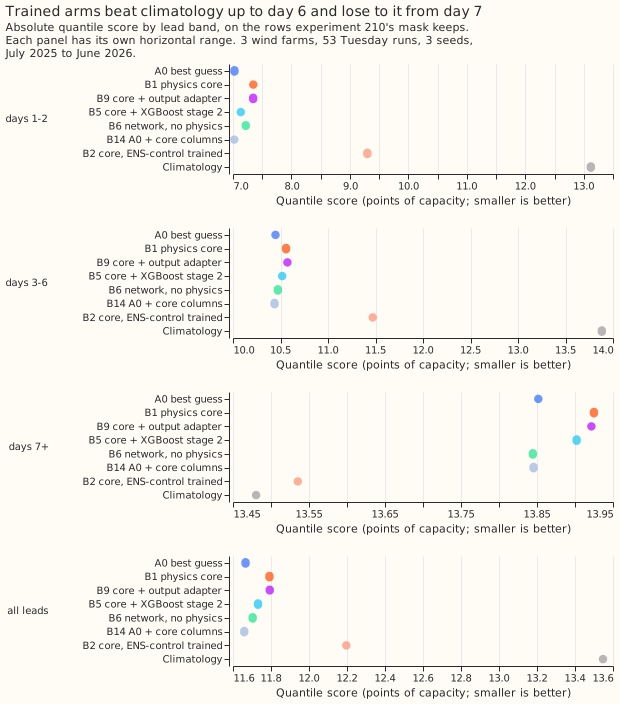
| Arm | Description | Kept rows, all leads | Kept rows, lead days 1 and 2 | All rows, all leads |
|---|---|---|---|---|
| A0r | Best guess, refitted here | 11.66 | 7.03 | 11.04 |
| B14 | Best guess plus the core's columns | 11.66 | 7.02 | 11.03 |
| B6 | Neural network, no physics | 11.70 | 7.22 | 11.08 |
| B5 | Core plus XGBoost stage 2 | 11.73 | 7.13 | 11.09 |
| B1 | Physics core, ERA5-trained | 11.79 | 7.35 | 11.14 |
| B9 | Core plus neural output adapter | 11.79 | 7.34 | 11.14 |
| B8 | Core without the idle layer | 11.79 | 7.35 | 11.14 |
| B2 | Core, ENS-control-trained | 12.20 | 9.30 | 11.68 |
| A1 | Best guess, ENS-control-trained | 12.17 | 9.24 | 11.67 |
| CLIM | Climatology | 13.55 | 13.12 | 13.12 |
| E0 | ERA5 as the forecast (reference) | 6.71 | 6.36 | 6.32 |
Beyond day 7, climatology (13.48 on the kept rows) beats every trained arm (13.53 to 13.93). The tails behave alike across arms: on the kept rows the 0.01 pinball loss is 0.285 to 0.288 and the 0.99 loss is 0.658 to 0.676 for A0r, B1, B5, B6, and B14, and the 5% to 95% band covers 91.4% to 91.7% of rows. Persistence on hours 0 to 6 scores 15.57, worse than every other arm.
Step 0: the ERA5 ceiling
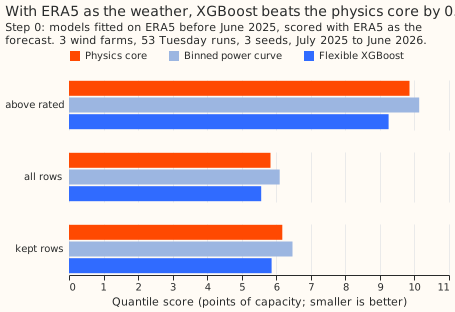
- With ERA5 as the weather, a flexible XGBoost model (X) beats the physics core (P) by 0.27 points and the binned power curve (S) by 0.54 (interval 0.43 to 0.64) on all rows. The gate asked whether S was within 0.02 of the ceiling. It was not within 0.02 of the ceiling, so the other arms ran.
- The core explains 0.84, 0.76, and 0.72 of the power's variance (R squared) at W1, W2, and W3. X explains 0.85, 0.77, and 0.75.
- Stop rule 3 fired literally at W2. The 5% to 95% band of B1 covered 59% of W2's idle rows (threshold 80%). W2 reports power in MW, not MVA, so observed idle power can be negative. Every arm clips forecasts at zero, which is shared by every arm, so the arms stay comparable.
Comparison with experiment 221
Experiment 221 put a neural head on the stored best guess, and found no reliable gain. On its own scored rows at lead days 1 and 2, its best guess scored 7.223 and its head 7.403, 0.18 points worse. Here, on different rows, the physics core is 0.32 points worse than the best guess and the neural network with no physics (B6) is 0.19 points worse at the same lead days. A neural head and a physics core therefore both fail to beat XGBoost on these three farms.
Checks
- Median minus mean: the median of the forecast sits 5.2 points below the mean on the kept rows for A0r and 5.3 for B1, so all arms share the same skew and the mean-error contrasts agree in direction with the quantile-score contrasts.
- A0r reproduces A0 on the nine shared levels (11.035 against 11.037, all rows).
- Leave-one-farm-out: C1 stays positive without any single farm (0.11 to 0.14), and C3 stays negative, though its interval includes zero without W1 or without W3.
- Row sets: on the rows above the farm's fitted rated speed, C1 is +0.43 (0.30 to 0.57). On all rows it is +0.10.
- Audit triggers 1 and 4 of the
ml-experimentskill fired, and trigger 7 may have. No Opus audit was run, because the manager ruled it out to save quota.
Departures from the plan
- ENS control member: A1 and B2 train on the ENS control member, not on the ENS mean.
- Temperature-only density correction: ERA5 surface pressure is not on disk, so the core uses a fixed 100 kPa.
- Idle layer: the idle layer shapes the mean, and the spread comes from the residual quantiles.
- Hub height: the fitted hub heights (32 to 37 m) are not physical, because they absorb the 25 km cell's sub-grid wind.
- Seeds: the physics arms are deterministic, so their three seeds repeat one fit.
- Post hoc arms: E0 (ERA5 as the forecast) and A0rT (A0r with air temperature) were added after the plan.
- Not run: B10 to B13, the no-history tests, and the curtailment-cost metric.
What the next experiment should answer
How much of the 5-point gap between the ensemble wind forecast and ERA5 wind can a better forecast input, such as a blend of weather models, close?