Faster Kalman level state when the residual keeps one sign
Take-home: this test could not tell whether a faster level state helps. The gated version scored the same as the current filter and the always-fast version scored worse. The gate could not have been passed by any filter with one state per hour band, so the null says little about filter speed. A redesigned gate and a wider grid of multipliers are the fair test.
We asked whether a Kalman filter that speeds up its level state when the recent forecast errors keep one sign cuts the loss on days when the forecast error keeps one sign for hours, without harming ordinary days. The level state is the slowly moving offset that the filter adds to the forecast. The filter is that of the convex demand model (experiment 111), and the forecast it corrects is the best-guess forecast of experiment 155 (arm D). We first added a known one-signed offset to the observed power of ordinary days and measured how much of its extra loss each filter removed. We then scored the filters on the real scored year at the five decision Primaries. Arm D is rebuilt here to the stored quantile score (2.7562 points against 2.756 points, inside the plan's tolerance of 0.005 points).
Verdict: inconclusive, by the pre-registered rule that a failed gate caps the verdict. The
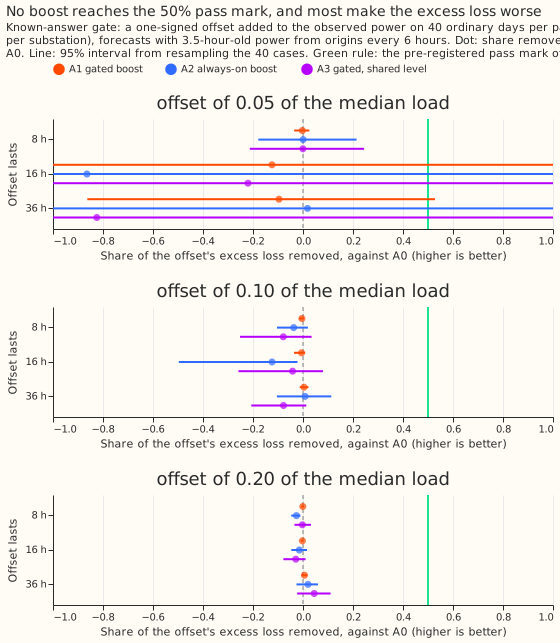
gate asked for at least 50% recovery of the extra loss, for an offset of 0.10 of the day's median
load lasting 16 hours and lasting 36 hours. The gated boost recovered -0.6% (95% interval -3.6% to
+0.9%) and +0.4% (-1.3% to +2.2%). The audit found that the gate's ceiling lies far below the pass
mark (see "Audit").
Arms and method
- A0: arm D of experiment 155: the T-all fits on the ensemble-mean weather (experiment 136's A2), the winter night offset, and recipe R, with the spread refitted on the tuning months.
- A1, A2, A3: only the level's process noise changes, as in the plan. A1 multiplies it by m while the counter is on. A2 multiplies it at every reading. A3 is A1 with the level increment shared across the four hour bands. The counter reads the one-step innovations in time order across bands.
- Tuning: the grid of 18 settings was scored on the odd tuning months of 2024-07 to 2025-06 at stage 1, with A0's spread held fixed. The pre-registered point (m 5, k 6, z 1.0) scored 2.7506 against A0's 2.7486. The best cell (m 5, k 8, z 0.5) scored 2.7450, 0.0056 below the pre-registered point, which passes the 0.005 rule, so the frozen setting is m 5, k 8, z 0.5.
- Row set:
fold_a_daily_gap_v1, the five decision Primaries (D5, D10, D11, D14, D16), leads 0.5 to 168 hours, 464,363 rows outside switching events. Telemetry delay 3.5 hours. Retraining schedule: monthly T-all fits stored by experiment 136; the contrast could depend on the schedule only through the filter's residuals, which every arm shares. - Gate (lab shortcuts): offsets of 0.05, 0.10, and 0.20 of the day's median load lasting 8, 16, and 36 hours, 8 days per substation per cell (40 per cell), on days of the even months. The forecast of a half-hour is the proxy-weather prediction plus the filter's correction, with origins every 6 hours. The loss uses a quantile table from the clean tuning-month errors. A matched 40 days without injection show the harm.
Results
Scores, scored year, quantile score in points (lower is better):
- A0 2.7562, A1 2.7564, A2 2.7791, A3 2.8336 (spread refitted). Stage-1 versions: 2.7910, 2.7904, 2.8232, 2.8969.
- With experiment 169's calibrated spread held fixed: A0 2.7521, A1 2.7568, A2 2.7897, A3 2.8499.
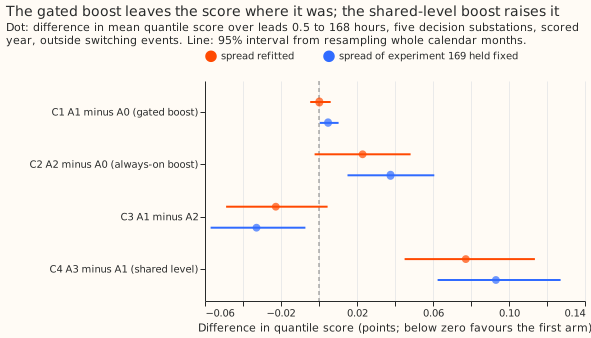
- C1 A1 minus A0: +0.0002 (95% interval -0.0046 to +0.0062; 1 of 5 substations better). With the fixed spread: +0.0048 (+0.0004 to +0.0103), a small loss.
- C2 A2 minus A0: +0.0229 (-0.0023 to +0.0482). C3 A1 minus A2: -0.0227 (-0.0489 to +0.0045). C4 A3 minus A1: +0.0773 (+0.0450 to +0.1136; 0 of 5 substations better).
- The gate's counter was on for 0.6% to 1.2% of readings at the five substations (326 to 585 triggers).
Pre-registered predictions:
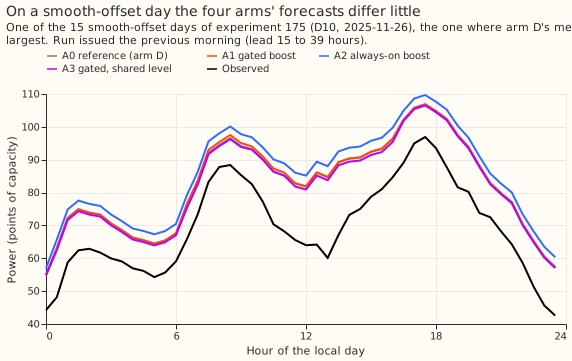
- P1 fails. On the 15 smooth-offset days of experiment 175, A1 changed the excess loss by -1.4% (interval -2.5% to +0.3%); a cut of 20% was predicted.
- P2 holds with the refitted spread. A1 minus A0 is +0.0002 and the upper bound is +0.0062. With the fixed spread the upper bound is +0.0103, just above the +0.01 limit.
- P3 holds on the point estimate only. A1 beats A2 by 0.023 points, with an interval that includes zero (excluding it with the fixed spread: -0.033, -0.057 to -0.007).
- P4 fails. A3 changed the excess loss on the smooth-offset days by -9.5% (-20.4% to +6.4%), worse than A1.
- P5 holds. On the 17 block days A1 cut the excess loss by 1.5% (+0.1% to +3.7%).
Known-answer gate:
- A1 recovered -0.4%, -0.6%, and +0.4% of the offset's excess loss at the 0.10 size for 8, 16, and 36 hours. At the 0.20 size the values for A1 were within about 3% of zero.
- The excess loss of A0 at the 0.10 size was 1.5, 1.0, and 0.9 points of quantile score, so there was loss to recover.
- A1 minus A0 on the 40 left-alone days: -0.001 points (-0.014 to +0.014); A2 +0.079 (+0.001 to +0.159); A3 +0.015 (-0.074 to +0.111).
- Post hoc, a multiplier of 100 on A1, A2, and A3 recovered less: -110% to +10% at the 0.10 and 0.20 sizes (A1: -25% at 16 hours, A2: -45%, A3: -114%), 40 cases per cell.
- The harm half of the gate also failed: A1 minus A0 on the left-alone days has an interval of -0.014 to +0.014, wider than the pass mark of +0.005, and the post hoc multiplier of 100 on A1 raised the quantile score by 0.28 points (+0.15 to +0.42).
- Wiring check (
e00190_wiring_check.py): on a stream with no noise, A0 follows a 7.8-point offset to between 4.9 and 7.1 points, A1 to between 5.2 and 7.1, and A3 also moves the bands that have not yet been read, as designed (8.6 points in one band). The code does what the plan specifies.
Audit
The audit (a fresh Opus agent, private brief e190_audit.md) re-derived the gate losses to within
4e-15 points, and found no bug in the injection, the filter, the reproduction, or the tuning. It
made three findings about the design:
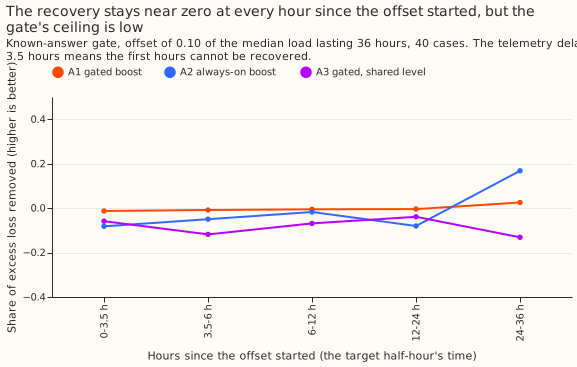
- The gate's ceiling lies below its pass mark (F1). The filter keeps one state per hour band, the telemetry delay is 3.5 hours, and the first origins come 6 hours before the offset starts. On most pairs the target's band has not been read since the offset began, so every per-band filter gives the clean correction there. An oracle that knew the offset exactly, but only where the target's own band had been read, would recover 0.5% (16 hours) and 9% (36 hours) at the 0.10 size. An oracle that used any band would recover 25% and 39%. No filter could have reached 50%.
- Faster filters do recover where the offset is visible (F2). On pairs whose band had been read since the offset began, the always-on boost recovered 52% (0.10 size, 36 hours) and a multiplier of 100 recovered 69% (0.20 size, 36 hours). Those pairs are a small share of all pairs (2% to 38%).
- A multiplier of 5 barely changes the filter (F3). At steady state the level gain rises from 0.066 to 0.082, because the autoregressive transient already supplies a total gain of about 0.38. The gated boost is therefore close to arm D by construction.
The scored-year contrasts and the verdict stand.
Checks
- Median forecast minus mean forecast per site: 0.00 at every site and arm.
- Mean-forecast error beside the quantile score: C1 on the mean absolute error is +0.0060 (-0.0011 to +0.0139), the same direction as the quantile score; C3 is -0.0567 (-0.0971 to -0.0157).
- Tails (all rows, q95 coverage 0.947 to 0.949 for every arm; q99 0.983 to 0.984). On the 5,395 cold-night rows: q95 coverage 0.837 (A0), 0.841 (A1), 0.858 (A2), 0.763 (A3); quantile score 3.342, 3.317, 3.309, 3.765.
- Rows within 24 hours after a trigger (194,765 rows): C1 +0.0009 (-0.0060 to +0.0083).
- Audit triggers: trigger 1 fired (the known-answer gate failed) and the audit above ran.
- Curtailment cost was not scored: this experiment has no generator forecasts to feed the node-plus-generators metric.
Caveats
- The gate runs on the proxy-weather forecast, not on ensemble weather, so it removes weather error from the comparison.
- The gate as run cannot be passed (see "Audit"), so its recovery numbers are not a measure of filter speed.
- Tuning used the stage-1 score, not arm D's, and every setting was scored with A0's spread table, which understates the gain of a setting whose errors are smaller.
- The counter counts readings, so after a gap in the data it can span more than the stated hours.
- The subsets "within 24 hours after a trigger" and cold nights are defined after the fact, from triggers and temperatures that a run at the origin could not yet see.
- The post hoc settings (
a1_fast, and the multiplier of 100) are diagnostic only.
What to try next
- Redesign the gate: score recovery only on pairs whose target band has been read since the offset began, or as a share of the oracle ceiling, and start origins after the offset starts.
- Widen the grid of multipliers beyond 10 (the audit's multiplier of 100 recovered 69% where the offset was visible), and test whether a shared level across bands removes the per-band limit.
- Look at the mean model as well: on the plotted day every arm forecasts about 10 points too high all day.
- A small learned correction that reads whether several neighbouring Primaries show the same-sign residual (a neural head on the filter's innovations). The prediction that could fail: it recovers at least 20% of the excess loss on the 15 smooth-offset days, which none of the four filters here did.