Experiment 189: can a small neural network, trained on realistic injected transfers, find real load shifts?
A small neural network (33,604 learned weights), trained only on synthetic transfers, found 7 of the 35 real transfers that lasted longer than 1 day. The rule-based detector RO-NC found 18. A transfer is a period, labelled by hand in experiment 41, in which switching moved load from one Primary substation (a substation that steps transmission voltage down to distribution voltage) to neighbouring Primary substations. A transfer counts as found when an alarm falls within 2 hours of its start and the alarm's end falls within the larger of 6 hours and 10% of its duration of the true end. RO-NC is the refit-offset neighbour-count detector of experiment 82, scored at 80 unexplained alarms in experiment 181: an unexplained alarm is one not near a logged closure or labelled transfer, and the count is over odd-numbered months.
We built an injector that adds synthetic transfers to the real residuals (observed minus forecast
power from the convex demand model of experiment
130). Its depth, duration, start time,
shape, and receivers are fitted to the real events. We trained the network on 7-day windows of one
Primary substation's residual and its neighbours', and scored it on real transfers of Primary pairs
it had never seen. The verdict is refuted, because the pre-registered prediction was at least 15
found. The start of a transfer is learnable, and the end is the weak part. The network placed
the start within 2 hours for 12 of the 35 transfers (17 after a second, longer training run),
against 20 for RO-NC, and the median start error among transfers found was 0.5 hours.
Results
- Architecture. Dilated one-dimensional convolutions, 33,604 weights. Inputs: 336 half-hours of the Primary's residual and the four most-read neighbours' (each divided by its noise unit, with a present-or-not channel), the hour of day, and a bank-holiday flag. Outputs: a start alarm, an end alarm, and a per-half-hour map for each. The network assigns each onset alarm the earliest end alarm after it as its end.
- Training data. D8 and D9 are two of the 16 Primary substations. Windows come from even-numbered months only: 80,000 windows per fold (40% with an injected transfer, the rest real stretches with no logged or labelled event, a fifth near bank holidays, a fifth on D8, a fifth on D9). The network never sees a real event.
- Folds. The 66 labelled transfers fall in 23 Primary pairs, grouped into 3 folds. Each fold's network and injector are fitted without that fold's pairs (including D8 drops that overlap them).
- Real transfers over 1 day (35), 80 unexplained odd-month alarms, experiment 130's rule (start within 2 hours, end within the larger of 6 hours and 10%):
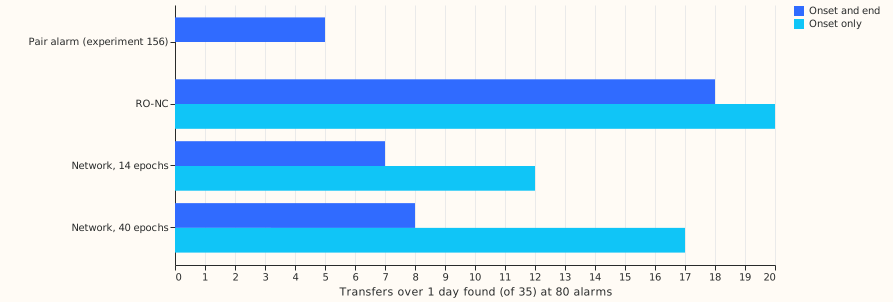
| Detector | Start and end found | Start only found |
|---|---|---|
| Pair alarm (experiment 156, quoted) | 5 | not run |
| RO-NC on the convex residual | 18 | 20 |
| Network, 14 epochs (pre-registered, seed 0) | 7 | 12 |
| Network, 40 epochs (post hoc, seed 1) | 8 | 17 |
- All 66 labelled transfers: the 14-epoch network finds 12 (start only 23) and the 40-epoch network 19 (start only 31), against 18 for RO-NC. The 31 transfers of 24 hours or less are mostly found by start alone.
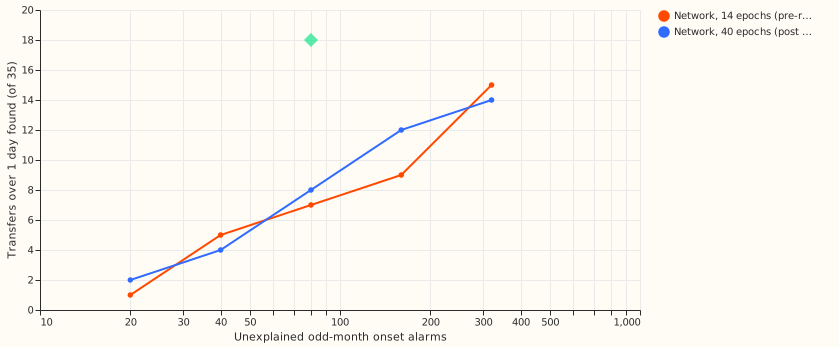
- Found against alarms (35 transfers). Pre-registered network at 20, 40, 80, 160, and 320 alarms: 1, 5, 7, 9, 15. Post hoc network: 2, 4, 8, 12, 14.
- Median start error of found transfers: 0.5 hours (both networks).
- Injected transfers (odd months, same thresholds), start and end found: 21% to 34% for the 14-epoch network (21% on Primary pairs it never saw, 34% on the pairs the injector was fitted on), 21% to 23% for the 40-epoch network. The network is as weak on injected as on real transfers, so the failure is not that the injector is easier than the real events.
- Realism check 1. A logistic regression on nine features measured from the residual (log depth in noise units and in MW, log duration, start hour as sine and cosine, weekend flag, day-night difference, count of opposite neighbours, balance, series count) separates real from injected events with area under the curve 0.59 (95% 0.52 to 0.66; 63 real events against 336 injected). The point estimate meets the pre-registered limit of 0.65, the upper end of the interval does not.
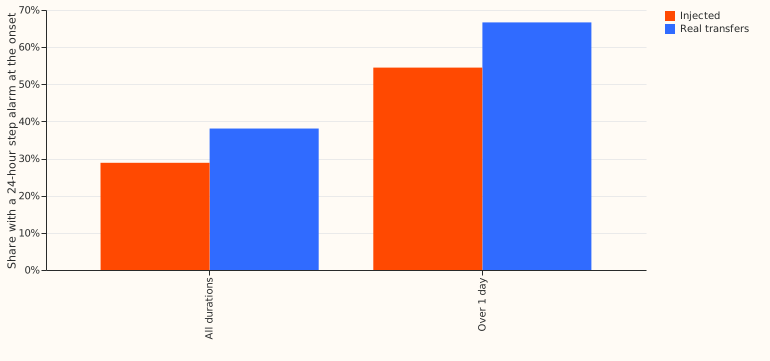
- Realism check 2. A stand-in for RO-NC (a 24-hour step above its threshold) has onset recall 67% on real transfers over 1 day and 54% on injected ones, a gap of 12 points against the pre-registered tolerance of 10; for all durations the gap is 9 points (38% against 29%). The injected events are slightly harder than the real ones. The check therefore marginally fails for transfers over 1 day.
- 17 unlabelled block days of experiment 175. Each fold's network is scored on all 17 days at 80 alarms. The 14-epoch networks find 1, 0, and 0 days, the 40-epoch networks find 1, 1, and 1, and the block detector of experiment 181 found 0.
Checks
- Median minus mean forecast, mean-forecast error, tail calibration, curtailment cost: not applicable, because no forecast is scored.
- Triggers. Trigger 2 fired (the result contradicts its prediction of at least 15). The
explanation tested here is that the injector might be too easy: it is not, because the network
also fails on injected transfers. No Opus audit was run (the Sonnet leakage review is below). The
other six audit triggers of the
ml-experimentskill did not fire; the check that leaves one site out was not run.
Review and deviations
- A Sonnet code review found a leak, fixed before scoring: D8 drops overlapping two labelled transfers entered every fold's injector fit. Drops that overlap a held-out transfer are now excluded. A second fix: an all-missing donor window produced NaN inputs.
- Reviewer findings not acted on. The threshold ignores alarms inside labelled spans and gives the end alarm its own 80-alarm budget, so the combined budget is looser than RO-NC's; this favours the network, which still fails. Early stopping used even-month windows after the review. The classifier features cannot see edge sharpness or noise; a convolutional discriminator on raw windows would be a stronger test. The stand-in's threshold was tuned on the same real events. Logged closures at a held-out Primary with a different side tuple are not excluded from the duration fit.
- Post hoc. The 40-epoch run (seed 1) was added after the 14-epoch run failed; its validation loss was not lower, so it is a second draw and not an improvement. Only seed 0 is pre-registered.
- Lab shortcuts. The residual uses ERA5 weather, which arrives about 5 days late. The end alarm uses the days after the end (hindsight). Transfers are injected into the residual, not the power.
- Not done. The brief's optional learned alarm reliability classifier (item 2).
- Interim report. The experiment manager's session was inactive, so no interim message was sent.
What to try next
One option is to pair the learned start alarm with RO-NC's end rule, because the start alone finds 12 to 17 transfers and the end is where the network fails. Another is a window long enough to hold the end of a multi-day transfer, with the injector's durations fitted to the labelled transfers only.
Code: ml-experiments/00189-switching-neural-onset-end-block-detector/; numbers are printed to
printed_realism.txt, printed_score_seed0.json, and printed_score_seed1.json in that folder.