Experiment 157: does fitting the solar capacity jointly with the demand terms recover an injected farm?
Take-home message: in this test, letting the solar capacity change month by month did not find
more of an injected solar farm than a capacity that changes once a year, so the forecast stage is
not worth running. We added the recorded output of five real solar farms, one at a time, to the
power of six Primary substations (D5, D9, D10, D11, D14, and D16). We then measured the recovery:
the share of the added farm's capacity that the fitted solar capacity found, where 1.0 means the
farm was found exactly. The two-stage method fits one capacity for each July-to-June season-year, as
in experiment 129. Fitted
again here on the same rows, it recovered 0.75 to 0.87 (median over the five farms, one figure per
Primary), where experiment 129 reported 0.78 to 0.88 on its own rows. The monthly method recovered
0.67 to 0.78, averaged over July 2024 to June 2025. At the five Primaries that decide the verdict
(all but D9), none reached the recovery of 0.95 to 1.05 that we fixed before running any fit. One
scale of the assumed solar-output curve, the same for every site, fits a median of 0.92 to 0.94 of
the five farms, because the farms' output curves differ from it (figure 1). The hypothesis is not
supported.
Net power is linear in solar capacity, so the capacity can be fitted inside the demand model of
studies.dp_gam instead of in a second stage. The joint arm gives the
capacity a non-negative level for each calendar month and penalises its change from month to month.
The two-stage arm and the joint arm both trained on the same rows before 2025-07-01. The Kalman
filter is not involved, because
this stage fits capacity and never forecasts. The idea of a joint fit comes from the PV design
session; the convex demand model and the injection come from experiments
110 and
129.
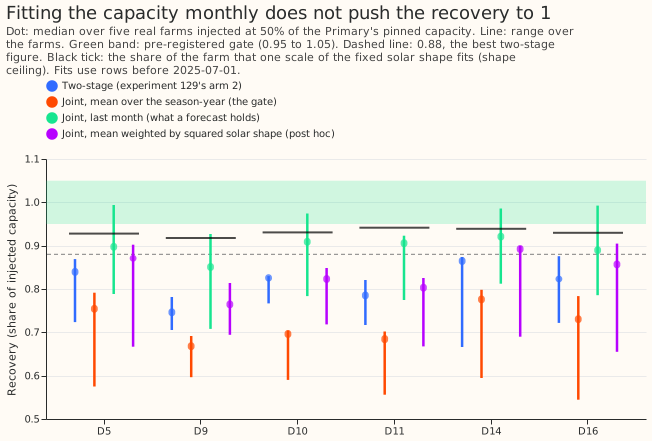
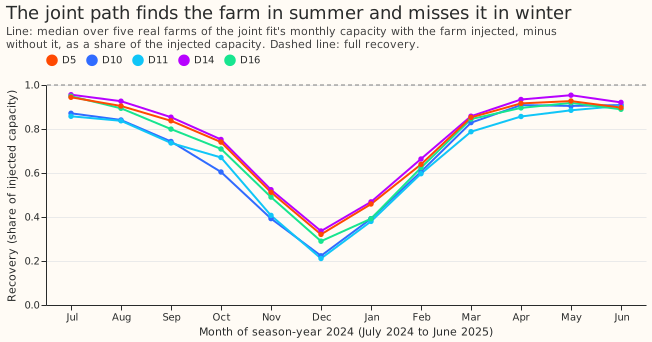
Terms. Recovery is the capacity fitted with a farm injected, minus the capacity fitted without
it, divided by the injected capacity. Each farm's output is scaled so that its own 99th
percentile equals 50% of the Primary's pinned capacity (the capacity that experiment 45's frozen
vintage holds), and that 50% is the injected capacity. D5, D10, D11, D14, and D16 are
the five decision Primaries, and D9 is shown beside them. A season-year runs from July to June and
is labelled by the year of the July, so season-year 2024 is July 2024 to June 2025. Capacity is
the 99th percentile of alternating-current output over daylight half-hours, in MW.
Results
- Verdict by the pre-registered rule: stop. Over the five farms, the median recovery of the joint fit (its fitted path averaged over season-year 2024) is 0.754 (D5), 0.696 (D10), 0.685 (D11), 0.776 (D14), 0.730 (D16), and 0.668 (D9). None lies in 0.95 to 1.05, and none exceeds 0.88. The joint fit recovered less than the predicted 0.78 to 0.92 at every Primary.
- Two-stage benchmark, same rows: 0.840 (D5), 0.825 (D10), 0.785 (D11), 0.865 (D14), 0.823 (D16), 0.746 (D9). The two-stage arm beats the joint arm's year mean at all six Primaries.
- The two-stage pin recovers none of an injection. It does not refit, so its recovery is 0 by construction, and an injection appears whole in the forecast error.
- Farm-to-farm spread. The five farms' recoveries span 0.55 to 0.80 for the joint year mean and 0.67 to 0.88 for the two-stage arm (the lines in figure 1).
- Growth-penalty sensitivity (labelled, cannot change the verdict). The year-mean median is 0.65 to 0.75 at a penalty share of 0.01 and 0.71 to 0.83 at 1.0. A stiffer penalty moves the joint arm towards the two-stage arm, and at penalty share 1.0 it still sits below the two-stage arm at every Primary.
- Post hoc read-outs. The joint fit's last month (June 2025, which is what a forecast would hold) recovers 0.85 to 0.92, with the farm maximum between 0.93 and 0.99. June is a month of strong sun, so the figure is not comparable with a year mean. A single month can also exceed a farm's year-wide shape ceiling, because the path may rescale each month. Weighting the months by the squared solar shape gives 0.76 to 0.89, close to the two-stage figures.
- Shape ceiling. The least-squares scale of a farm's output on the derated unit shape of
studies.dp_gam, over the training rows of season-year 2024, is 0.92 to 0.94 as a median over farms (0.77 to 0.97 for single farms). The ceiling is the most that a single capacity scale of the fixed shape finds in that season-year if the demand terms absorb nothing. It bounds the two-stage arm's one scale per season-year, and a monthly path can exceed it, so the 0.95 gate was out of reach for most farms under one scale per season-year. The cause of the farm's shape differing from the fleet shape (tilt, azimuth, inverter clipping, or irradiance error) was not tested. - Winter months are barely identified. The monthly recovery is 0.84 to 0.96 from April to August and 0.2 to 0.35 in December (figure 2). A likely cause is that the demand terms absorb the small winter signal. We did not test this.
Checks
- Wiring check passed. With no injection, the two-stage fit built from the month design's Gram
matrix reproduces
fit_gamat D10 to 1e-6 (46.062283 against 46.062283 points of effective capacity). The check covers the two-stage arm with no injection only, so the joint arm has no independent check. - Triggers of the
ml-experimentskill's "Audit before merge": none fired. The wiring check passed. The result agrees with the prediction that fewer than 4 of 5 Primaries reach the gate, and it disagrees with the predicted range of 0.78 to 0.92, because the joint fit recovered less. That contradiction does not change the verdict, and the likely cause is the winter months in the unweighted year mean.
Caveats
- One origin. The fits use rows before 2025-07-01 and read season-year 2024 only.
- Intervals are ranges over five farms, not confidence intervals. Each Primary has one real power series, and the fit is nearly linear in the injected farm, so the variation across farms is the main source of uncertainty.
- Only five farms, each injected at 50% of the Primary's pinned capacity, were tested. Experiment 129 also tested synthetic plants and a cloud-driven load, and this experiment did not.
- Compute. CPU, 1 core, 25 seconds for the grid of six Primaries, five farms, two arms, and three growth penalties. Pre-registered penalty share: 0.1 of the mean Gram diagonal over the month columns that have rows.
What to try next
- A fixed-shape capacity probably cannot reach 1.0, so test a different shape first. A fitted tilt and azimuth per Primary, or a fitted peak-to-capacity ratio, would raise the ceiling. A joint capacity fit is worth planning only once the ceiling is above the 0.95 gate.
- No forecast arms are run, because the pre-registered decision rule says to stop.
Plan (written before any fit)
Question. Experiment 129 found a capacity per season-year from each Primary's own power and recovered an injected real farm's output at 0.78 to 0.88. Experiment 139 found the as-of capacity no better than the pin, and the hindsight capacity equal to it. Net power is linear in capacity, so the capacity can instead be fitted inside the GAM-K fit as a monthly path. Does fitting the capacity as a monthly path recover the injection near 1.0? This experiment runs only the known-answer stage, as the maintainer asked, because the expected forecast gain is under 0.05 points of the quantile score.
Arms, all on the same rows. Every arm trains on rows before the origin 2025-07-01 and has the same demand terms, so that only the capacity differs.
| Arm | Capacity | Role |
|---|---|---|
| 1. Pin | Experiment 45's frozen vintage, held |
Reference. It does not refit, so it recovers none of the injection |
| 2. Two-stage as-of | Experiment 129's arm 2: non-negative increments per season-year, ridge 0.1 on the cumulative capacity | Benchmark |
| 3. Joint | A non-negative level for each calendar month (the derated unit shape times the level), a penalty on the squared change of the level from month to month, and a near-zero ridge on the level | The arm under test |
The joint fit's growth penalty is fixed in advance. It is 0.1 times the mean diagonal of the
Gram matrix over the capacity columns, the share experiment 129's arm 4 used. Two values, 0.01 and
1.0, run as labelled sensitivity checks that cannot change the verdict. The shape parameters (tilt
35 degrees, south-facing, ratio of direct-current to alternating-current rating 1.15, inverter
clip at the alternating-current capacity, and 0.4% per kelvin de-rating) stay as in
studies.dp_gam. The Kalman filter acts on residuals only in the forecast
stage, so it is not involved here: this stage fits capacity and never forecasts.
Injection. Each of the five real farms of experiment 129 (labels A, B, C, D, F; anonymised) is added to the Primary's power over all training rows at 50% of the Primary's pinned capacity, as a farm's output divided by its 99th percentile. Rows where the farm's reading is missing or a dropout are removed from both the injected and the matching base fit, so a difference of fits never mixes two row sets. Recovery is read per Primary and farm, then summarised by the median over farms. The base fit has no injection.
Recovery read-out. The raw recovery averages the fitted path over season-year 2024, the latest complete season-year before the origin. The joint fit's last-month value, which is what a forecast would hold, is reported beside it. The divisor that experiment 129 applied (the median recovery of other farms) is not applied to the pre-registered gate, because the question is whether the joint fit needs no divisor. The divided two-stage recovery is shown for context.
Primaries and checks. D5, D10, D11, D14, and D16 count for the decision. D9 is reported beside them. The tables show every farm at every Primary, plus the unmodified base capacity of each arm in MW, so that a reader can see the joint path's level against the two-stage steps. As a wiring check, a fit with zero injection must reproduce arm 2's published capacity for the same cut to three decimal places.
Five triggers. Stored: private files only. Serving path: not touched. Degradation rule: not touched. More than one defensible design: no, because the maintainer fixed the arms and the stop rule. Callers not nameable without searching: no.
Compute. CPU only, at most 4 cores, thread caps all 1, each job under systemd-run --user
--scope -p MemoryMax=16G -p OOMPolicy=continue. The first Primary is timed before the full grid.
Reviews. One Sonnet code review (leakage first: no row at or after the origin may train) and one Sonnet prose review. No Opus review.
Advice followed. From experiment 129, count only season-years with at least 12,000 training half-hours when reading a capacity, and use an as-of capacity and never a hindsight capacity in a forecast test. Departs from none.