A faster onset alarm from simultaneous opposite steps at a metered neighbour, feeding a mask forecast
Take-home message. A load transfer is an operator moving demand from one substation to a neighbour by switching. The refit-offset neighbour-count detector (RO-NC) learns of a transfer about 48 hours after the step, because it waits 24 hours for the step and 24 more for the peak. An alarm that fires when one metered substation steps by several noise units (multiples of its usual half-hour-to-half-hour variation) and a connected metered substation steps the opposite way is known 3 to 9 hours after the step, depending on the window (2, 4, or 6 hours). On the transfers the alarm finds, masking the readings from it closes 95% of the forecast-error gap to the true series, against 40% for RO-NC's mask. The alarm finds few transfers: 38% of the simulated transfers, counted one by one (RO-NC 69%), and 5 of 35 real ones (RO-NC 20). Pooled over all forecasts, masking from either alarm scores 0.119 points of capacity better than masking from RO-NC alone, and, on all rows after a transfer begins, no mask beats the weather-model-only forecast.
We asked whether a much earlier alarm would let the mask forecast of experiment 151 start masking days before RO-NC raises its alarm. A transfer moves power from one substation to its neighbours, so the two substations step in opposite directions at the same time, while weather and holidays move neighbours the same way. We built an alarm on that pair of steps over windows of 2, 4, and 6 hours, and set its threshold so that its real alarms in odd months that no logged switching explains number at most 80, as RO-NC's do. We then added simulated transfers (from experiment 141 and experiment 147) to the recorded half-hourly power of six Primary substations, in 44 simulated copies of the record (worlds), and scored two measures: how soon each alarm is known (the lag from the step), and the forecast error of a mask driven by each alarm. The mask sets the readings missing from the alarm's start until its end is called. The forecast is a weather-driven generalised additive model (GAM) whose Kalman filter corrects it with recent power, scored against the true series without the simulated transfers, in points of effective capacity (percent of the substation's capacity; smaller is better).
By the pre-registered rule the verdict is partly supported. The speed test (C1) is supported.
The forecast test (C4) is not: masking from either alarm scores 0.119 points better than masking
from RO-NC (negative is better), but the upper end of the 99% interval is -0.025, above the required
-0.10. The no-harm test on real rows (C5) is not supported either. The pair alarm adds almost no
recall to RO-NC, because 223 of the 231 even-month transfers it finds (4-hour window) are also found
by RO-NC.
- Arms. RO-NC (alarm known 48 hours after the step), the pair alarm NEW (known 1.5 windows after the step: a peak test of half a window, then the window itself), and UNION (the intervals of either alarm, merged within 24 hours). An interval is the span the mask treats as a transfer. The mask arms are MASK-RONC, MASK-NEW, and MASK-UNION, beside no correction (K0), the forecast fed the true series (CLEAN), and the weather model alone (GAM-only). The end of every interval uses RO-NC's offline end rule, called as in experiment 148, so the onset alarm is the only difference. Weather in the filter's residual is ERA5, as in experiments 141 and 151 (past weather standing in for the forecast, which flatters every arm equally); no refit runs.
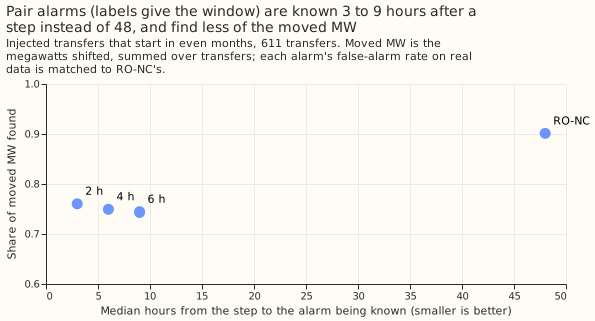
- Tuning. Matched thresholds k: 4.5 (2 h), 3.75 (4 h), and 3.5 (6 h), giving 68, 66, and 57 real unexplained alarms in odd months. The 4-hour window had the highest share of moved MW found on odd-month transfers (0.760, against 0.736 and 0.752) and is the headline.
- Detection, even-month transfers (611 of the 1,160 in the 44 worlds). Median lag from the step to the alarm being known: 6 hours against 48. Share of moved MW found 0.749 for the pair alarm, 0.901 for RO-NC, and 0.902 for the union (shares of moved MW, not of transfers); C2 is -0.152 (95% -0.226 to -0.097) and C3 is +0.001 (95% -0.022 to +0.031). Of the 1,160 simulated transfers, 43% have a metered receiver. Those carry 89% of the moved MW (the coverage). The window sets the lag, so the lag does not vary between transfers and its interval has zero width.
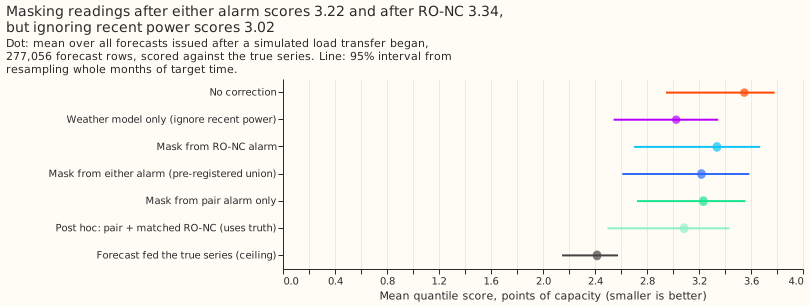
- C4, all 277,056 forecast rows after a transfer began (12 months of target time). Mean quantile score in points of capacity: K0 3.549, CLEAN 2.416, GAM-only 3.025, MASK-RONC 3.338, MASK-NEW 3.233, MASK-UNION 3.219. MASK-UNION minus MASK-RONC -0.119 (95% -0.215 to -0.052; 99% -0.244 to -0.025); MASK-NEW minus MASK-RONC -0.105 (95% -0.355 to +0.099); MASK-NEW minus GAM-only +0.209 (95% +0.069 to +0.281). Share of the K0-to-CLEAN gap closed: MASK-RONC 19%, MASK-NEW 28%, MASK-UNION 29%, GAM-only 46%.
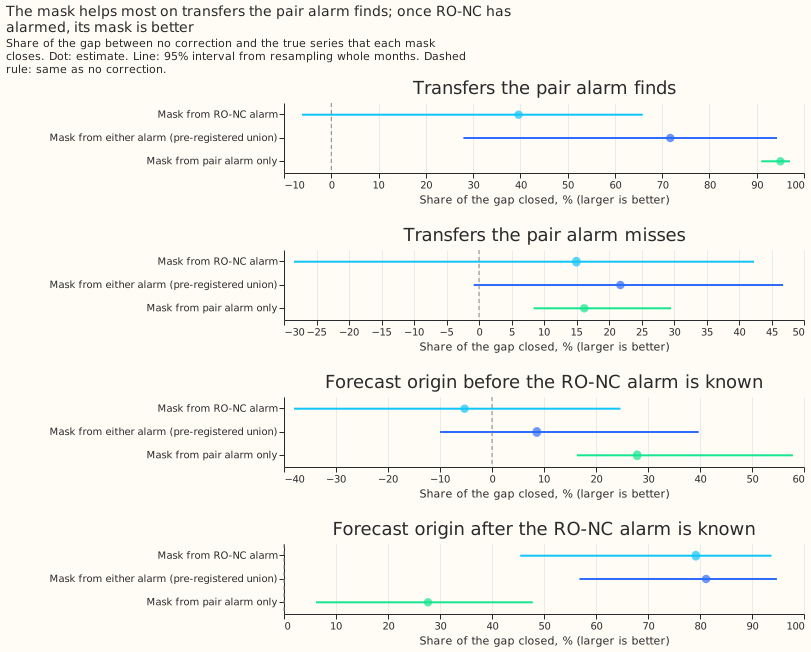
- Where the mask helps. On the 29,582 rows of transfers the pair alarm finds, MASK-NEW closes 95% of the gap (95% interval 91% to 97%), MASK-RONC 40%, and MASK-UNION 72%. After RO-NC's alarm is known, MASK-RONC closes 79% and MASK-NEW 28%. Before RO-NC's alarm, MASK-NEW closes 28% (16% to 58%) and MASK-RONC -5% (worse than no correction).
- Each transfer weighted equally (475 transfers). MASK-UNION minus MASK-RONC -0.133 (95% -0.225 to -0.043). Without D11, which supplies 48% of rows: -0.213 (95% -0.310 to -0.107). Leaving out any one of the six substations keeps the sign of the union contrast.
- C5, real stream (874,369 rows outside logged transfers), minus no correction. MASK-RONC +0.228 (95% +0.086 to +0.403), MASK-UNION +0.140 (+0.033 to +0.265), MASK-NEW +0.064 (-0.002 to +0.135), GAM-only +0.297 (+0.216 to +0.387); positive is worse. Forecasts issued inside a logged real transfer and scored after its end (9 pairs of a logged transfer and a substation): K0 9.843, MASK-RONC 5.018, MASK-UNION 4.496, MASK-NEW 5.824, GAM-only 4.713.
- False alarms by substation (all months, no logged closure within 24 hours, 4-hour window). The pair alarm raises 9 at substation D8 and 0 at D9. RO-NC raises 28 at D8 and 33 at D9. The 2-hour window raises 23 at D8 and 1 at D9.
- Real transfers over a day (35). The pair alarm finds 6, 5, and 7 at the 2, 4, and 6-hour windows (median lag 3.2, 6.5, and 9.5 hours); RO-NC finds 20.
- Tail calibration after onset (share of actuals at or below the quantile; pinball loss). K0: q01 0.024 (0.280), q05 0.049 (0.851), q95 0.814 (1.104), q99 0.906 (0.460). MASK-RONC: 0.029 (0.329), 0.060 (0.880), 0.858 (0.949), 0.931 (0.365). MASK-UNION: 0.024 (0.293), 0.053 (0.824), 0.868 (0.938), 0.936 (0.369). GAM-only: 0.002 (0.185), 0.012 (0.694), 0.822 (0.855), 0.921 (0.311). All arms use the same uncertainty width, so these are contrasts in the forecast's location. The masks move the upper tail (q95 and q99) towards the nominal 0.95 and 0.99.
- Post hoc arms (labelled; the pre-registered verdict is unchanged). MASK-NEW at the 2-hour and 6-hour windows: 3.212 and 3.256. MASK-NEW with the alarm series only (no partner): 3.333. The pair alarm plus only those RO-NC intervals that match an injected transfer (an oracle, because it uses the truth): 3.086, which is 0.215 below the union's 3.301 for the same construction without the filter, so RO-NC's alarms that match no injected transfer worsen the score by about 0.2 points.
Checks
- Median minus mean forecast by substation: D10 -0.076, D11 -0.044, D14 +0.084, D16 +0.040, D5 -0.347, D9 -0.091 points of capacity, identical for every arm.
- Mean-forecast contrast has the same sign as the quantile score: MASK-UNION minus MASK-RONC -0.204 (95% -0.312 to -0.103) in the error of the mean forecast and -0.204 in the error of the median forecast.
- Triggers. The audit trigger for a contradicted prediction fired: the share of transfers with a metered receiver (43%) is below the predicted 60% to 85%, and the union found the same moved MW as RO-NC (+0.001) instead of +0.05 to +0.15 more. The explanation, tested: 223 of the 231 transfers the pair alarm finds are also found by RO-NC, so the pair alarm cannot add recall. The 89% coverage by moved MW is the figure that matters, because the forecast error follows the megawatts moved. The trigger for a nested arm beating the arm that contains it fired in the first run and not after the fix described below. A language-model reviewer audited the first run and re-derived its headline numbers. The fix changed the pair-alarm forecast scores, and that reviewer did not repeat the re-derivation, so the fixed numbers have one independent code review and no independent re-derivation. The session's brief allowed no Opus audit.
Caveats
- Lab conditions. Injected steps are exactly balanced between metered neighbours and the weather residual uses ERA5, so the 0.75 share of moved MW found is a ceiling. The 5 of 35 real transfers are the counterweight.
- The mask arms lose to ignoring recent power. GAM-only scores 3.025 on the same rows and is not part of the pre-registered contrasts; on real rows outside transfers it is worse than no correction (+0.297 points of capacity).
- Few months. The all-row contrasts rest on 12 calendar months, and the by-transfer contrasts on 475 transfers from six substations.
- The pair alarm's first threshold choice used real odd months only, and the 4-hour window was chosen on odd-month injected transfers; the even-month share of moved MW found is 0.011 higher for the 2-hour window.
What the next experiment should answer
The next question is whether a forecast that drops recent power while any alarm is active, and otherwise keeps it, beats the weather model alone. The weather model alone scores 0.52 points better than no correction on rows after a transfer began (3.025 against 3.549) but 0.30 points worse on real rows outside transfers (3.000 against 2.703), so switching between the two could capture the gain of each.
Changes to the pre-registered plan
The plan, decision rule, and arms were committed before any run. Three changes followed:
- Peak test (before any run). The plan's first-crossing alarm was replaced by a peak test of
W/2, because a first crossing dates the onset up toWearly. - Causal partners (after the code review). The first run kept a partner interval only when the partner's own next 24 hours kept half the step, which a live service cannot see. Partners now copy their alarm's interval. This changed MASK-NEW from 2.955 to 3.233 and MASK-UNION minus MASK-RONC from -0.294 to -0.119.
- Post hoc arms. The alarm-series-only, other-window, and match-filtered arms, and the leave-one-site-out and weather-model-only contrasts, were added after the audit and the review.