Differentiable physics, E7 forecast: does an Economy 7 night-step term lower the day-ahead error on winter nights?
Take-home message: the day-ahead forecast runs low on cold winter nights from 01:00 UTC, and a
correction learned from its own past errors removes that bias. The experiment cannot say that the
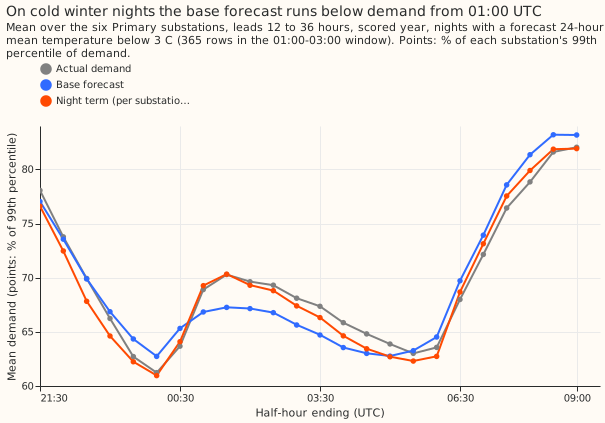
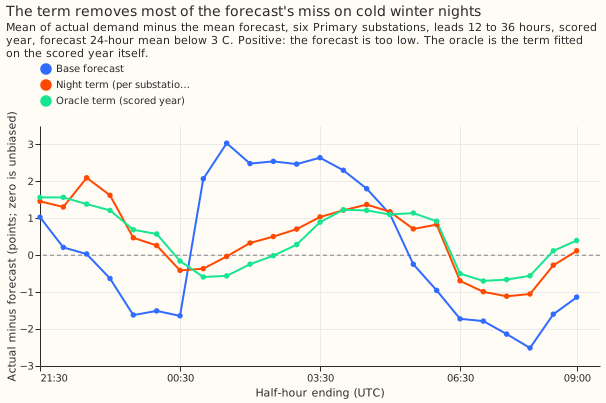
bias grows with cold. On cold winter nights from 01:00 UTC the base forecast ran 2.5 points too low
on average (a point is 1% of a substation's 99th percentile of demand; "cold" means a forecast daily
mean below 3 °C). With the night correction (an additive term fitted on the forecast's own past
errors) it runs 0.2 points too low, and 93% of actual values fall below the 0.95 quantile, against
80% for the base forecast. The correction lowers the day-ahead quantile score (twice the mean
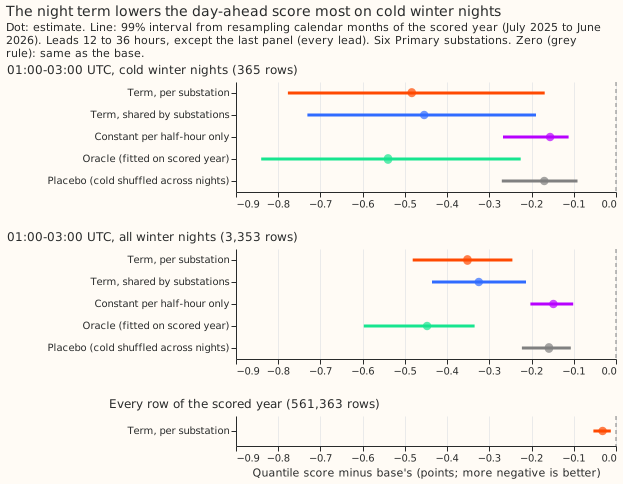
pinball loss) by 0.484 points on those rows (99% interval from resampling calendar months, -0.777 to
-0.169) and by 0.032 points over every row of the year (-0.054 to -0.012). A second analysis by a
fresh reviewer (the audit, below) showed that a plain winter night offset with no temperature does
as well, so the data show a winter night bias and not a cold-driven step. The verdict is
inconclusive: the shuffled-night placebo control failed, and the 365 headline rows are too few for
the rule committed in the plan (at least 3 months and 50 rows per substation).
We asked whether the step in Primary substation demand at the start of cheap night-rate electricity (Economy 7), which experiment 123 found, can be added to the day-ahead forecast. The base is the convex-optimisation demand model with a Kalman filter, driven by the mean of the European Centre for Medium-Range Weather Forecasts (ECMWF) ensemble (ENS) weather forecast (experiment 133's shared-noise arm). We fitted a ridge regression of the base's own past errors on the half-hour (UTC), the forecast temperature, and the day of the week, refitted monthly on data before each month, and added the fitted correction to every forecast quantile. We scored it on the six decision substations over the year from July 2025, with winter 2025-26 as the only winter.
Results (every number is printed in report.json, produced by e00137_report.py):
- Arms. Base (no term);
t_site(one fit per substation, ridge penalty 100, chosen on the odd tuning months);t_pool(one fit shared by the six substations);oracle(the term fitted on the scored year itself);fixed123andfixed123b(experiment 123's step inserted);t_const(post hoc: the per-half-hour constants only);placebo(temperature shuffled across nights). - Rows. The scored year of
fold_a_daily_gap_v1, forecasts issued at 09:00 UTC, leads 12 to 36 hours, six substations, outside the hand-filtered switching events. Headline rows: the half-hours ending 01:00 to 03:00 UTC on winter nights whose forecast 24-hour mean temperature is below 3 °C (365 rows in 3 months by valid time; 35 rows at each of D5 and D16, 60 to 85 at the others). - C1 (term per substation minus base), headline rows: -0.484 (-0.777 to -0.169); 5 of 6 substations improve (D9 does not: +0.100); leaving each substation out gives -0.400 to -0.599. The pre-registered readability rule (3 months, 50 rows per substation) is not met, so by the rule the contrast is not assessable.
- Wider row sets: all winter nights in the 01:00 to 03:00 window (3,353 rows): -0.352 (-0.482 to -0.245), 6 of 6 substations. All winter-night half-hours at leads 12 to 36 hours (16,089 rows): -0.115 (-0.178 to -0.056). Cold winter nights, every night half-hour (1,752 rows, post hoc): -0.194 (-0.249 to -0.134).
- C2 (term shared by substations minus base): -0.454 (-0.731 to -0.190). C5 (per-substation minus shared): -0.030 (-0.094 to +0.089). Sharing one fit across substations loses nothing measurable.
- C4 (non-inferiority, every row, every lead): -0.032 (-0.054 to -0.012), 6 of 6 substations; the upper bound is below the +0.01 limit.
- Oracle minus base: -0.540 (-0.840 to -0.226). The term achieves 90% of the oracle's improvement.
- C3 (experiment 123's step inserted, minus base), invalid arm: +2.643 (+1.541 to +3.551); the
summer-adjusted
fixed123b(post hoc): +1.979 (+1.247 to +2.615). The audit found both arms specified wrongly (finding 4 below), so these numbers say nothing about experiment 123's step. - Placebo minus base: -0.170 (-0.271 to -0.091). The constants-only arm
t_constgives -0.156 (-0.268 to -0.112): about a third of the term's gain needs no temperature at all. - Absolute scores (points), headline rows: base 2.190,
t_site1.706,t_pool1.736, oracle 1.650, placebo 2.020,t_const2.034. Every row of the year: base 2.706,t_site2.675. - Tail calibration, headline rows (coverage / pinball): q95 coverage 0.800 (base), 0.932
(
t_site), pinball 0.613 against 0.444; q99 coverage 0.959 against 0.995, pinball 0.132 against 0.113; q05 coverage 0.041 against 0.047; q01 coverage 0.033 against 0.038, pinball 0.217 against 0.270. The term lifts the whole distribution, so the upper tail improves and the 0.01 quantile gets slightly worse. Every row of the year: q95 coverage 0.948 against 0.951. - Mean forecast error, headline rows (actual minus mean forecast): 2.519 (base), 0.230
(
t_site). The mean absolute error falls from 3.748 to 2.864 (-24%). - Curtailment-cost metric: not run. The metric needs a forecast for a connection point and its generators, which this experiment does not forecast; the shift matters most for the upper tail, where q95 and q99 coverage improve.
Predictions against outcome. C1 was predicted at -0.5 to -2.0 points and came out at -0.484, just short of the range. The term recovered 90% of the oracle's gain (predicted at least 50%; the oracle's interval lies wholly below zero). The mean forecast's signed error shrank by 91% (predicted at least a third); the mean absolute error shrank by 24%, short of a third. The all-row score (C4) changed by -0.032 (predicted -0.03 to +0.01).
Controls.
- Leakage: passed. Adding 100 points to
actualfrom the monthly fit dates of 2025-11-01, 2026-01-01, and 2026-02-01 on, and rerunning the whole monthly fit, changed no corrected quantile of that cut's month (maximum change 0.0). - Injected step (an 8-point step plus 0.5 points per degree below 15.5 °C, which is 14.25 points
at 3 °C): passed. The fitted step minus the clean fit's was within 3.7% of the truth at every
substation at every winter cut from November 2025 to March 2026 (
t_pool: within 0.6%). - Reproduction: passed. The base's score over five substations (the five that experiment 133 scored) at 12 to 36 hours is 2.4622 against experiment 133's 2.462.
- Shuffled-night placebo: failed. It gained 0.170 points where the band was +/-0.1. The placebo
keeps each half-hour's constant, which carries a third of the gain (
t_const). The verdict is capped atinconclusiveby the plan.
Checks.
- Median minus mean forecast, per substation (base and term alike, since the term shifts both): D5 -0.125, D9 -0.019, D10 -0.045, D11 -0.035, D14 +0.013, D16 +0.000 points.
- Mean-forecast error beside each contrast: the mean absolute error changes in the same direction as the quantile score (C1 headline -0.884, C4 -0.059), so the audit trigger for a mean-forecast error that moves against the quantile score did not fire.
- Leave-one-substation-out: no flip of sign (-0.400 to -0.599 on the headline rows), so trigger 4 did not fire.
- Triggers fired: the failed-control trigger (the placebo) and the trigger for a control that moves the score by more than its paired interval's half-width. The audit is in the next section.
Audit. A fresh Opus agent re-derived the contrasts from the stored predictions with its own code
(report in the private briefs folder, e137_audit_report.md). Findings and triage:
- Finding 1, accepted: a post hoc arm that swaps
coldfor a November-to-March indicator scores -0.432 on the headline rows; the temperature term minus that arm is -0.052 (-0.123 to +0.022), and -0.000 (-0.018 to +0.015) on cold winter nights, all night half-hours. On all winter window rows the temperature term is worse than the offset by +0.094 (+0.016 to +0.143). The take-home message, headline, and advice say this. A shuffle ofcoldwithin each calendar month keeps most of the gain (-0.25 to -0.39 over 12 seeds). - Finding 2, accepted: the planned placebo shuffles across the whole history, so it carries no
season and falls back to the per-half-hour constants (
t_const-0.156). Its failure is the constants working, not leakage. The plan's cap atinconclusivestill applies. - Finding 3, accepted: the headline rows fall in 3 months by valid time (2025-11, 2026-01,
2026-02;
report.jsoncounts 4 by origin month), and D5 and D16 hold 35 rows against the 50 required, so C1 is not assessable under the rule. The readable cold-night subset (1,752 rows) gives -0.194; the same seasonal explanation applies. - Finding 4, accepted:
fixed123andfixed123bomit experiment 123's actual summer rise, correct the forecast's rise and not its level, use each substation's own fit where the plan says the pooled step, and insert the step in summer. Both arms shifted the forecast by 4.4 to 17.6 points where 2.4 to 4.4 were needed. Both arms are marked invalid above and were not rerun. - Finding 5, accepted: the leakage control compared fits on filtered rows, which cannot fail. It
now corrupts
actualfrom three cuts on, reruns the whole monthly fit, and compares the corrected quantiles of each cut's month. The audit's own end-to-end test passed as well. - Findings 6, 7, and 9, no fault found: the temperature window, the ridge and noise choices, the quantile shift (no crossings), and the 2.4622 reproduction check out. Tail coverage on cold nights, every half-hour: q95 0.913 (base) and 0.937 (term); q01 0.031 and 0.022.
- Finding 8, accepted: the code's window is the half-hours ending 01:00 to 03:00 (five rows); the plan's text said 01:30 to 03:00, and the plan section below now says 01:00 to 03:00.
Caveats and what to try next.
- The scored year holds one winter, and the term trained on one earlier winter (2024-25) at the start of it. A second winter would settle the verdict.
- The term moves the whole night, including the 22:00 to 23:00 half-hours, where the mean error on cold nights goes from about zero to about +2 points (figure 3). A term confined to the half-hours after 00:30 would test whether that raises the score.
- The temperature feature is a 24-hour ENS-mean temperature from 09:00 UTC on the evening date, so a "cold night" here is not experiment 123's daily mean below 3 °C.
- Next: test a seasonal night offset, or a fix to the base forecast's winter night level, and retest when winter 2026-27 exists, with a within-month placebo for any temperature term.
Plan, as committed before any code ran
The text below is the plan as committed in the first commit of this branch, with the amendments of the plan review applied before any code ran.
Question
Experiment 123 found that demand at 13 of 14 Primary substations steps up around 01:00 UTC on winter nights, by about 10 points at a daily mean of 3 C, and that the day-ahead forecast of experiment 114 runs below actual demand from about 01:00 on cold nights. An operator sees that step and the forecast's miss. This experiment asks whether an explicit night term, learned from the base forecast's own past errors, closes the miss.
Design
- Base. Experiment 133's
poolarm: the convex GAM with a Kalman filter (GAM-K) on the ENS ensemble mean, with one shared noise setting. Its prediction frames are read from experiment 133's private folder (tuning months 2024-07 to 2025-06, odd and even, and the scored year). No file of the best-guess assembly is edited. - The term. For a half-hour at UTC clock time
hin the night set (21:00 to 08:30 UTC, 24 half-hours) on the night of evening dateD, the correction to every quantile isa[h] + b[h] * cold + c[h] * weekend, wherecold = max(0, 15.5 - T),Tis the ENS-mean temperature averaged over the 24 hours from 09:00 UTC onDto 09:00 UTC on the next day, which a 09:00 UTC run always covers in full for the night it forecasts, andweekendflags Saturday and Sunday evenings. Coefficients are a ridge regression of the base forecast's error (actual minus the mean forecast) on those 72 columns, fitted per substation (T_SITE) or shared across the six substations (T_POOL), on all rows whose run origin and valid time are both before the first of the month being forecast (an expanding window, refitted monthly, starting from 2024-07). The ridge penalty is chosen on the odd tuning months from a fixed grid. The spread around the shifted median is unchanged. - The clock is UTC. Experiment 123 found the step follows UTC on British Summer Time nights (a post hoc finding at 13 of 14 substations). The term therefore uses UTC and does not test that choice.
- Two reference arms.
FIXED123inserts experiment 123's estimated step (the pooledfit_headlinestep at the forecast temperature, with its estimated ramp) minus the step the base already forecasts on the same night.ORACLEisT_SITEfitted on the scored year's own rows, so it bounds what any term of this form could gain. - Weather at forecast time.
Tis the ENS-mean forecast available at the origin. No ERA5 value enters any score. Experiment 123's winters are used only byFIXED123, and end before the scored year. - Resampling. Month resampling for C1 draws only the calendar months that hold C1 rows; the
contrast is readable only if at least 3 months and 50 rows per substation hold them, and is
otherwise reported as not assessable. With one winter the expected verdict is
inconclusive, and the write-up says so rather than relaxing the rule. - Limits stated now. The expanding window holds one training winter (2024-25) for the first scored winter months and grows through winter 2025-26. The scored year holds one winter, so the cold-night rows are few and the month-resampled interval will be wide.
Rows and subsets
- Rows:
fold_a_daily_gap_v1, 09:00 UTC init, six decision series, scored year (the runs stored by experiment 133). - E7 window rows: valid time 01:00 to 03:00 UTC (the half-hours ending 01:00 to 03:00, five rows).
- Cold nights:
Tbelow 3 °C (the sameTas the term's regressor; a 24-hour mean shifted 9 hours from the calendar day, so it is not experiment 123's daily mean). - Winter: November to March.
- Headline subset: E7 window rows, cold winter nights, leads 12 to 36 hours. Beside it: all winter nights, all E7 window rows, all rows, and a figure of the step against the forecast on the coldest nights.
Controls (run before any scoring)
- Injected step. Add a synthetic step of known size to the
actualof every night in the stored frames (a ramp from 0 at 00:30 to 8 points at 01:30 UTC, held to 08:30, plus 0.5 points per degree ofcold), refitT_SITEandT_POOLwith the same code, and read the fitted correction at 3 °C. Pass: the fitted step at 01:30 to 03:00 UTC is within 25% of the truth (8 + 0.5 * 12.5 = 14.25 points) at 5 of 6 substations, from the first scored winter month on. - Shuffled-night placebo. Permute
coldacross the nights of each substation and refit. Pass: the C1 contrast on the permuted term is within +/-0.1 points of zero. - Leakage. Corrupt
actual(add 100 points) at every valid time on or after each monthly cut in a copy of the frames and refit. Pass: the coefficients of every monthly fit are identical to the uncorrupted fit, and the corrections applied to the month are unchanged. - Reproduction. The stored base rows reproduce experiment 133's
poolscore at 12 to 36 hours to within 1e-4 points. - Stop rule. If the injected-step control fails at 3 or more substations, stop, record the
verdict
failed, and write what was found. No scored contrast is read after a failed control.
Compute
CPU only. The ridge fits are small: a run is expected to take minutes on 4 cores, well inside the
16 GB memory cap. Predictions are written under data/ml-experiments/00137-*/predictions/ with
q01 to q99, actual, lead_hours, and time_series_id, so studies.tail_calibration can
score them.
Prior work followed
- Experiment 123's estimated step, timing, and cold slope (read first, not re-estimated).
- Experiment 133's stored frames, scoring and month-resampled intervals, copied by pattern.
advicefrom experiment 123: judge on cold winter nights from 01:00; try the UTC clock. Departure: the term is fitted on the forecast's errors, not on the observed night mean, so that the part of the step the base already models is not added twice.