Experiment 76: does experiment 64's gain beyond 10 days come from a leak?
Take-home message: we found no route for a leak, and a refit with no solar term at all reproduces
the gain of experiment 64's best arm at 10 days and beyond. The gain therefore matches the XGBoost
model starting its fit at zero, which happens whenever a base margin is supplied, and not the solar
offset. A caveat limits that reading: the reference model d1l was fitted in experiment 46's
pipeline, so a refit of d1l in this pipeline would show whether the start-at-zero effect is real.
We asked whether the lower error of experiment 64's arm am at forecast leads of 10 days and
beyond could come from information that was not available at forecast time. In am, the XGBoost
model starts from a base margin: a starting prediction, added to each row, equal to the substation's
solar capacity times a forecast of how sunny the day will be, times a weight fitted on the training
years. The weight, and so the margin, is zero from 10 days. Yet am still scored 0.082 points below
the best guess d0 there. The score is the quantile score, an error measure in which lower is
better, and 1 point is 1% of a Primary substation's capacity. A Primary substation feeds 11 kV
circuits from the 33 kV network. d0 is experiment 33's best-guess recipe, and d1l is the same
recipe without the radiation inputs, from experiment 46.
We read the code and checked the margin at every training row and at the validation rows at 10 days
and beyond in the first 8 forecast runs of each series. We also made two new sets of forecasts.
am0 is am refitted with a margin of zero in every row, so that it starts from zero like am and
carries no solar term. am_train_only is the stored am model predicted with the margin set to
zero at every lead.
The verdict is supported. The prediction of no leak held. The prediction that am0 scores
0.03 to 0.08 points above am at 10 days and beyond held after the 14-day correction in size
(0.035) but its interval reaches zero, and without the correction the difference is +0.004.
The audit found no route for a leak
All 20 checks of e00076_audit.py pass, 4 for each of the 5 Primary substations.
- The margin is zero from 10 days. Of the training rows, 98,965 to 98,973 per series have a lead of 10 days or more, and the largest margin among them is exactly 0. In the first 8 forecast runs, 1,784 validation rows per series have a lead of 10 days or more, and zeroing the margin changes none of their predictions. The weight is set to zero for those leads by construction, so this confirms that the lead bands agree and that the margin reaches the model as zero. At shorter leads, zeroing the margin changes the quantiles by up to 0.086 points.
- Every training row is at or before 2025-06-30 23:30 UTC. The weights are cross-fitted on those rows, the capacity fit leaves out the week of 2025-06-30, and the calibration of the ensemble forecast of sunshine stops with an error if a row is outside the training window. The audit checks the training rows themselves. The weights, capacity, and calibration were checked by reading the code of experiments 46 and 64.
- Prediction applies the margin once. Rebuilding
am's predictions from its stored models with the margin that the validation code supplies reproduces experiment 64's stored quantiles exactly for seed 0 (largest difference 0).
Across all 5 series and 3 seeds, the 244,185 prediction rows at 10 days and beyond have raw
quantiles that are identical between am_train_only and am (largest difference 0). At shorter
leads they differ by up to 0.17 points of capacity.
The gain matches a start-at-zero effect
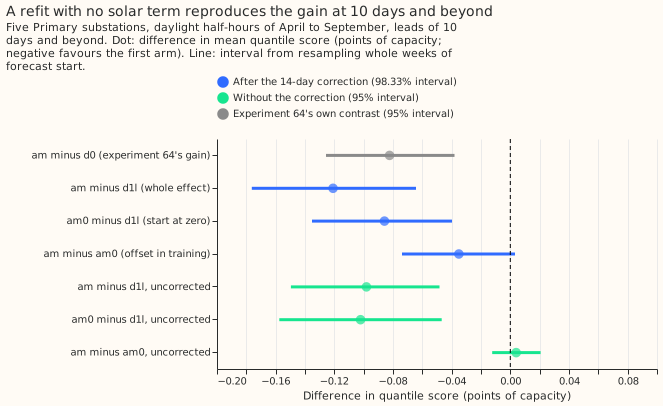
Mean quantile score at 10 days and beyond, in points of capacity, after the 14-day correction and
the 1.15 spread factor: am 4.904, am0 4.939, am_train_only 4.941, d0 4.986, and d1l 5.025.
Without the correction (the spread factor kept), am scores 4.739, am0 4.735, and d1l 4.837.
| Contrast at 10 days and beyond | Difference | Interval |
|---|---|---|
am minus am0, corrected (offset in training) |
-0.035 | -0.074 to +0.003 (98.33%) |
am0 minus d1l, corrected (start at zero) |
-0.086 | -0.135 to -0.040 (98.33%) |
am minus d1l, corrected (whole effect) |
-0.121 | -0.176 to -0.064 (98.33%) |
am minus am0, uncorrected |
+0.004 | -0.012 to +0.021 (95%, exploratory) |
am0 minus d1l, uncorrected |
-0.102 | -0.158 to -0.047 (95%, exploratory) |
am minus d1l, uncorrected |
-0.098 | -0.150 to -0.048 (95%, exploratory) |
am minus d0, corrected (experiment 64) |
-0.082 | -0.126 to -0.038 (95%, exploratory) |
d1l minus d0, corrected |
+0.039 | +0.006 to +0.074 (95%, exploratory) |
am_train_only minus am, corrected |
+0.037 | +0.001 to +0.072 (95%, exploratory) |
A negative difference means that the first arm has the lower error. The three corrected decision contrasts are read at 98.33%, which is a 95% interval split across three contrasts (a Bonferroni correction). Every other row is exploratory, meaning that it is not in the decision rule, and is read at 95%. All intervals come from 50,000 resamples that draw whole ISO weeks of forecast start (26 weeks at 10 days and beyond) and the 3 seeds, on 21,658 scored rows per seed.
The decision rule, as written before any code ran, names the effect a start-point effect. The
rule applies when am0 minus d1l has an upper end below zero and am minus am0 does not, and
the corrected rows meet both conditions. The uncorrected rows agree: the offset in training adds
+0.004 (-0.012 to +0.021), and the refit with no solar term accounts for all of the gap to d1l.
The 14-day correction moves the corrected contrasts by about 0.03 points, because it uses each
arm's own recent errors. am_train_only scores 0.037 points worse than am at 10 days and beyond
although its raw quantiles are identical. We infer that the correction, which adds the mean of an
arm's own recent median errors, carries the margin's effect from shorter leads into the longer ones.
The uncorrected rows remove that route, and the corrected am minus am0 of -0.035 shrinks to
+0.004.
The XGBoost model am0 scores worse than d0 at leads under 10 days (+0.051, interval +0.002 to
+0.099, exploratory). Starting at zero therefore does not help at every lead. The mean scores at
those leads are 4.267 for am and 4.502 for am0, so the solar offset lowers the error there by
about 0.24 points, which agrees with experiment 64 (no interval computed here).
Limits
- The start-at-zero reading is not isolated.
d1lis experiment 46's stored model, andam0is fitted in experiment 64's pipeline, so any difference between the two pipelines is in the contrast. The mechanism, that an XGBoost model given a base margin starts from zero instead of from its estimated base score, is the documented behaviour of XGBoost and is not tested here. - The validation rows are experiment 64's. They are daylight half-hours at five Primary substations from July to September 2025 and from April to June 2026, and the result is measured on 26 weeks of forecast start at 10 days and beyond.
What a next experiment could answer
A refit of d1l in this pipeline, with the same seeds, compared with am0, would show whether
the start-at-zero gain is real. If the two matched, the gain beyond 10 days would be an artefact of
the pipelines. If am0 stayed lower, the base score of the production XGBoost model would merit a
test of its own.