Experiment 75: can a Primary demand forecast learn the normal running arrangement from labelled load shifts?
Take-home message: outside switching, the Primary substation demand forecast was already close to the normal running arrangement, so neither removing the labelled switching from training nor telling the model how much load switching moved changed the quantile score by more than 0.06 points of capacity. The experiment cannot show that removing the switching is harmless within its 0.02-point margin. It also cannot show a gain from either extra input. The plain weekly-refitted XGBoost demand model stays the v1 candidate. Subtracting the moved MW from each lag lowered the score by 0.42 points on the few half-hours whose lag sits inside a labelled event, but the interval (-1.51 to +0.02, not adjusted for several comparisons) does not show it, so SW2-12 (the same test with a detector's labels) should try it first. The verdict is inconclusive.
An electricity network operator sometimes closes a normally open switch, so that one Primary substation (a substation that steps down to the local distribution network) carries load that belongs to a neighbour. The metered power then differs from the power in the normal running arrangement (NRA). We asked whether an XGBoost demand model forecasts the NRA as well when its training targets leave out the half-hours of labelled switching events, and whether the signed MW that switching moved at each lagged power input, or each lag minus that MW, lowers the error.
We refitted the model every week for 16 Primary substations on four arms. We scored the arms on the 292 daily forecast runs of experiment 48, on half-hours outside labelled switching and logged closures. The score is the quantile score, in points of capacity, where smaller is better. The 82 labelled events come from experiment 41. Their onsets, ends, and moved MW are hindsight values, so the result is an upper bound on what a detector could achieve.
- Arms (all weekly, seed 0, N1 recipe of experiment 48).
plain: trained on all rows.nra: training rows inside a labelled event are dropped.nra_mw:nraplus the signed MW at each of the three lags.nra_lag:nrawith each lag replaced by the lag minus that MW. - Rows. 3,199,243 cases, of which 2,928,842 are NRA rows. Every arm holds the same cases.
- Score on the NRA rows (points of capacity).
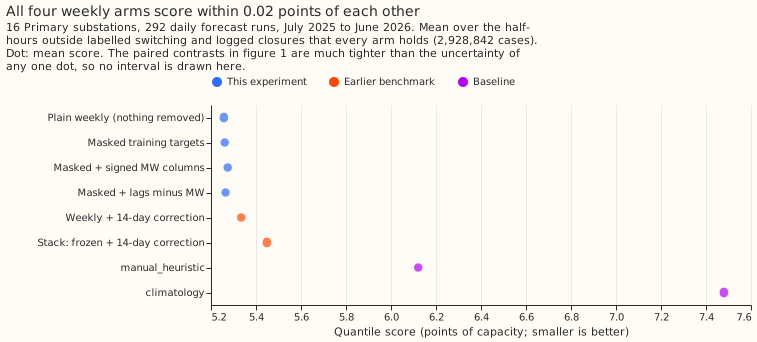
plain5.257,nra5.261,nra_mw5.274,nra_lag5.264. Benchmarks from experiment 48: weekly with the 14-day correction 5.334, the stack (frozen model, 14-day correction) 5.448,manual_heuristic6.121,climatology7.479. The two baselines hold slightly fewer NRA cases (2,927,210 and 2,783,317). - C1,
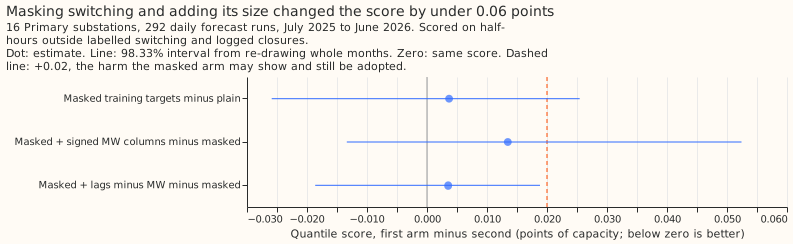
nraminusplain: +0.004 (98.33% interval -0.026 to +0.025). The upper end exceeds the +0.02 margin, which is the most that experiment 44 says a perfect detector could gain. The training-target mask is therefore not shown to be harmless. It is not shown to be harmful either, and the plain arm is the v1 NRA candidate. - C2,
nra_mwminusnra: +0.013 (-0.013 to +0.052). C3,nra_lagminusnra: +0.004 (-0.019 to +0.019). Neither interval lies below zero, so neither arm is supported. - Half-hours with a lag inside an event: 37,394 (1.3%), in 8 months. There the mask lowered the score by 0.50 (95% interval -2.08 to +0.35), the corrected lags lowered it by a further 0.42 (-1.51 to +0.02), and the MW columns raised it by 1.07 (-0.19 to +3.31). These intervals are not corrected for several comparisons.
- Reproduction check. The
plainarm's mean score on all cases, 5.4403, matches experiment 48's stored weekly score, 5.4402. Only 9% of per-case scores match to 0.001. The largest gap is 4.39 points, because repeated graphics-card fits are not bit-for-bit identical. The 0.004 in C1 is therefore at the level of fit-to-fit noise. - Caveats. Only 22 of the 82 labelled events fall in the scored year. Events before January 2022 are not masked in training. The result rests on one validation year and one seed.
- Next. SW2-12 repeats the arms with the detector's labels. It adds first the corrected lags together with the MW columns, which this experiment did not run.