Experiment 58: is the recall gap without a metered receiver a step-size effect, and does a stronger veto help?
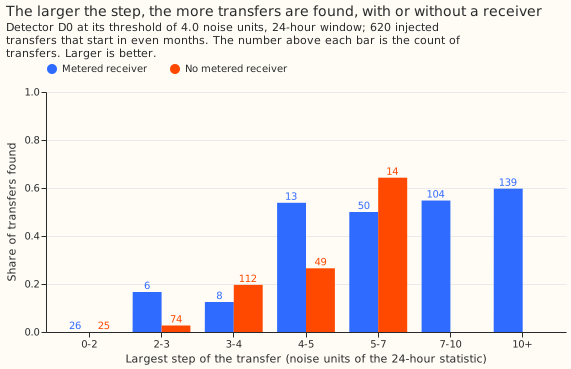
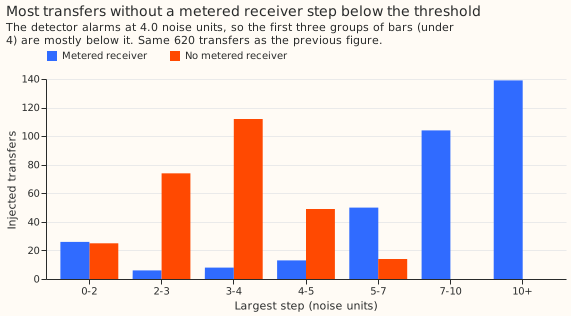
Much of the gap in recall between injected load transfers with and without a metered receiver comes from the injected step being too small for the detector to see, and a stronger neighbour veto adds almost nothing. We tested a detector that raises an alarm when the 24-hour average of one Primary substation's residual (measured minus predicted power) steps up or down. To test it, we injected known load transfers: a donor substation loses load, and receiver substations gain it. A receiver is metered when its own power is measured. The detector found 0.50 of the injected transfers that have a metered receiver and 0.17 of those without one. We re-cut the share found by the size of the injected step, in noise units (multiples of the usual size of the 24-hour step statistic on a quiet day), to see whether the gap belongs to the detector or to how we built the transfers. We also made the neighbour veto stronger: the veto removes an alarm when at least two neighbouring substations stepped the same way, and its strength is the size of step, in noise units, that counts. Step size explains at least half of the gap, and between about half and all of it: 211 of the 274 transfers without a metered receiver step by less than the alarm threshold of 4.0 noise units. The stronger veto raised the share found by +0.013 (98.33% interval 0.000 to +0.029, resampling whole calendar months), against +0.008 in experiment 55.
Verdict
Partly supported. C1 (the gap) is supported on the pre-registered match and mixed on the check, and C2 (the veto) is inconclusive. All intervals are 98.33%, from 20,000 resamples of whole calendar months, over the 620 injected transfers that move 25% to 40% of the receiving load for over 1 day and start in even months.
| Contrast | Result | Reading |
|---|---|---|
| C1, gap in share found, metered minus unmetered receiver, at equal largest step | -0.002 (-0.166 to +0.119); raw gap 0.33 | Step size explains at least half the gap |
| C1 check, the same on the donor's step alone | +0.161 (+0.013 to +0.322) | Mixed; reported, not decisive |
| C2, D2 at veto 1.0 minus D0M, share found | +0.013 (0.000 to +0.029) | Inconclusive: needs an interval wholly above zero |
| C3, the same, transfers with no metered receiver (274) | +0.037 (+0.011 to +0.055) | Reported only |
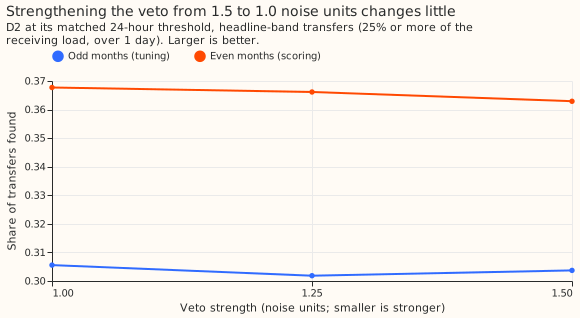
D0 is the detector without the veto. D0M is D0 at experiment 43's thresholds (4-hour window 6.0, 24-hour window 4.0); experiment 55 showed the threshold search returns them. D2 is D0 with the neighbour veto. C1 to C3 are the three planned contrasts. Odd months chose a veto of 1.0 noise units, but the odd-month shares found were 0.306 at 1.0, 0.302 at 1.25, and 0.304 at 1.5, so the choice is close to arbitrary, and the selection is not reflected in the C2 interval. The matched 24-hour thresholds were 3.55, 3.65, and 3.70, and the even-month unexplained 24-hour alarms were 63 for D2 against 80 for D0M. The veto lost 6 of the transfers D0M finds and gained 14 that D0M misses.
Recall by step size
The share found rises steeply with step size, and the two groups differ in step size more than in detection. Among the transfers with a metered receiver, 40 of 346 step by less than 4.0 noise units and the detector finds 2 of those; 172 of the 306 that step by 4.0 or more are found (0.56). Among those with no metered receiver, 211 of 274 step by less than 4.0 and 24 are found; 22 of the 63 that step by 4.0 or more are found (0.35). The median largest step is 8.9 noise units with a metered receiver and 3.3 without one. In the four equal-count bins of the range the two groups share (0.4 to 6.8 noise units, 358 of the 620 transfers), the metered group has only 19, 5, 7, and 53 transfers per bin against 71, 84, 82, and 37 for the unmetered group, so the matched comparison rests mostly on the top bin (26 of 53 against 16 of 37).
The conclusion holds less firmly when the groups are matched on the donor's step alone. A transfer with a metered receiver also has a chance to alarm on the receiver, so the pre-registered match uses the largest step over the donor and the metered receivers. That largest step can exceed the donor's step only for transfers with a metered receiver, which favours the metered group. The donor-only match is therefore the fairer check. Matched on the donor alone, the gap is +0.161, which is just under half of 0.33, and its interval (+0.013 to +0.322) lies on both sides of 0.165. A logistic regression of found on the logarithm of the step and on a metered-receiver flag gives a metered-receiver coefficient of +0.26 when matched on the largest step and +0.81 when matched on the donor's step. A coefficient of +0.81 is 2.2 times higher odds of being found at equal donor step.
What held in the prediction and what did not
- Partly held: the gap shrank, but to zero, not to 0.05 to 0.15. The pre-registered gap was -0.002 on the largest step.
- Not held: odd months picked 1.0, not 1.25. Odd months picked 1.0 by 0.002 over 1.5.
- Held: the even-month gain was +0.013, inside the predicted +0.01 to +0.03. The matched threshold fell to 3.55, inside the predicted 3.4 to 3.6.
Limits
- The bins are thin where the groups overlap. Only 12 transfers with a metered receiver fall in the middle two bins, so the matched gap has a wide interval.
- The bin edges are fixed from the pooled transfers, not redrawn inside each resample. The C1 interval is therefore slightly narrow.
- We estimated the noise units from odd months, and the 620 even-month transfers were already used in experiment 55, which is where 0.17 and 0.50 came from. Those data informed the C1 design.
- 19 of the 1,900 injected transfers move no MW, because the donor's power is zero or missing there (2 of the 620 even-month transfers). They stay in every count.
- A veto of 1.0 or 1.25 noise units falls below the 2.0 noise units at which a neighbouring substation counts as a partner. The loss of 6 transfers and gain of 14 shows no harm at these strengths.
What the next experiment should answer
The next experiment should show why the detector misses about half of the transfers whose step is 4.0 noise units or more. Of the 306 transfers with a metered receiver that step by 4.0 or more, 134 are missed, and the cause is unknown. A shape-aware detector, SW2-7, models the moved load as a share of the donor's expected daily profile, which is how the injection builds a transfer, so its recall on the injected transfers would flatter it. Score SW2-7 on transfers injected with a different shape, such as a flat MW step or a profile reversed in time, on the 14 and 35 labelled real transfers, and by bins of step in noise units. Report each against D0M in the same bins, so that a gain shows up as recall at a step the detector already sees, not as a gain from the injection's own shape.
Code: ml-experiments/00058-sw2-8b-donor-step-recut-and-stronger-veto/, with every number printed
by e00058_report.py and e00058_steps.py.