Experiment 21: which error correction works best, and does it help BSP and GSP demand?
We asked which way of correcting a demand forecast with its recent errors works best, and whether the correction helps at bulk supply points and grid supply points. We compared several variants on 4 such series and on 16 Primary substations (substations that step power down to the local distribution network), over 73 forecast runs from July 2025 to June 2026. The 14-day additive correction stayed the best variant. It did not lower the error at the 4 bulk and grid supply points, but it lowered the Primary error by the same amount as in experiment 00019.
Verdict: inconclusive for bulk supply points (BSP) and grid supply points (GSP), and the 14-day
additive correction stays the best variant. N1 is the single-stage quantile model trained on the
control member of the ensemble weather forecast (ENS) of the European Centre for Medium-Range
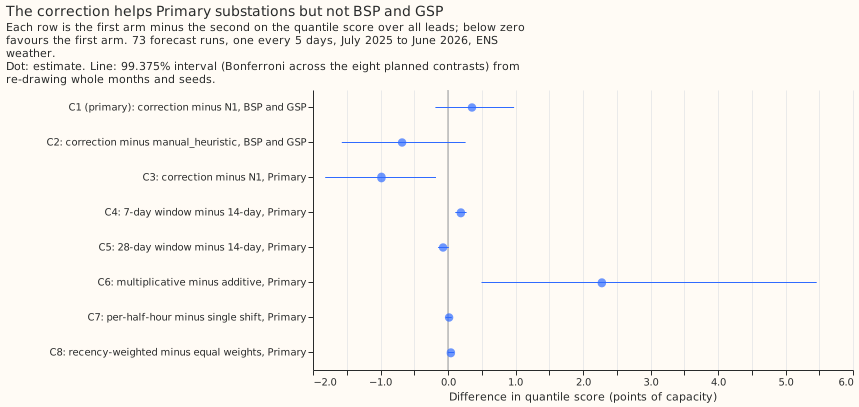
Weather Forecasts. The correction does not lower the BSP and GSP quantile score: C1 is +0.36 points
of capacity (99.375% interval -0.19 to +0.98) on 4 series. It does lower the Primary score with
power 2 days old: C3 is -0.99 (-1.82 to -0.18), the same size as the -0.99 that experiment 00019
found with power 3.5 hours old. Against manual_heuristic the corrected forecast scores -0.68 on
BSP and GSP (C2, -1.57 to +0.26; mean absolute error of the median -1.47, -2.36 to -0.63). No
variant beat the 14-day additive correction. A point is 1% of the series' effective capacity. Scores
are on 73 forecast runs, one every 5 days, from July 2025 to June 2026, with ENS weather. The
generators are not named. The quantile score measures how well the forecast quantiles fit
what happened, and smaller is better. manual_heuristic is a stored baseline that forecasts from the
power at the same time of day in earlier weeks and years.
What the arms score
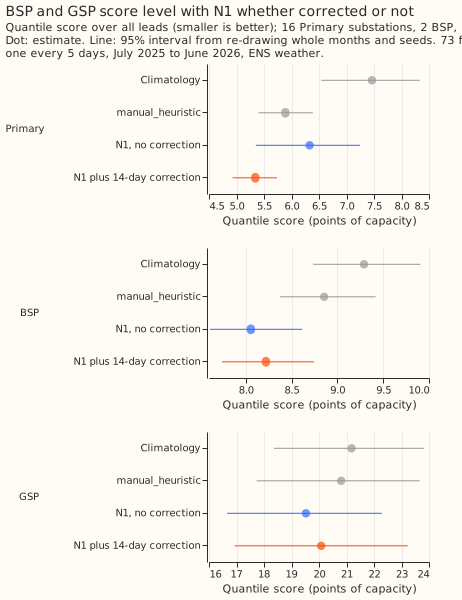
Quantile score over all leads (mean signed error of the median in brackets; negative means the forecast is too low).
| Arm | Primary (16) | BSP (2) | GSP (2) |
|---|---|---|---|
climatology |
7.46 (-2.87) | 9.29 (+1.16) | 21.18 (-9.67) |
manual_heuristic |
5.89 (-1.34) | 8.86 (+0.76) | 20.81 (-4.80) |
| N1 | 6.33 (-2.60) | 8.06 (+0.01) | 19.52 (-5.17) |
| N1 plus 14-day correction | 5.34 (-0.52) | 8.22 (+0.08) | 20.08 (-1.93) |
Findings
- A bias correction cannot help where N1 has no bias. N1's two BSP series have a mean error of +0.01 points, so the correction only adds noise to those series (E2, +0.16, -0.09 to +0.39). The two GSP series are biased low by 5.2 points, the correction removes 3.2 of that, and the quantile score still rises (E3, +0.56, -0.29 to +1.45). The 4 series leave intervals too wide to separate the two types.
- Over all leads, a delay of 2 days costs nothing. The correction with 3.5-hour-old power scores the same as with 2-day-old power for Primary (E4, -0.0003, -0.018 to +0.019) and for BSP and GSP (E5, +0.02, -0.10 to +0.14). Up to 48 hours, fresher power helps a little (E4 -0.07, -0.11 to -0.03; E5 -0.19, -0.35 to -0.05).
- A 7-day window is worse (C4, +0.19, +0.11 to +0.28) and a 28-day window is level or slightly better (C5, -0.07, -0.15 to +0.01). No window qualifies to replace 14 days under the decision rule. A longer window is worth testing with monthly retraining in place.
- The multiplicative form is much worse (C6, +2.28, +0.50 to +5.46). Its mean error of the median is -3.4 points against -0.5 for the additive form.
- A per-half-hour shift (C7, +0.02, -0.04 to +0.06) and recency weights (C8, +0.04, -0.00 to +0.09) change nothing.
- The corrected forecast beats
climatologyon BSP and GSP (E11, -1.09, -1.70 to -0.42), and N1 alone is level withmanual_heuristicon Primary substations over all leads (E10, +0.44, -0.10 to +0.93), but worse at leads of 3 days or more (+0.57, 0.00 to +1.10).
Predictions against outcomes
- Missed: the correction was predicted to lower the BSP and GSP score by at least 0.5 points; it raised it by 0.36 (C1).
- Met: the Primary gain was predicted at 0.6 to 0.9 points; it was 0.99 (C3).
- Partly missed: the 28-day window and the per-half-hour form were predicted to lose; each was level with the 14-day form, and the 28-day window was nominally the best variant.
Limits
- BSP and GSP have 2 series each. The 99.375% interval on C1 is 1.2 points wide, wider than any gain the correction could plausibly give.
- Errors are measured at short lead and applied at long lead. Each past half-hour's error uses the forecast of the run current at that time, at a lead of 0 to 5 days, and the correction is applied up to 15 days ahead.
- Runs with under 3 days of history get no correction. That is 44 of 1,460 runs per seed for the 14-day variants (73 runs times 20 series); the 7-day and 28-day windows and the 3.5-hour delay differ by a few runs.
- The rows are runs every 5 days, not daily. Experiment 19's limit on daily forecasts applies.
Plan, written before any code ran
Plan: sizing
- Stored data: prediction sets only, under
data/ml-experiments/; no production table changes. - Production serving path: not touched.
- Degradation rule: not touched. A run with under 3 days of history gets no correction.
- Defensible designs: more than one. The variants are the question; each is fixed below.
- Callers: the scripts copy 00019's
corrections_forand scoring, which the author could name without searching.
Selection. C4 to C8 test five variants at threshold 0, so replacing A14 by the best qualifying variant carries a selection effect that only the Bonferroni correction covers.
Size: medium. No model is fitted, because every arm post-processes the stored predictions of N1 from experiment 00013, which covers all 20 series. One Sonnet review of the plan, one of the code (leakage and the delay), and one of the write-up.
Plan: arms
All arms are scored on the cases of fold_a_every5d_v1 that every arm holds, with an observed value
and a valid time before 2026-07-01. The corrected arms apply to N1's three seeds. A correction
shifts or scales all 9 quantiles of a run and re-sorts them. No spread factor is applied, so that
the correction is isolated.
The correction. For each run with origin T, the window is the W days that end 2 days before
T. For each half-hour in the window, the forecast is the median of the latest earlier run that
began before it (the rule of 00019, which checks that no forecast comes from a run that began after
its half-hour). The error is the observed power over capacity minus that median. A run with under 3
days of paired history gets no correction.
- A14: add the mean error over a 14-day window to every quantile (00019's correction, with the delay changed from 3.5 hours to 2 days).
- A7, A28: the same with a 7-day and a 28-day window.
- M14 (Primary substations only, where power stays positive): multiply every quantile by the ratio of the window's mean observed power to its mean forecast median, clipped to 0.5 to 2.0; no correction when the mean median is under 0.01 of capacity.
- H14: add, to each valid time, the mean error of the window's half-hours with the same Europe/London half-hour of day; a cell with fewer than 3 pairs gets the window's overall mean error.
- R14: the 14-day mean error with weights
0.5 ** (age_days / 3.5), age counted back from the window's end, so the newest days weigh most. - A14-fast: A14 with 00019's 3.5-hour delay, to measure what the 2-day delay costs (exploratory).
- References: N1,
manual_heuristic,climatology, all uncorrected. A stored arm has no seed, so it is repeated once per seed.
Delay. A run at origin T uses only power stamped at or before T minus 2 days and a
half-hour (97 half-hours), so the correction needs power that is 2 days old. The run's code asserts
this bound. The delay is much longer than the 3.5 hours of 00013's lags.
Lead mismatch. Each past half-hour's error is measured against the forecast of the run with the latest origin at or before that half-hour, so the correction measures errors at leads of 0 to 5 days, and applies the result at leads up to 15 days. A bias that grows with lead is under-corrected.
Bias is the mean signed error of the median, reported by arm and by group (Primary, BSP, GSP), beside the quantile score and the mean absolute error of the median.
Groups. BSP and GSP have 2 series each. The planned contrasts pool the 4 and the tables also show each type. A resolved interval for either type alone is not expected.
Plan: past weather
No past weather is used; the correction reads observed power only, and N1's weather is ENS in training and scoring.