Experiment 19: does stacking small gains beat manual_heuristic for Primary demand?
We asked whether stacking several small improvements gives a demand forecast for Primary substations (substations that step power down to the local distribution network) that beats a stored baseline built from the power at the same time in earlier weeks. The stack added to a single-step model a correction using the previous 14 days of forecast errors, a weighting of recent years, and a 15% widening of the forecast range. We scored it on 16 Primary substations over 73 forecast runs from July 2025 to June 2026. The stack beat the baseline and the single-step model, and the 14-day correction supplied nearly all of the gain.
Supported: the full stack beats manual_heuristic and N1, and the 14-day error correction
supplies nearly all of the gain (-0.99 of -1.00). N1 is the single-stage quantile model trained on
the control member of the ensemble weather forecast (ENS) of the European Centre for Medium-Range
Weather Forecasts. Scores are the quantile score over all leads, in points of capacity (1 point is
1% of a series' effective capacity), on 16 Primary substations, 73 forecast runs every 5 days from
July 2025 to June 2026, with ENS weather. C1, the stack minus manual_heuristic, is -0.56 (99.44%
interval -0.93 to -0.26), and the mean absolute error of the median agrees (-0.88, -1.51 to -0.30).
C2, the stack minus N1, is -1.00 (-1.88 to -0.14), which meets the -0.3 threshold. The stack's
quantile score is 5.32, N1's is 6.33, and manual_heuristic's is 5.89. Up to 48 hours the stack
scores 4.61 against 5.68 (C1, 95% interval -1.38 to -0.79), and from 3 days on 5.49 against 5.94.
The quantile score measures how well the forecast quantiles fit what happened, and smaller is
better. manual_heuristic is a stored baseline that forecasts from the power at the same time of
day in earlier weeks and years.
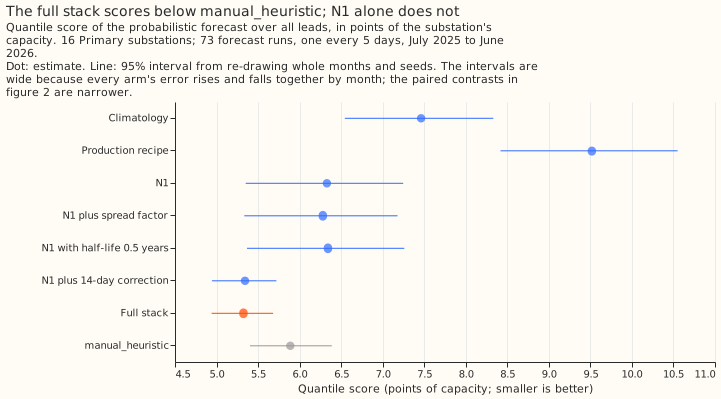
| Arm | Quantile score | Median error | 5%-95% band covers | 10%-90% band covers |
|---|---|---|---|---|
manual_heuristic |
5.89 | 8.23 | 81% | 72% |
climatology |
7.46 | 10.33 | 83% | 74% |
| Production recipe | 9.52 | 9.92 | 10% | 8% |
| N1 | 6.33 | 8.45 | 80% | 71% |
| N1 plus correction | 5.34 | 7.34 | 80% | 70% |
| N1 with half-life 0.5 years | 6.34 | 8.46 | 80% | 70% |
| N1 plus spread factor | 6.28 | 8.45 | 85% | 77% |
| Full stack | 5.32 | 7.35 | 85% | 76% |
| Stack without correction | 6.29 | 8.46 | 85% | 77% |
| Stack without half-life | 5.32 | 7.34 | 85% | 76% |
| Stack without spread factor | 5.35 | 7.35 | 80% | 70% |
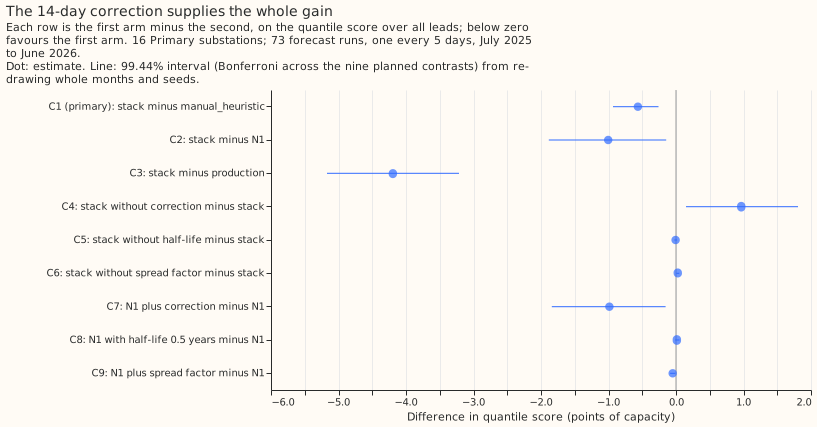
The correction removes a level bias. N1, frozen at 2025-06-30, forecast the validation year 2.6 points too low on average. The correction cuts that bias to 0.5, and the median error falls by 1.1 points (C7: -0.99 on the quantile score, -1.84 to -0.15 at 99.44%, 7 of 12 months below zero). Dropping the correction from the stack raises the score by 0.97 (C4, +0.15 to +1.81). The half-life does nothing here. C8 is +0.01 (-0.01 to +0.05) and C5 is -0.005 (-0.026 to +0.016), so the 0.5-year half-life earns no place. The spread factor is worth a small gain. C9 is -0.05 (-0.09 to -0.01), and dropping the factor raises the stack's score by 0.026 (C6, +0.005 to +0.049, threshold zero), though 5% to 95% coverage is only 85%.
The singles add up to the stack's gain. The three single gains sum to -1.02 (C7 -0.99, C8 +0.01, C9 -0.05) against the stack's -1.00 (C2), so the components overlap by at most 0.02 points.
The stack's gains fall in the predicted ranges, except the correction's, which is larger. The
stack's gain over N1 (-1.00) falls in the predicted -0.6 to -1.2, and over manual_heuristic
(-0.56) in -0.2 to -0.8. The correction's gain (-0.99) is larger than the predicted drop of 0.4 to
0.9, the half-life's (+0.01) is inside its range, and the spread factor's (-0.05) is at the top of
its range. C1's interval is narrower than the plus or minus 0.7 predicted.
Limits
- The correction's history comes from 5-day-spaced runs. A past half-hour's forecast has a lead of 0 to 5 days, so the history errors are larger than a daily service would see, and the correction is applied at every lead to 15 days. A daily service would use leads under 1 day.
- N1 is never retrained. The correction partly stands in for monthly retraining, which experiment 00017 found lowers the error by 0.5 points (retrained monthly against yearly); the two have not been combined.
- The production row's coverage of 10% is a property of the stored forecast, not of this experiment. Its stored quantiles come from ensemble members and are not a calibrated band.
- The half-life was chosen on the scored year, and 26 of 1,460 series-runs (73 runs times 20 series; the first runs of some series) had no history and received a correction of zero.
- The 3.5-hour telemetry delay is assumed, as in experiment 00013.
Plan, written before any code ran
Plan: sizing
- Stored data: prediction sets only, under
data/ml-experiments/. - Production serving path: not touched.
- Degradation rule: not touched.
- Defensible designs: more than one; the correction's history source and window, and the half-life, are fixed below before any fit.
- Callers: the scripts copy 00013's helpers and read its stored predictions, which the author could name without searching.
Size: complex, because more than one defensible design tests the hypothesis. One Sonnet review of the plan, one of the code (leakage, fit stopping at the training end), and one of the write-up (Opus is kept for work that is truly vital).
Plan: arms
Rows, series, columns, lags, seeds (0, 1, 2), and pooling over the 51 members are those of
experiment 00013 (73 runs of fold_a_every5d_v1, valid times before 2026-07-01).
- Stored:
manual_heuristic,climatology, the production recipe, and N1, read from 00013. - N1H: N1 refitted with a recency half-life of 0.5 years in place of 2 years, anchored at 2025-06-30. Nothing else changes. The model is frozen at that date, as N1 is.
- Correction (C): for each series and run with origin
T, the mean of (observed power minus the median forecast) over the half-hours in the 14 days ending at the newest usable observation (00013's telemetry assumption: 3.5 hours beforeT), added to every quantile. The forecast for a past half-hour comes from the validation run with the latest origin at or before that half-hour, so only earlier runs are used. A run with fewer than 3 days of scored history gets no correction. The runs are 5 days apart, so a past forecast has a lead of 0 to 5 days; a daily service would use leads under 1 day, and the error of the correction on these rows is probably larger than the service's. - Spread (S): each quantile
qbecomesq50 + 1.15 * (q - q50), withq50the corrected median where the correction applies. The factor is 00018's, fitted on the staged chain, not on N1. - Arms by component: N1, N1+C, N1+H, N1+S, the full stack F = H+C+S, and the three drops F-C (H+S), F-H (N1+C+S), F-S (H+C).
Plan: leakage checks
The scoring script asserts that every observation entering a correction has a grid index at or
before the origin minus 7 half-hours, that the run supplying the forecast for a past half-hour has
an origin at or before that half-hour, that a run with fewer than 3 days of history gets a
correction of zero (and reports how many rows that is), and that N1H's training rows end at
2025-06-30 23:30. Observed power is read through load_series_arrays, as in 00013, and the median
is the pooled mixture's q50. The spread factor is not re-tuned on N1; the 5% to 95% coverage of
every arm is reported.
Plan: limits stated in advance
- The half-life was chosen on the scored year. 00017 chose 0.5 years on origins through June 2026, which overlap this validation year, and 00017 retrained monthly. N1H is frozen and trained on 15 months, so its weights fall to about a quarter at the start of the archive.
- The correction's history has leads of 0 to 5 days (runs are 5 days apart) and is applied to leads up to 15 days, and N1 already carries origin lags, so 00017's 1.5-point gain, measured on a model with no power lags, may not transfer.
Plan: past weather
ENS weather in training and scoring; lags and the correction use observed power before the origin. No past weather is used.
Plan: earlier advice
Followed: compare against manual_heuristic on both metrics (00013, 00018); test a deployable
recent-error correction (00013, 00017); the 0.5-year half-life (00017); the 1.15 spread factor
(00018). Departure: N1 is not retrained monthly, so the half-life is tested without 00017's
moving anchor.