Does a correction bring the pooled mixture's 5% to 95% band to 90% coverage for solar and wind?
We asked whether a small correction can make the 5% to 95% band of a solar or wind forecast contain the measured output 90% of the time. That share is the band's coverage. We widened or narrowed the band by a factor, in several variants, and measured the coverage in five groups of lead times (0 to 24 hours, 1 to 2 days, and so on). For solar, one factor brought the share of outputs inside the band, which was 94% or 95%, down to about 90% in every group with no change in accuracy. For wind, no planned variant worked in the first two groups, and only a variant added after seeing the data did.
Verdict: partly supported. For solar, the planned spread factor brings the 5% to 95% band of the pooled mixture from 94% to 95% coverage to about 90% in every lead band, at no change in the CRPS. For wind, no planned arm brings the first two lead bands within 2.5 points of 90. A post hoc arm that pools the lead bands into two groups does. ENS is the ECMWF ensemble, ERA5 its reanalysis of past weather, CRPS the continuous ranked probability score, and stage 1a an XGBoost model per series trained on ERA5. The page is proposal P12 in the research plan, and the corrected pooled mixture of 00002's ERA5-trained stage 1a, with no new fit, is the input.
Results
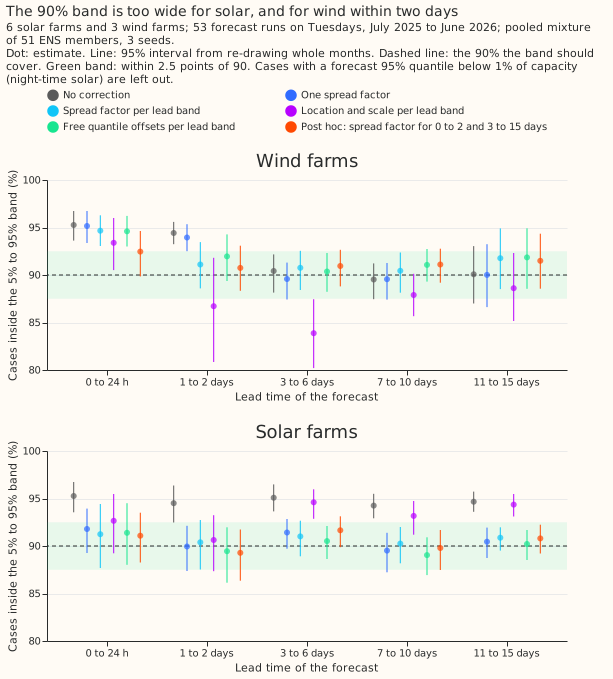
- Uncorrected solar over-covers in every band. Coverage is 95.3%, 94.5%, 95.1%, 94.3%, and 94.7% from the first band to the last, against a target of 90%. The prediction said 2 to 3 points above 90 in at least one band, and the result is 4 to 5 points in all five.
- Uncorrected wind over-covers in the first two days only. Coverage is 95.3%, 94.4%, 90.4%, 89.5%, and 90.1%, as predicted.
- Solar:
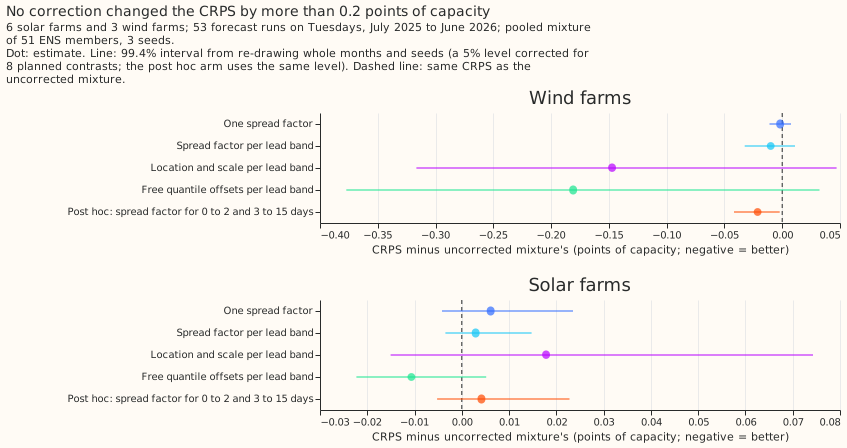
spread,spread_band, andfree_quantilereach 90%. Every band lies within 2.5 points of 90 (for examplespreadat 91.8%, 89.9%, 91.4%, 89.5%, and 90.5%). The CRPS changes by +0.006 forspread(C2, 99.4% interval -0.004 to +0.024), +0.003 forspread_band(C4), and -0.011 forfree_quantile(C8, -0.022 to +0.005). The fitted single factor is 0.90 to 1.00, median 0.95. - Wind: no planned arm reaches 90%. The closest planned arms in the first band are
locscale(93.4%) andspread_band(94.7%), and in the second bandspread_band(91.1%) andfree_quantile(92.0%). The factor per band is 0.90 for both bands but exists in only 3 months (0 to 24 h) and 8 months (1 to 2 days), because the 5,000-case minimum is reached late. The single factor is 1.00 to 1.05 (C1 -0.002, C3 -0.010). - Wind: the location-and-scale arm undershoots 90% in the middle bands. Its coverage is 93.4%, 86.7%, 83.9%, 87.9%, and 88.6%, so it lies outside 2.5 points of 90 in the second and third bands and is further from 90 than no correction in the third to fifth bands. Its CRPS change is a separate result: C5 is -0.147 with an interval of -0.317 to +0.047.
- Wind: the free quantile arm changes the CRPS by -0.181. The interval is -0.377 to +0.032 (C7), so it includes zero.
- Prediction against result. The prediction that the spread factor per lead band and the
location-and-scale arm bring every wind band within 2.5 points of 90 is wrong for both arms. The
prediction that no arm changes the CRPS by more than 0.1 points is wrong for wind
locscaleandfree_quantile(C5 and C7), although both intervals include zero. - Post hoc, wind: a spread factor on two lead groups reaches 90%. Coverage is 92.5%, 90.7%, 91.0%, 91.1%, and 91.5%, and the CRPS change is -0.021 (-0.042 to -0.002), a small gain: the interval excludes zero and the estimate is under the 0.05-point threshold of the decision rule. The arm was chosen after the planned results were seen, and the decision rule does not cover it.
- Reference arms. The beta-transform blend of 00002 has the lowest wind CRPS (10.92, against 11.11 uncorrected) and 90.0% to 94.6% wind coverage. The stage 2 calibrator is worse than no correction on CRPS for both technologies (solar 5.43, wind 11.29).
- Absolute CRPS (points of capacity, all leads): solar uncorrected 5.03,
spread5.03,locscale5.04, climatology 5.63; wind uncorrected 11.11,spread11.11,free_quantile10.93, climatology 13.03. Seed spread is at most 0.002 for the arms listed. - Verdict. The decision rule gives one outcome per technology: supported for solar and refuted for wind. "Partly supported" names that split.
Failures and limits
- The claims rest on 6 solar farms and 3 wind farms in one validation year. Farms of one technology differ: in 00002's scores wind farm coverage ranged from 88% to 95%, and a factor per technology cannot remove that.
- The first month cannot be corrected, and the short wind bands stay uncorrected for most of the
year. Over the months with a per-band fit, coverage for solar
spread_bandis 87.1% to 90.9%, and for windspread_bandis 93.3% in the first band and 89.0% in the second. The solar 0 to 24 h value is below the 2.5-point limit, so the solar result in that band is less firm than the all-months figures suggest. - The explanations for the wind result are untested. Too few cases for the per-band fit is consistent with the short fit history, but where the 0 to 24 h per-band fit exists its coverage is still 93.3%. No arm compared pooled and per-band fits over the same months.
- The ENS validation year is the only year the stored mixture covers, so each correction is scored once and not selected on a second year.
Lessons
- A single factor near 0.95 brought solar coverage within 2.5 points of 90 in every band with no detectable CRPS change. The upper bound of the CRPS interval is +0.024.
- The location-and-scale calibrator per lead band was less reliable than a spread factor. Its CRPS interval is 0.36 points wide and its coverage undershoots 90% in two wind bands. Whether a larger sample would fix it is untested.
- Pooling the lead bands into two groups reached 90% for wind in this sample. The arm was chosen after seeing the planned results, so a later experiment should test it on another year.
Size
The size is complex, because the experiment adds new methods and admits more than one defensible design.
- What gets stored: private predictions only. No schema in
packages/contracts/changes. - Production serving path: not touched. The calibrators run on stored quantiles after the fact.
- Degradation rule: not touched.
- More than one defensible design: yes. The correction can scale about the median or about each quantile, and can be fitted globally or per lead band.
- Code whose callers cannot be named without searching: no. The mixture arithmetic copies
studies/stage1_pilot/stage2_common.py, and the stored member quantiles are experiment 00002's.
Which earlier advice the plan followed
- Followed: pool the ERA5-trained quantiles over the ECMWF ensemble (ENS) members before any calibrator (00002); report the pooled mixture beside every calibrated arm (00002); fit the correction on earlier validation months only, as 00002's beta-transform blend does.
- Departs from: nothing. No arm uses lagged power, so the advice on lagged power does not apply.
- Not tested: the PV ratio target and the wind
base_marginthat the research plan lists for this proposal. Experiment 00012 found the two within 0.05 points of its benchmark (C3, C4), and both change stage 1a and not its calibration.
Setup
Rows and series. The 6 solar farms (labels A to F) and 3 wind farms (W1 to W3) of
fold_a_tuesdays_v1: 53 runs on Tuesdays, valid times from 2025-07-01 to 2026-06-30, every valid
time with an observed power. Labels are anonymised in the write-up.
Inputs. Stage 1a is an XGBoost model per series, trained on ERA5 weather and fitted before
2025-06-17, so every validation case is out of sample. The stage 2 calibrator of 00002 is not used
here. The 9 quantile levels (5%, 10%, 25%, 40%, 50%, 60%, 75%, 90%, 95%) of each of the 51 ENS
members, from the ERA5-trained stage 1a of experiment 00002 (full variant), pooled into a mixture
as in 00002 separately for each fitting seed (0, 1, 2); each seed is corrected and scored on its
own. ERA5 is used only in training, so no past weather enters at forecast time, and no arm uses a
lag or a calendar column.
Fitting the corrections. The cases of a scored month are the runs whose initialisation time falls in that month. Each arm is fitted per technology on the cases with valid times before the first run of the scored month, so that a fit sees no outcome later than the earliest forecast it is applied to. A fit uses only non-trivial cases, those whose uncorrected 95% quantile exceeds 1% of capacity, and trivial cases (night-time solar zeros) are left uncorrected. A fit needs at least 5,000 earlier non-trivial cases (per lead band for the band arms); with fewer the arm returns the uncorrected mixture, so the first months of the year, which cannot be fitted, are scored uncorrected. The write-up states which months and bands this affects, gives the number of earlier runs beside each fit's case count (one run supplies a few hundred cases that share one weather situation), and reports coverage over the corrected months alone as well as over all months.
Arms
| Arm | Correction of the mixture's quantiles q and median m |
|---|---|
none |
None |
spread |
m + k (q - m), one k per technology, the value on a grid of 0.60 to 1.60 in steps of 0.05 whose coverage is nearest 90% |
spread_band |
The same, with one k per technology and lead band |
locscale |
m + a + k (q - m), one (a, k) per technology and lead band, minimising the mean CRPS on a grid (a from -0.05 to +0.05 in steps of 0.01, k as above) |
free_quantile |
q_t + d_t, where d_t is the t-quantile of the observed power minus q_t over the fitted cases, per technology, lead band, and level |
The locscale fit draws at most 30,000 of the fitting cases, at random with a fixed seed, to limit
the cost of its grid search. Each corrected quantile is clipped to 0 to 1 of capacity and the nine
are then sorted.
Planned contrasts
Each is the arm's CRPS minus that of none, in points of capacity, per technology, over all leads
(the lead-band tables are descriptive).
| Id | Technology | Arm |
|---|---|---|
| C1, C2 | wind, solar | spread |
| C3, C4 | wind, solar | spread_band |
| C5, C6 | wind, solar | locscale |
| C7, C8 | wind, solar | free_quantile |
Checks before the contrasts are read
- Reproduction.
none, averaged over the three seeds, must reproduce 00002'sb_mixture_fullmean CRPS to within 0.05 points per technology (11.11 for wind and 5.05 for solar), or the experiment stops. - Leakage review. A reviewer reads the code to confirm that no fit reads a case whose valid time is not before the first run of the scored month.
Post hoc arm
spread_two_groups (script e00016_posthoc.py) fits one spread factor per technology and lead
group (0 to 2 days, 3 to 15 days) by the spread rule. It is outside the pre-registered contrasts,
and its CRPS contrasts H1 and H2 are descriptive.
Resolution limit
The data are 9 series in two weather regions and one validation year. The write-up reads coverage differences of a few percentage points per technology and descriptively, and shows coverage with a month-resampled 95% interval.