Does a stage 2 calibrator beat the pooled stage 1a mixture?
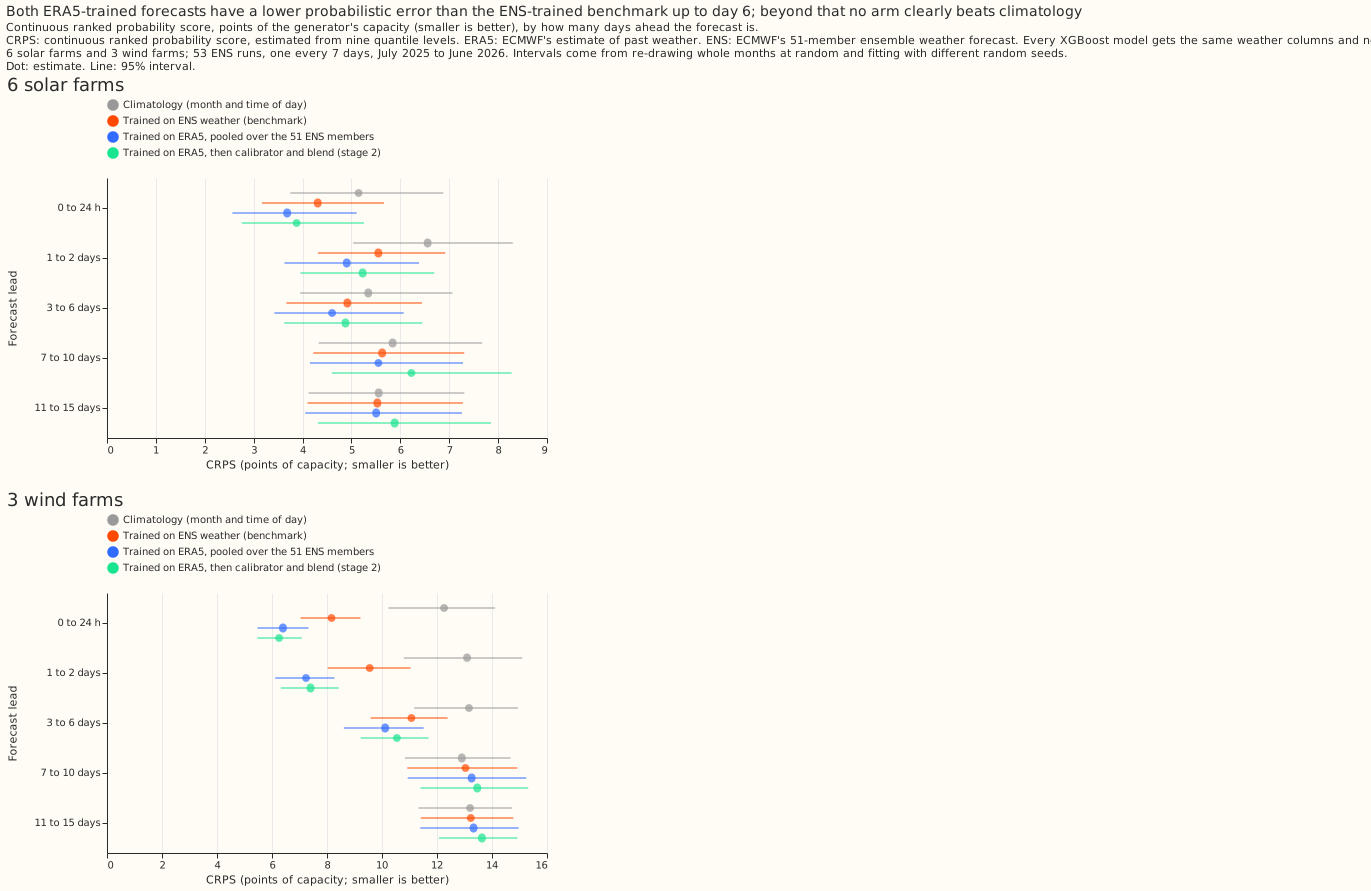
We asked whether a second model, which corrects the spread of the forecast (its 5% to 95% band) produced by a first weather-to-power model, makes solar and wind farm forecasts better than simply pooling the first model's output over the 51 weather forecasts. We compared both with a model trained directly on archived weather forecasts, for 6 solar farms and 3 wind farms over 53 weekly forecast runs in one held-out year. Pooling the first model's output beat the model trained on archived forecasts. The second model gave no improvement over pooling, and made the solar forecasts worse.
Verdict: the pooled ERA5-trained mixture beats the ENS-trained quantile model, and the stage 2
calibrator and learned blend did not improve on it, and were worse for solar. Study 2b ran in one
held-out year (fold A, 53 weekly runs) for 6 solar farms and 3 wind farms. The full write-up is the
Results section of studies/stage1_pilot/README_stage2.md. ERA5 is a reanalysis, an estimate of
past weather. ENS is the European Centre for Medium-Range Weather Forecasts' ensemble forecast,
which has 51 members. The stage 2 calibrator is a second model that corrects the forecast quantiles
that stage 1a produces.
Input columns
The columns are those of experiment 00001, with no calendar column and no power lag.
- Solar farms (9 columns):
shortwave,longwave,temperature_2m,dew_point_temperature_2m,pressure_surface,precipitation,wind_speed_10m,solar_zenith,solar_azimuth. - Wind farms (6 columns):
wind_speed_10m,wind_speed_100m,wind_dir_sin_10m,wind_dir_cos_10m,wind_dir_sin_100m,wind_dir_cos_100m. - The calibrator takes the stage 1a quantiles for one ensemble member plus the same columns.
Absolute scores, all leads
CRPS in points of capacity.
| arm | solar | wind |
|---|---|---|
climatology_q (reference) |
5.65 | 13.03 |
a_ens_quantile (benchmark) |
5.29 | 11.73 |
b_mixture_full |
5.05 | 11.11 |
c_stage2_full_blp |
5.45 | 11.37 |
Planned contrasts
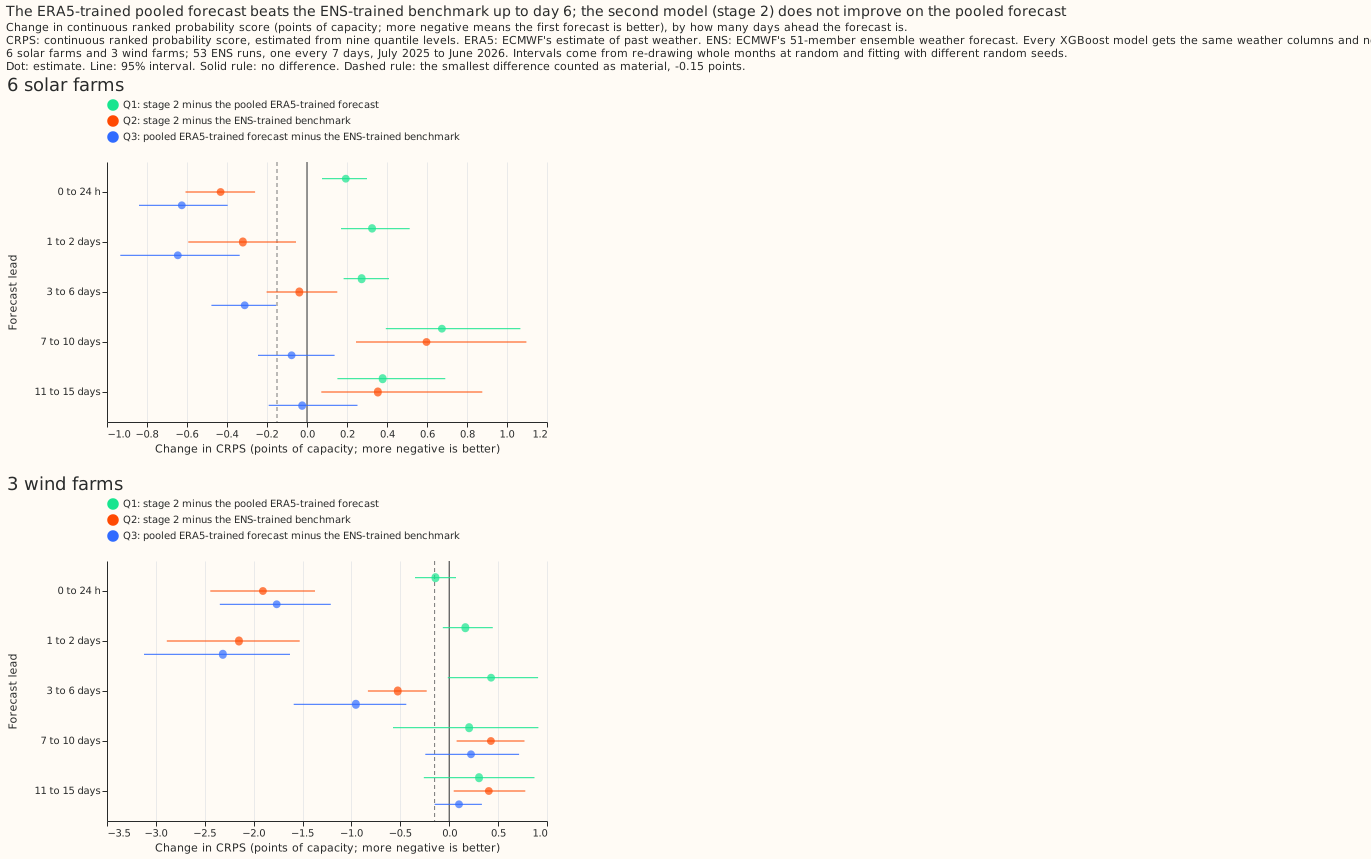
- Q1 (stage 2 minus the mixture) is not material. Solar +0.40 (+0.26 to +0.61), wind +0.26 (-0.17 to +0.64).
- Q2 (stage 2 minus the ENS-trained quantile arm) is material for wind only. Wind -0.36 (-0.59 to -0.12), solar +0.17 (-0.03 to +0.50).
- Q3 (mixture minus the ENS-trained quantile arm) is material for both. Wind -0.62 (-0.99 to -0.26), solar -0.24 (-0.36 to -0.06). The gain sits in the first six days.
What else the study found
- For the mixture and stage 2 arms, the long ERA5 history changes the CRPS by 0.01 to 0.09 points against stage 1a trained on the ENS months only.
- In the tail the ERA5-trained gain for wind is not larger than at the centre of the distribution. The exceedance Brier scores of the 90th and 95th percentiles improve by 0.50 and 0.27 over the ENS-trained arm.
- The ENS-trained arm under-forecasts wind exceedances, and stage 2's bins above 0.30 are also under-forecast.
- The learned blend does not help reliably. It changes the CRPS by +0.00 to +0.08 for stage 2.
Failures and limits
- One fold, one weather product, single-member training rows, no power lags, no per-series calibrators, and 12 validation months.
- Quantile-mapping ENS onto ERA5 before stage 1a is untested.
- Long feature lists were not run in this experiment; experiment 00001 reports that comparison.
Lessons for later experiments
- Report the pooled mixture beside any stage 2 arm, because the mixture is the reference stage 2 has to beat.
- Predictions are under
data/studies/per_study/stage2_pilot/and are not yet indata/ml-experiments/with a manifest.